

24 Solid-State Polymerization of Conjugated …
505
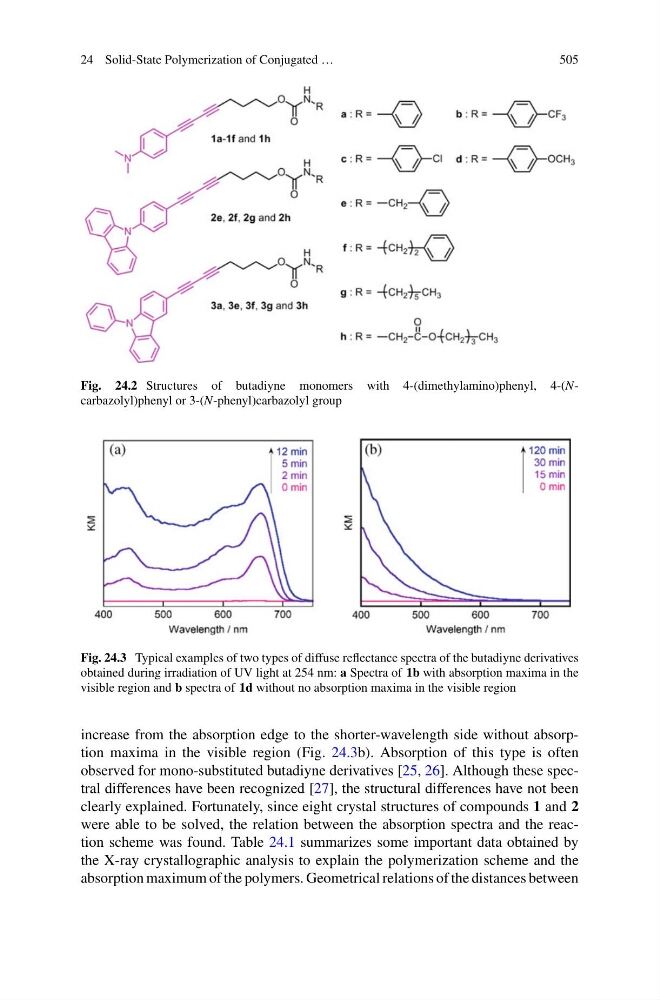
Fig. 24.2 Structures of butadiyne monomers with 4-(dimethylamino)phenyl, 4-(Ncarbazolyl)phenyl or 3-(N-phenyl)carbazolyl group
Fig. 24.3 Typical examples of two types of diffuse reflectance spectra of the butadiyne derivatives
obtained during irradiation of UV light at 254 nm: a Spectra of 1b with absorption maxima in the
visible region and b spectra of 1d without no absorption maxima in the visible region
increase from the absorption edge to the shorter-wavelength side without absorption maxima in the visible region (Fig. 24.3b). Absorption of this type is often
observed for mono-substituted butadiyne derivatives [25, 26]. Although these spectral differences have been recognized [27], the structural differences have not been
clearly explained. Fortunately, since eight crystal structures of compounds 1 and 2
were able to be solved, the relation between the absorption spectra and the reaction scheme was found. Table 24.1 summarizes some important data obtained by
the X-ray crystallographic analysis to explain the polymerization scheme and the
absorption maximum of the polymers. Geometrical relations of the distances between
505
Fig. 24.2 Structures of butadiyne monomers with 4-(dimethylamino)phenyl, 4-(Ncarbazolyl)phenyl or 3-(N-phenyl)carbazolyl group
Fig. 24.3 Typical examples of two types of diffuse reflectance spectra of the butadiyne derivatives
obtained during irradiation of UV light at 254 nm: a Spectra of 1b with absorption maxima in the
visible region and b spectra of 1d without no absorption maxima in the visible region
increase from the absorption edge to the shorter-wavelength side without absorption maxima in the visible region (Fig. 24.3b). Absorption of this type is often
observed for mono-substituted butadiyne derivatives [25, 26]. Although these spectral differences have been recognized [27], the structural differences have not been
clearly explained. Fortunately, since eight crystal structures of compounds 1 and 2
were able to be solved, the relation between the absorption spectra and the reaction scheme was found. Table 24.1 summarizes some important data obtained by
the X-ray crystallographic analysis to explain the polymerization scheme and the
absorption maximum of the polymers. Geometrical relations of the distances between