

502
S. Okada et al.
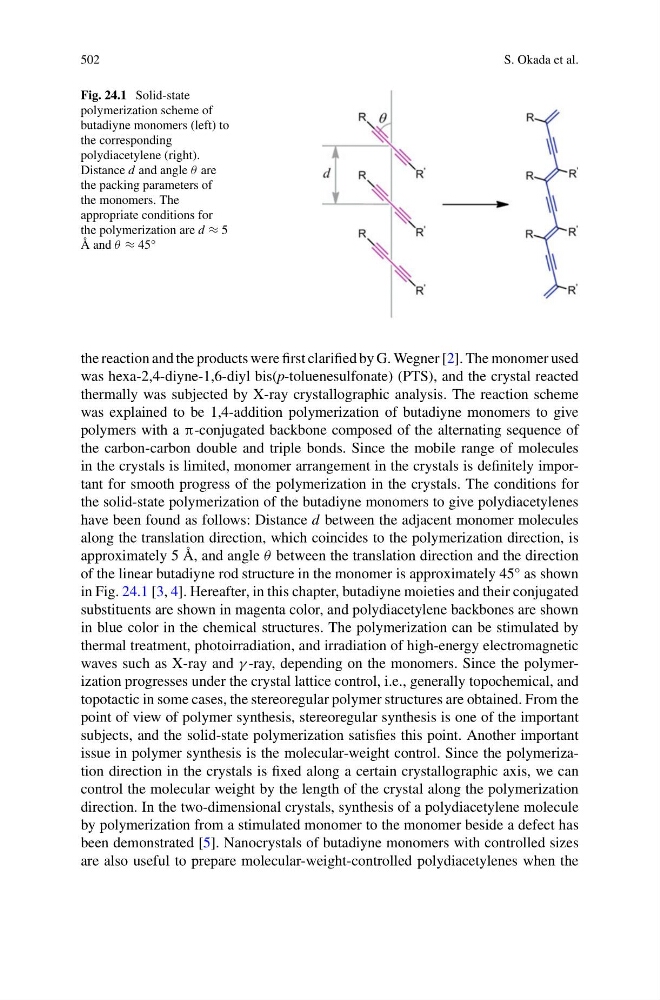
Fig. 24.1 Solid-state
polymerization scheme of
butadiyne monomers (left) to
the corresponding
polydiacetylene (right).
Distance d and angle θ are
the packing parameters of
the monomers. The
appropriate conditions for
the polymerization are d ≈ 5
Å and θ ≈ 45°
the reaction and the products were first clarified by G. Wegner [2]. The monomer used
was hexa-2,4-diyne-1,6-diyl bis(p-toluenesulfonate) (PTS), and the crystal reacted
thermally was subjected by X-ray crystallographic analysis. The reaction scheme
was explained to be 1,4-addition polymerization of butadiyne monomers to give
polymers with a π-conjugated backbone composed of the alternating sequence of
the carbon-carbon double and triple bonds. Since the mobile range of molecules
in the crystals is limited, monomer arrangement in the crystals is definitely important for smooth progress of the polymerization in the crystals. The conditions for
the solid-state polymerization of the butadiyne monomers to give polydiacetylenes
have been found as follows: Distance d between the adjacent monomer molecules
along the translation direction, which coincides to the polymerization direction, is
approximately 5 Å, and angle θ between the translation direction and the direction
of the linear butadiyne rod structure in the monomer is approximately 45° as shown
in Fig. 24.1 [3, 4]. Hereafter, in this chapter, butadiyne moieties and their conjugated
substituents are shown in magenta color, and polydiacetylene backbones are shown
in blue color in the chemical structures. The polymerization can be stimulated by
thermal treatment, photoirradiation, and irradiation of high-energy electromagnetic
waves such as X-ray and γ -ray, depending on the monomers. Since the polymerization progresses under the crystal lattice control, i.e., generally topochemical, and
topotactic in some cases, the stereoregular polymer structures are obtained. From the
point of view of polymer synthesis, stereoregular synthesis is one of the important
subjects, and the solid-state polymerization satisfies this point. Another important
issue in polymer synthesis is the molecular-weight control. Since the polymerization direction in the crystals is fixed along a certain crystallographic axis, we can
control the molecular weight by the length of the crystal along the polymerization
direction. In the two-dimensional crystals, synthesis of a polydiacetylene molecule
by polymerization from a stimulated monomer to the monomer beside a defect has
been demonstrated [5]. Nanocrystals of butadiyne monomers with controlled sizes
are also useful to prepare molecular-weight-controlled polydiacetylenes when the
S. Okada et al.
Fig. 24.1 Solid-state
polymerization scheme of
butadiyne monomers (left) to
the corresponding
polydiacetylene (right).
Distance d and angle θ are
the packing parameters of
the monomers. The
appropriate conditions for
the polymerization are d ≈ 5
Å and θ ≈ 45°
the reaction and the products were first clarified by G. Wegner [2]. The monomer used
was hexa-2,4-diyne-1,6-diyl bis(p-toluenesulfonate) (PTS), and the crystal reacted
thermally was subjected by X-ray crystallographic analysis. The reaction scheme
was explained to be 1,4-addition polymerization of butadiyne monomers to give
polymers with a π-conjugated backbone composed of the alternating sequence of
the carbon-carbon double and triple bonds. Since the mobile range of molecules
in the crystals is limited, monomer arrangement in the crystals is definitely important for smooth progress of the polymerization in the crystals. The conditions for
the solid-state polymerization of the butadiyne monomers to give polydiacetylenes
have been found as follows: Distance d between the adjacent monomer molecules
along the translation direction, which coincides to the polymerization direction, is
approximately 5 Å, and angle θ between the translation direction and the direction
of the linear butadiyne rod structure in the monomer is approximately 45° as shown
in Fig. 24.1 [3, 4]. Hereafter, in this chapter, butadiyne moieties and their conjugated
substituents are shown in magenta color, and polydiacetylene backbones are shown
in blue color in the chemical structures. The polymerization can be stimulated by
thermal treatment, photoirradiation, and irradiation of high-energy electromagnetic
waves such as X-ray and γ -ray, depending on the monomers. Since the polymerization progresses under the crystal lattice control, i.e., generally topochemical, and
topotactic in some cases, the stereoregular polymer structures are obtained. From the
point of view of polymer synthesis, stereoregular synthesis is one of the important
subjects, and the solid-state polymerization satisfies this point. Another important
issue in polymer synthesis is the molecular-weight control. Since the polymerization direction in the crystals is fixed along a certain crystallographic axis, we can
control the molecular weight by the length of the crystal along the polymerization
direction. In the two-dimensional crystals, synthesis of a polydiacetylene molecule
by polymerization from a stimulated monomer to the monomer beside a defect has
been demonstrated [5]. Nanocrystals of butadiyne monomers with controlled sizes
are also useful to prepare molecular-weight-controlled polydiacetylenes when the