

492
K. Tanaka
O
O
O
O
Cu Cu
O
O
O
O
OH
OH
O
O
OH
O
O
Cu Cu
O
O
O
O
NO 2
Si
Me 2 N
H
Me 2 N
(R)NO 2
(R)-MOF-12
OH
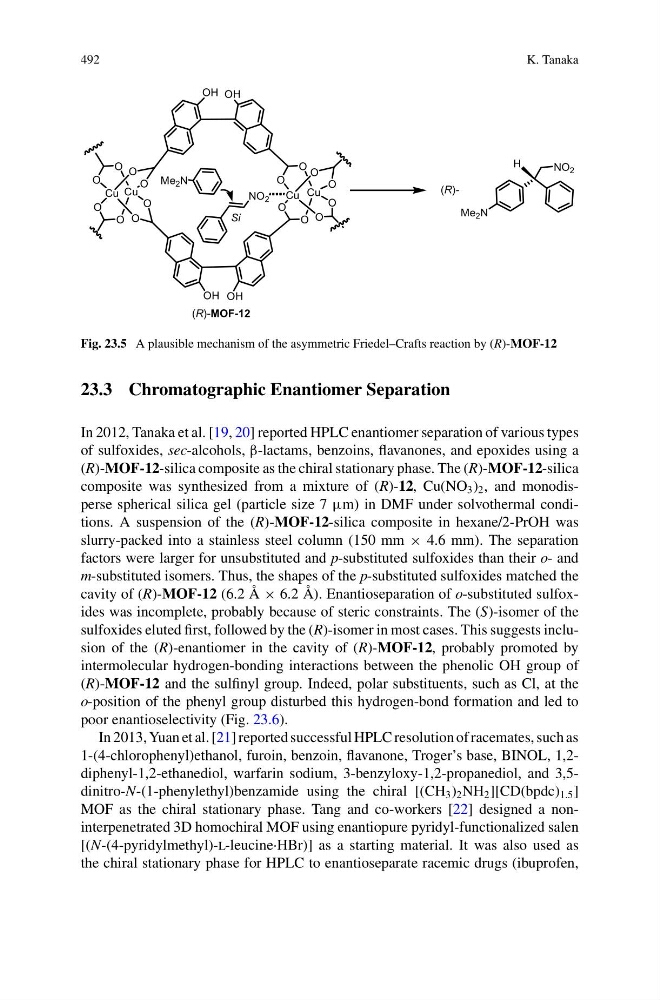
Fig. 23.5 A plausible mechanism of the asymmetric Friedel–Crafts reaction by (R)-MOF-12
23.3 Chromatographic Enantiomer Separation
In 2012, Tanaka et al. [19, 20] reported HPLC enantiomer separation of various types
of sulfoxides, sec-alcohols, β-lactams, benzoins, flavanones, and epoxides using a
(R)-MOF-12-silica composite as the chiral stationary phase. The (R)-MOF-12-silica
composite was synthesized from a mixture of (R)-12, Cu(NO 3 ) 2 , and monodisperse spherical silica gel (particle size 7 μm) in DMF under solvothermal conditions. A suspension of the (R)-MOF-12-silica composite in hexane/2-PrOH was
slurry-packed into a stainless steel column (150 mm × 4.6 mm). The separation
factors were larger for unsubstituted and p-substituted sulfoxides than their o- and
m-substituted isomers. Thus, the shapes of the p-substituted sulfoxides matched the
cavity of (R)-MOF-12 (6.2 Å × 6.2 Å). Enantioseparation of o-substituted sulfoxides was incomplete, probably because of steric constraints. The (S)-isomer of the
sulfoxides eluted first, followed by the (R)-isomer in most cases. This suggests inclusion of the (R)-enantiomer in the cavity of (R)-MOF-12, probably promoted by
intermolecular hydrogen-bonding interactions between the phenolic OH group of
(R)-MOF-12 and the sulfinyl group. Indeed, polar substituents, such as Cl, at the
o-position of the phenyl group disturbed this hydrogen-bond formation and led to
poor enantioselectivity (Fig. 23.6).
In 2013, Yuan et al. [21] reported successful HPLC resolution of racemates, such as
1-(4-chlorophenyl)ethanol, furoin, benzoin, flavanone, Troger’s base, BINOL, 1,2diphenyl-1,2-ethanediol, warfarin sodium, 3-benzyloxy-1,2-propanediol, and 3,5dinitro-N-(1-phenylethyl)benzamide using the chiral [(CH 3 ) 2 NH 2 ][CD(bpdc) 1.5 ]
MOF as the chiral stationary phase. Tang and co-workers [22] designed a noninterpenetrated 3D homochiral MOF using enantiopure pyridyl-functionalized salen
[(N-(4-pyridylmethyl)-l-leucine·HBr)] as a starting material. It was also used as
the chiral stationary phase for HPLC to enantioseparate racemic drugs (ibuprofen,
K. Tanaka
O
O
O
O
Cu Cu
O
O
O
O
OH
OH
O
O
OH
O
O
Cu Cu
O
O
O
O
NO 2
Si
Me 2 N
H
Me 2 N
(R)NO 2
(R)-MOF-12
OH
Fig. 23.5 A plausible mechanism of the asymmetric Friedel–Crafts reaction by (R)-MOF-12
23.3 Chromatographic Enantiomer Separation
In 2012, Tanaka et al. [19, 20] reported HPLC enantiomer separation of various types
of sulfoxides, sec-alcohols, β-lactams, benzoins, flavanones, and epoxides using a
(R)-MOF-12-silica composite as the chiral stationary phase. The (R)-MOF-12-silica
composite was synthesized from a mixture of (R)-12, Cu(NO 3 ) 2 , and monodisperse spherical silica gel (particle size 7 μm) in DMF under solvothermal conditions. A suspension of the (R)-MOF-12-silica composite in hexane/2-PrOH was
slurry-packed into a stainless steel column (150 mm × 4.6 mm). The separation
factors were larger for unsubstituted and p-substituted sulfoxides than their o- and
m-substituted isomers. Thus, the shapes of the p-substituted sulfoxides matched the
cavity of (R)-MOF-12 (6.2 Å × 6.2 Å). Enantioseparation of o-substituted sulfoxides was incomplete, probably because of steric constraints. The (S)-isomer of the
sulfoxides eluted first, followed by the (R)-isomer in most cases. This suggests inclusion of the (R)-enantiomer in the cavity of (R)-MOF-12, probably promoted by
intermolecular hydrogen-bonding interactions between the phenolic OH group of
(R)-MOF-12 and the sulfinyl group. Indeed, polar substituents, such as Cl, at the
o-position of the phenyl group disturbed this hydrogen-bond formation and led to
poor enantioselectivity (Fig. 23.6).
In 2013, Yuan et al. [21] reported successful HPLC resolution of racemates, such as
1-(4-chlorophenyl)ethanol, furoin, benzoin, flavanone, Troger’s base, BINOL, 1,2diphenyl-1,2-ethanediol, warfarin sodium, 3-benzyloxy-1,2-propanediol, and 3,5dinitro-N-(1-phenylethyl)benzamide using the chiral [(CH 3 ) 2 NH 2 ][CD(bpdc) 1.5 ]
MOF as the chiral stationary phase. Tang and co-workers [22] designed a noninterpenetrated 3D homochiral MOF using enantiopure pyridyl-functionalized salen
[(N-(4-pyridylmethyl)-l-leucine·HBr)] as a starting material. It was also used as
the chiral stationary phase for HPLC to enantioseparate racemic drugs (ibuprofen,