

486
K. Tanaka
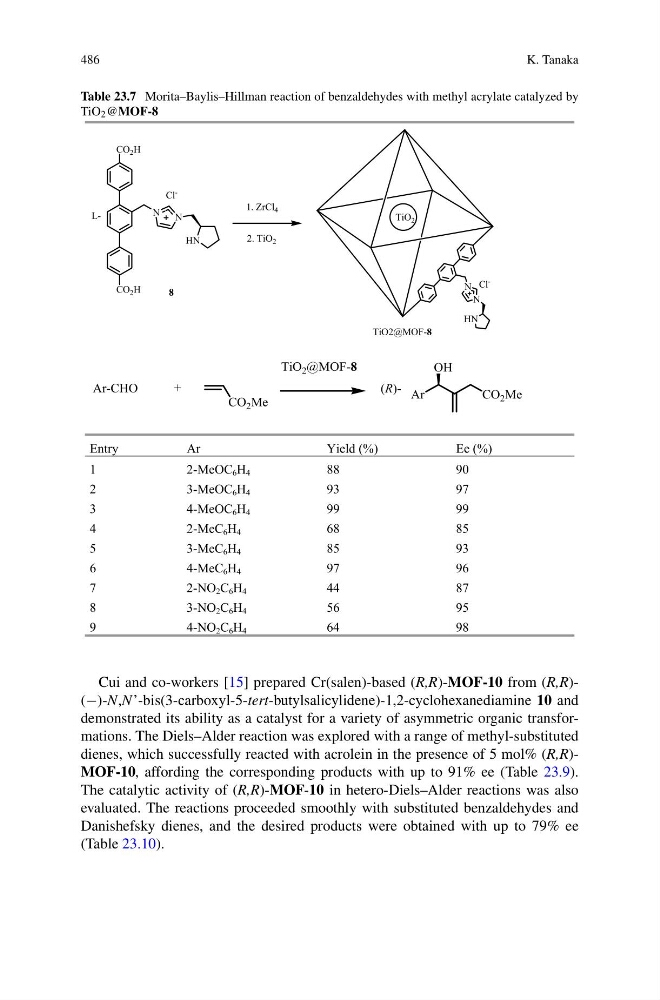
Table 23.7 Morita–Baylis–Hillman reaction of benzaldehydes with methyl acrylate catalyzed by
TiO 2 @MOF-8
CO 2 H
CO 2 H
N
N
HN
Cl
-
8
L1. ZrCl 4
N
N
HN
Cl
-
2. TiO 2
TiO 2
TiO2@MOF-8
+
Ar-CHO
CO 2 Me
Ar
OH
CO 2 Me
TiO 2 @MOF-8
(R)Entry
Ar
Yield (%)
Ee (%)
1
2-MeOC 6 H 4
88
90
2
3-MeOC 6 H 4
93
97
3
4-MeOC 6 H 4
99
99
4
2-MeC 6 H 4
68
85
5
3-MeC 6 H 4
85
93
6
4-MeC 6 H 4
97
96
7
2-NO 2 C 6 H 4
44
87
8
3-NO 2 C 6 H 4
56
95
9
4-NO 2 C 6 H 4
64
98
Cui and co-workers [15] prepared Cr(salen)-based (R,R)-MOF-10 from (R,R)(−)-N,N’-bis(3-carboxyl-5-tert-butylsalicylidene)-1,2-cyclohexanediamine 10 and
demonstrated its ability as a catalyst for a variety of asymmetric organic transformations. The Diels–Alder reaction was explored with a range of methyl-substituted
dienes, which successfully reacted with acrolein in the presence of 5 mol% (R,R)MOF-10, affording the corresponding products with up to 91% ee (Table 23.9).
The catalytic activity of (R,R)-MOF-10 in hetero-Diels–Alder reactions was also
evaluated. The reactions proceeded smoothly with substituted benzaldehydes and
Danishefsky dienes, and the desired products were obtained with up to 79% ee
(Table 23.10).
K. Tanaka
Table 23.7 Morita–Baylis–Hillman reaction of benzaldehydes with methyl acrylate catalyzed by
TiO 2 @MOF-8
CO 2 H
CO 2 H
N
N
HN
Cl
-
8
L1. ZrCl 4
N
N
HN
Cl
-
2. TiO 2
TiO 2
TiO2@MOF-8
+
Ar-CHO
CO 2 Me
Ar
OH
CO 2 Me
TiO 2 @MOF-8
(R)Entry
Ar
Yield (%)
Ee (%)
1
2-MeOC 6 H 4
88
90
2
3-MeOC 6 H 4
93
97
3
4-MeOC 6 H 4
99
99
4
2-MeC 6 H 4
68
85
5
3-MeC 6 H 4
85
93
6
4-MeC 6 H 4
97
96
7
2-NO 2 C 6 H 4
44
87
8
3-NO 2 C 6 H 4
56
95
9
4-NO 2 C 6 H 4
64
98
Cui and co-workers [15] prepared Cr(salen)-based (R,R)-MOF-10 from (R,R)(−)-N,N’-bis(3-carboxyl-5-tert-butylsalicylidene)-1,2-cyclohexanediamine 10 and
demonstrated its ability as a catalyst for a variety of asymmetric organic transformations. The Diels–Alder reaction was explored with a range of methyl-substituted
dienes, which successfully reacted with acrolein in the presence of 5 mol% (R,R)MOF-10, affording the corresponding products with up to 91% ee (Table 23.9).
The catalytic activity of (R,R)-MOF-10 in hetero-Diels–Alder reactions was also
evaluated. The reactions proceeded smoothly with substituted benzaldehydes and
Danishefsky dienes, and the desired products were obtained with up to 79% ee
(Table 23.10).