

23 Asymmetric Catalysis and Chromatographic …
481
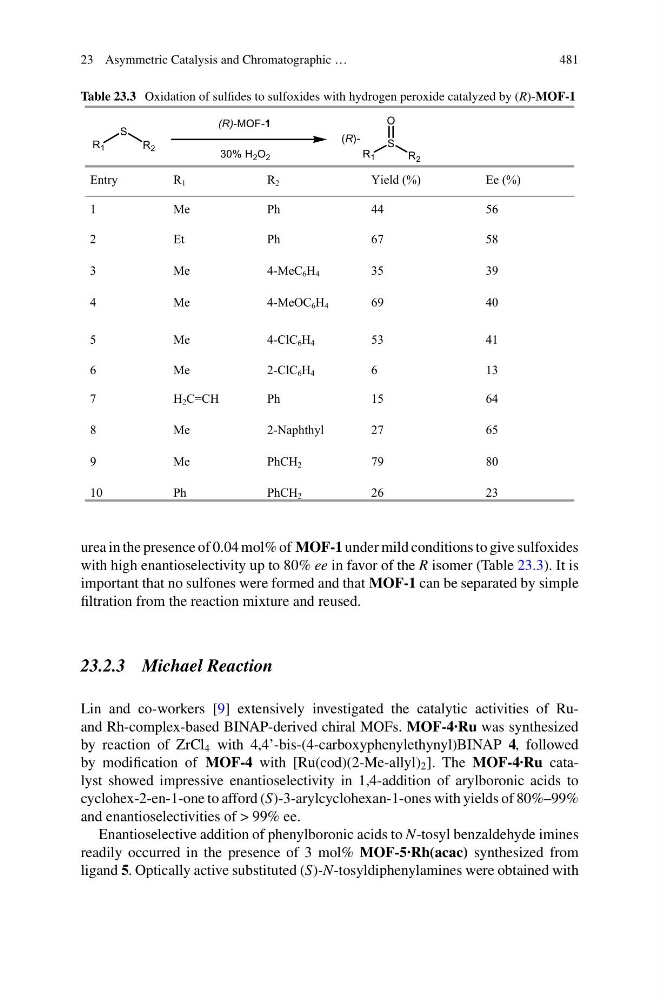
Table 23.3 Oxidation of sulfides to sulfoxides with hydrogen peroxide catalyzed by (R)-MOF-1
R 1
S
R 2
O
R 1
S
R 2
30% H 2 O 2
(R)-MOF-1
(R)Entry
R 1
R 2
Yield (%)
Ee (%)
1
M e
P h
4 4
5 6
2
E t
P h
6 7
5 8
3
Me
4-MeC 6 H 4
35
39
4
Me
4-MeOC 6 H 4
69
40
5
Me
4-ClC 6 H 4
53
41
6
Me
2-ClC 6 H 4
6
1 3
7
H 2 C=CH
Ph
15
64
8
Me
2-Naphthyl
27
65
9
Me
PhCH 2
79
80
10
Ph
PhCH 2
26
23
urea in the presence of 0.04 mol% of MOF-1 under mild conditions to give sulfoxides
with high enantioselectivity up to 80% ee in favor of the R isomer (Table 23.3). It is
important that no sulfones were formed and that MOF-1 can be separated by simple
filtration from the reaction mixture and reused.
23.2.3 Michael Reaction
Lin and co-workers [9] extensively investigated the catalytic activities of Ruand Rh-complex-based BINAP-derived chiral MOFs. MOF-4·Ru was synthesized
by reaction of ZrCl 4 with 4,4’-bis-(4-carboxyphenylethynyl)BINAP 4, followed
by modification of MOF-4 with [Ru(cod)(2-Me-allyl) 2 ]. The MOF-4·Ru catalyst showed impressive enantioselectivity in 1,4-addition of arylboronic acids to
cyclohex-2-en-1-one to afford (S)-3-arylcyclohexan-1-ones with yields of 80%–99%
and enantioselectivities of > 99% ee.
Enantioselective addition of phenylboronic acids to N-tosyl benzaldehyde imines
readily occurred in the presence of 3 mol% MOF-5·Rh(acac) synthesized from
ligand 5. Optically active substituted (S)-N-tosyldiphenylamines were obtained with
481
Table 23.3 Oxidation of sulfides to sulfoxides with hydrogen peroxide catalyzed by (R)-MOF-1
R 1
S
R 2
O
R 1
S
R 2
30% H 2 O 2
(R)-MOF-1
(R)Entry
R 1
R 2
Yield (%)
Ee (%)
1
M e
P h
4 4
5 6
2
E t
P h
6 7
5 8
3
Me
4-MeC 6 H 4
35
39
4
Me
4-MeOC 6 H 4
69
40
5
Me
4-ClC 6 H 4
53
41
6
Me
2-ClC 6 H 4
6
1 3
7
H 2 C=CH
Ph
15
64
8
Me
2-Naphthyl
27
65
9
Me
PhCH 2
79
80
10
Ph
PhCH 2
26
23
urea in the presence of 0.04 mol% of MOF-1 under mild conditions to give sulfoxides
with high enantioselectivity up to 80% ee in favor of the R isomer (Table 23.3). It is
important that no sulfones were formed and that MOF-1 can be separated by simple
filtration from the reaction mixture and reused.
23.2.3 Michael Reaction
Lin and co-workers [9] extensively investigated the catalytic activities of Ruand Rh-complex-based BINAP-derived chiral MOFs. MOF-4·Ru was synthesized
by reaction of ZrCl 4 with 4,4’-bis-(4-carboxyphenylethynyl)BINAP 4, followed
by modification of MOF-4 with [Ru(cod)(2-Me-allyl) 2 ]. The MOF-4·Ru catalyst showed impressive enantioselectivity in 1,4-addition of arylboronic acids to
cyclohex-2-en-1-one to afford (S)-3-arylcyclohexan-1-ones with yields of 80%–99%
and enantioselectivities of > 99% ee.
Enantioselective addition of phenylboronic acids to N-tosyl benzaldehyde imines
readily occurred in the presence of 3 mol% MOF-5·Rh(acac) synthesized from
ligand 5. Optically active substituted (S)-N-tosyldiphenylamines were obtained with