

468
M. Akazome and S. Matsumoto
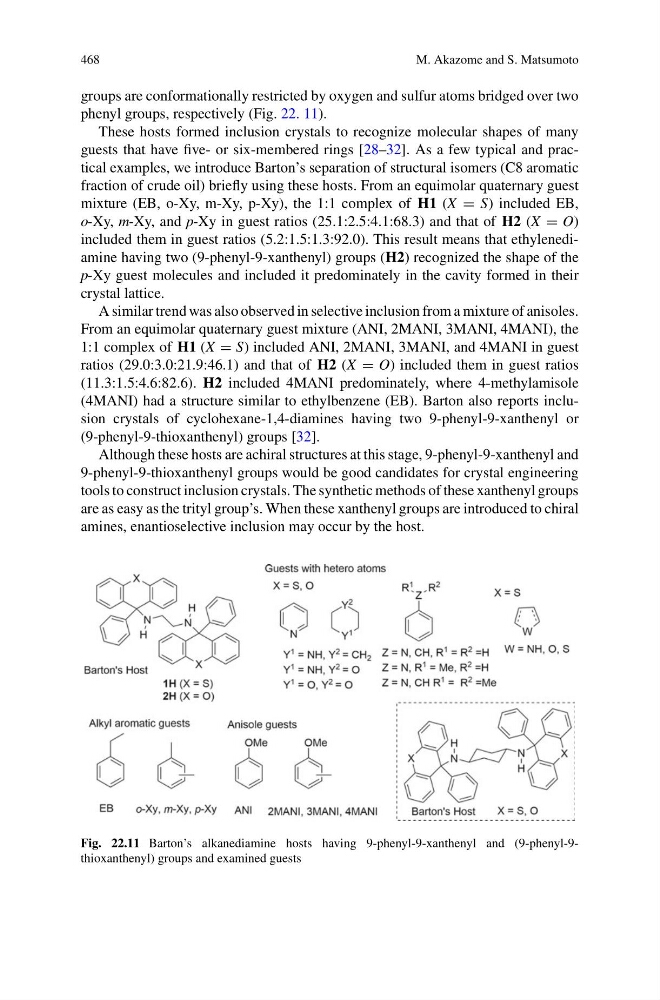
groups are conformationally restricted by oxygen and sulfur atoms bridged over two
phenyl groups, respectively (Fig. 22. 11).
These hosts formed inclusion crystals to recognize molecular shapes of many
guests that have five- or six-membered rings [28–32]. As a few typical and practical examples, we introduce Barton’s separation of structural isomers (C8 aromatic
fraction of crude oil) briefly using these hosts. From an equimolar quaternary guest
mixture (EB, o-Xy, m-Xy, p-Xy), the 1:1 complex of H1 (X = S) included EB,
o-Xy, m-Xy, and p-Xy in guest ratios (25.1:2.5:4.1:68.3) and that of H2 (X = O)
included them in guest ratios (5.2:1.5:1.3:92.0). This result means that ethylenediamine having two (9-phenyl-9-xanthenyl) groups (H2) recognized the shape of the
p-Xy guest molecules and included it predominately in the cavity formed in their
crystal lattice.
A similar trend was also observed in selective inclusion from a mixture of anisoles.
From an equimolar quaternary guest mixture (ANI, 2MANI, 3MANI, 4MANI), the
1:1 complex of H1 (X = S) included ANI, 2MANI, 3MANI, and 4MANI in guest
ratios (29.0:3.0:21.9:46.1) and that of H2 (X = O) included them in guest ratios
(11.3:1.5:4.6:82.6). H2 included 4MANI predominately, where 4-methylamisole
(4MANI) had a structure similar to ethylbenzene (EB). Barton also reports inclusion crystals of cyclohexane-1,4-diamines having two 9-phenyl-9-xanthenyl or
(9-phenyl-9-thioxanthenyl) groups [32].
Although these hosts are achiral structures at this stage, 9-phenyl-9-xanthenyl and
9-phenyl-9-thioxanthenyl groups would be good candidates for crystal engineering
tools to construct inclusion crystals. The synthetic methods of these xanthenyl groups
are as easy as the trityl group’s. When these xanthenyl groups are introduced to chiral
amines, enantioselective inclusion may occur by the host.
Fig. 22.11 Barton’s alkanediamine hosts having 9-phenyl-9-xanthenyl and (9-phenyl-9thioxanthenyl) groups and examined guests
M. Akazome and S. Matsumoto
groups are conformationally restricted by oxygen and sulfur atoms bridged over two
phenyl groups, respectively (Fig. 22. 11).
These hosts formed inclusion crystals to recognize molecular shapes of many
guests that have five- or six-membered rings [28–32]. As a few typical and practical examples, we introduce Barton’s separation of structural isomers (C8 aromatic
fraction of crude oil) briefly using these hosts. From an equimolar quaternary guest
mixture (EB, o-Xy, m-Xy, p-Xy), the 1:1 complex of H1 (X = S) included EB,
o-Xy, m-Xy, and p-Xy in guest ratios (25.1:2.5:4.1:68.3) and that of H2 (X = O)
included them in guest ratios (5.2:1.5:1.3:92.0). This result means that ethylenediamine having two (9-phenyl-9-xanthenyl) groups (H2) recognized the shape of the
p-Xy guest molecules and included it predominately in the cavity formed in their
crystal lattice.
A similar trend was also observed in selective inclusion from a mixture of anisoles.
From an equimolar quaternary guest mixture (ANI, 2MANI, 3MANI, 4MANI), the
1:1 complex of H1 (X = S) included ANI, 2MANI, 3MANI, and 4MANI in guest
ratios (29.0:3.0:21.9:46.1) and that of H2 (X = O) included them in guest ratios
(11.3:1.5:4.6:82.6). H2 included 4MANI predominately, where 4-methylamisole
(4MANI) had a structure similar to ethylbenzene (EB). Barton also reports inclusion crystals of cyclohexane-1,4-diamines having two 9-phenyl-9-xanthenyl or
(9-phenyl-9-thioxanthenyl) groups [32].
Although these hosts are achiral structures at this stage, 9-phenyl-9-xanthenyl and
9-phenyl-9-thioxanthenyl groups would be good candidates for crystal engineering
tools to construct inclusion crystals. The synthetic methods of these xanthenyl groups
are as easy as the trityl group’s. When these xanthenyl groups are introduced to chiral
amines, enantioselective inclusion may occur by the host.
Fig. 22.11 Barton’s alkanediamine hosts having 9-phenyl-9-xanthenyl and (9-phenyl-9thioxanthenyl) groups and examined guests