

458
M. Akazome and S. Matsumoto
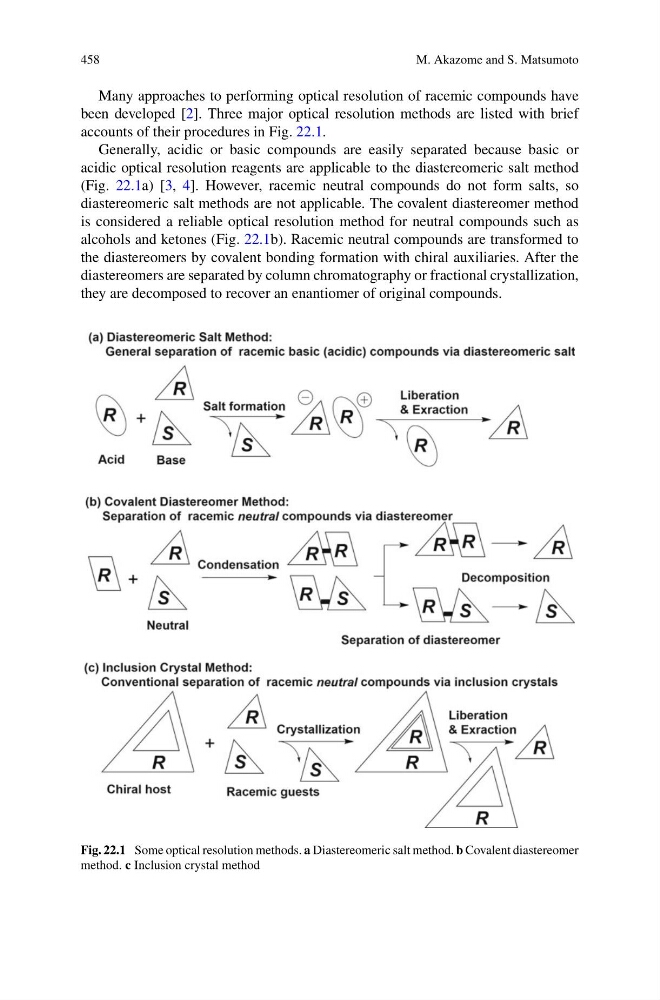
Many approaches to performing optical resolution of racemic compounds have
been developed [2]. Three major optical resolution methods are listed with brief
accounts of their procedures in Fig. 22.1.
Generally, acidic or basic compounds are easily separated because basic or
acidic optical resolution reagents are applicable to the diastereomeric salt method
(Fig. 22.1a) [3, 4]. However, racemic neutral compounds do not form salts, so
diastereomeric salt methods are not applicable. The covalent diastereomer method
is considered a reliable optical resolution method for neutral compounds such as
alcohols and ketones (Fig. 22.1b). Racemic neutral compounds are transformed to
the diastereomers by covalent bonding formation with chiral auxiliaries. After the
diastereomers are separated by column chromatography or fractional crystallization,
they are decomposed to recover an enantiomer of original compounds.
Fig. 22.1 Some optical resolution methods. a Diastereomeric salt method. b Covalent diastereomer
method. c Inclusion crystal method
M. Akazome and S. Matsumoto
Many approaches to performing optical resolution of racemic compounds have
been developed [2]. Three major optical resolution methods are listed with brief
accounts of their procedures in Fig. 22.1.
Generally, acidic or basic compounds are easily separated because basic or
acidic optical resolution reagents are applicable to the diastereomeric salt method
(Fig. 22.1a) [3, 4]. However, racemic neutral compounds do not form salts, so
diastereomeric salt methods are not applicable. The covalent diastereomer method
is considered a reliable optical resolution method for neutral compounds such as
alcohols and ketones (Fig. 22.1b). Racemic neutral compounds are transformed to
the diastereomers by covalent bonding formation with chiral auxiliaries. After the
diastereomers are separated by column chromatography or fractional crystallization,
they are decomposed to recover an enantiomer of original compounds.
Fig. 22.1 Some optical resolution methods. a Diastereomeric salt method. b Covalent diastereomer
method. c Inclusion crystal method