

448
M. Sakamoto
0.01 M acetonitrile solution of 33 was irradiated by sunlight outdoors on a clear day
at a temperature of 10–20 °C, the dimer precipitated as a white solid by stirring for
about 6 h until the solvent was evaporated. When seed crystals were not used, 34 was
obtained with low ee or as a racemate. On the other hand, when seed crystals were
added, the dimer having the same chirality as the seed crystals was obtained in 15–
30% ee. Thus, an optically active substance could be obtained simply by irradiating
a solution of a prochiral compound with sunlight.
For the above PP-type asymmetric reaction system, efficient racemization did
not proceed and optical purity was only up to 80% ee due to competition of light
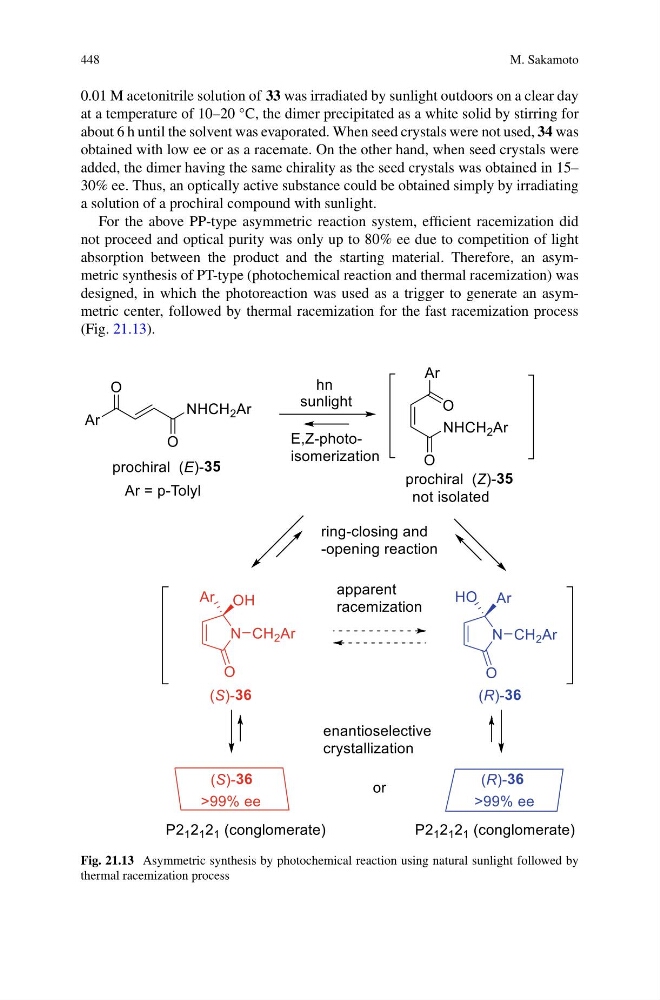
absorption between the product and the starting material. Therefore, an asymmetric synthesis of PT-type (photochemical reaction and thermal racemization) was
designed, in which the photoreaction was used as a trigger to generate an asymmetric center, followed by thermal racemization for the fast racemization process
(Fig. 21.13).
Fig. 21.13 Asymmetric synthesis by photochemical reaction using natural sunlight followed by
thermal racemization process
M. Sakamoto
0.01 M acetonitrile solution of 33 was irradiated by sunlight outdoors on a clear day
at a temperature of 10–20 °C, the dimer precipitated as a white solid by stirring for
about 6 h until the solvent was evaporated. When seed crystals were not used, 34 was
obtained with low ee or as a racemate. On the other hand, when seed crystals were
added, the dimer having the same chirality as the seed crystals was obtained in 15–
30% ee. Thus, an optically active substance could be obtained simply by irradiating
a solution of a prochiral compound with sunlight.
For the above PP-type asymmetric reaction system, efficient racemization did
not proceed and optical purity was only up to 80% ee due to competition of light
absorption between the product and the starting material. Therefore, an asymmetric synthesis of PT-type (photochemical reaction and thermal racemization) was
designed, in which the photoreaction was used as a trigger to generate an asymmetric center, followed by thermal racemization for the fast racemization process
(Fig. 21.13).
Fig. 21.13 Asymmetric synthesis by photochemical reaction using natural sunlight followed by
thermal racemization process