

440
M. Sakamoto
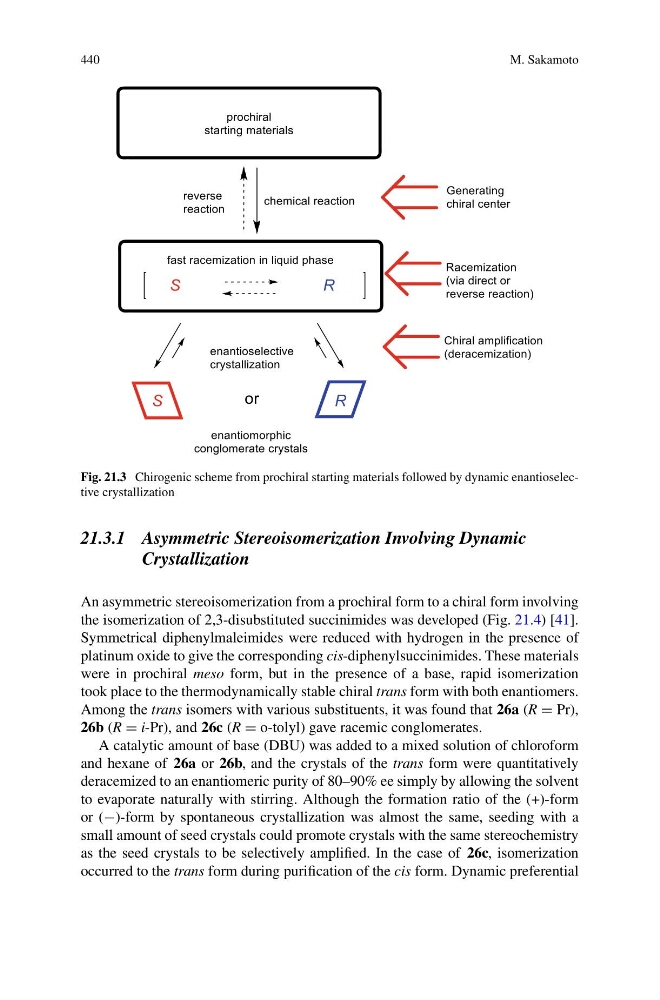
Fig. 21.3 Chirogenic scheme from prochiral starting materials followed by dynamic enantioselective crystallization
21.3.1 Asymmetric Stereoisomerization Involving Dynamic
Crystallization
An asymmetric stereoisomerization from a prochiral form to a chiral form involving
the isomerization of 2,3-disubstituted succinimides was developed (Fig. 21.4) [41].
Symmetrical diphenylmaleimides were reduced with hydrogen in the presence of
platinum oxide to give the corresponding cis-diphenylsuccinimides. These materials
were in prochiral meso form, but in the presence of a base, rapid isomerization
took place to the thermodynamically stable chiral trans form with both enantiomers.
Among the trans isomers with various substituents, it was found that 26a (R = Pr),
26b (R = i-Pr), and 26c (R = o-tolyl) gave racemic conglomerates.
A catalytic amount of base (DBU) was added to a mixed solution of chloroform
and hexane of 26a or 26b, and the crystals of the trans form were quantitatively
deracemized to an enantiomeric purity of 80–90% ee simply by allowing the solvent
to evaporate naturally with stirring. Although the formation ratio of the (+)-form
or (−)-form by spontaneous crystallization was almost the same, seeding with a
small amount of seed crystals could promote crystals with the same stereochemistry
as the seed crystals to be selectively amplified. In the case of 26c, isomerization
occurred to the trans form during purification of the cis form. Dynamic preferential
M. Sakamoto
Fig. 21.3 Chirogenic scheme from prochiral starting materials followed by dynamic enantioselective crystallization
21.3.1 Asymmetric Stereoisomerization Involving Dynamic
Crystallization
An asymmetric stereoisomerization from a prochiral form to a chiral form involving
the isomerization of 2,3-disubstituted succinimides was developed (Fig. 21.4) [41].
Symmetrical diphenylmaleimides were reduced with hydrogen in the presence of
platinum oxide to give the corresponding cis-diphenylsuccinimides. These materials
were in prochiral meso form, but in the presence of a base, rapid isomerization
took place to the thermodynamically stable chiral trans form with both enantiomers.
Among the trans isomers with various substituents, it was found that 26a (R = Pr),
26b (R = i-Pr), and 26c (R = o-tolyl) gave racemic conglomerates.
A catalytic amount of base (DBU) was added to a mixed solution of chloroform
and hexane of 26a or 26b, and the crystals of the trans form were quantitatively
deracemized to an enantiomeric purity of 80–90% ee simply by allowing the solvent
to evaporate naturally with stirring. Although the formation ratio of the (+)-form
or (−)-form by spontaneous crystallization was almost the same, seeding with a
small amount of seed crystals could promote crystals with the same stereochemistry
as the seed crystals to be selectively amplified. In the case of 26c, isomerization
occurred to the trans form during purification of the cis form. Dynamic preferential