

436
M. Sakamoto
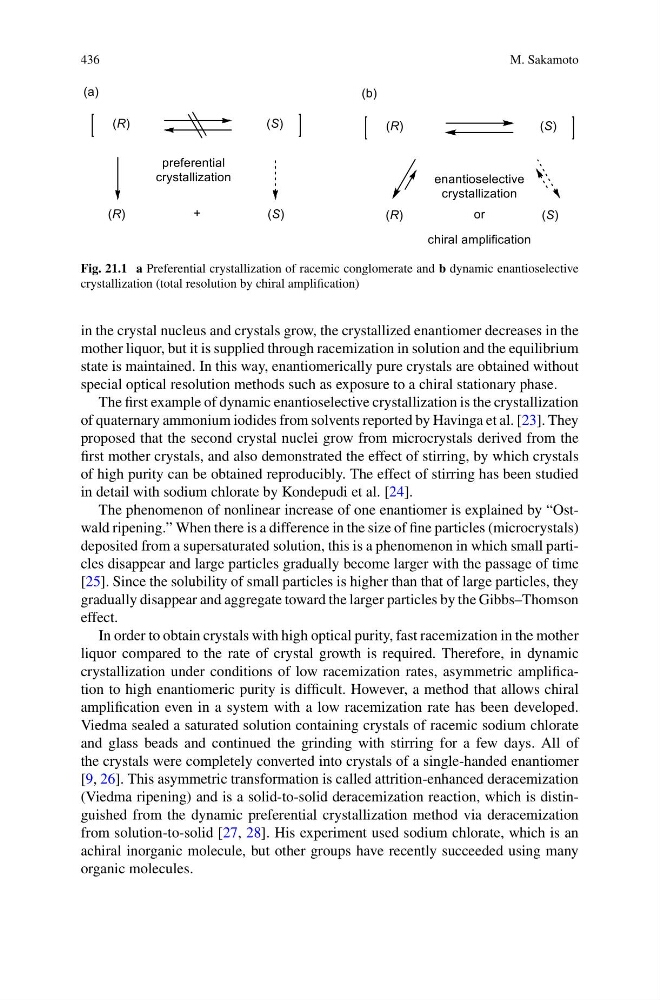
Fig. 21.1 a Preferential crystallization of racemic conglomerate and b dynamic enantioselective
crystallization (total resolution by chiral amplification)
in the crystal nucleus and crystals grow, the crystallized enantiomer decreases in the
mother liquor, but it is supplied through racemization in solution and the equilibrium
state is maintained. In this way, enantiomerically pure crystals are obtained without
special optical resolution methods such as exposure to a chiral stationary phase.
The first example of dynamic enantioselective crystallization is the crystallization
of quaternary ammonium iodides from solvents reported by Havinga et al. [23]. They
proposed that the second crystal nuclei grow from microcrystals derived from the
first mother crystals, and also demonstrated the effect of stirring, by which crystals
of high purity can be obtained reproducibly. The effect of stirring has been studied
in detail with sodium chlorate by Kondepudi et al. [24].
The phenomenon of nonlinear increase of one enantiomer is explained by “Ostwald ripening.” When there is a difference in the size of fine particles (microcrystals)
deposited from a supersaturated solution, this is a phenomenon in which small particles disappear and large particles gradually become larger with the passage of time
[25]. Since the solubility of small particles is higher than that of large particles, they
gradually disappear and aggregate toward the larger particles by the Gibbs–Thomson
effect.
In order to obtain crystals with high optical purity, fast racemization in the mother
liquor compared to the rate of crystal growth is required. Therefore, in dynamic
crystallization under conditions of low racemization rates, asymmetric amplification to high enantiomeric purity is difficult. However, a method that allows chiral
amplification even in a system with a low racemization rate has been developed.
Viedma sealed a saturated solution containing crystals of racemic sodium chlorate
and glass beads and continued the grinding with stirring for a few days. All of
the crystals were completely converted into crystals of a single-handed enantiomer
[9, 26]. This asymmetric transformation is called attrition-enhanced deracemization
(Viedma ripening) and is a solid-to-solid deracemization reaction, which is distinguished from the dynamic preferential crystallization method via deracemization
from solution-to-solid [27, 28]. His experiment used sodium chlorate, which is an
achiral inorganic molecule, but other groups have recently succeeded using many
organic molecules.
M. Sakamoto
Fig. 21.1 a Preferential crystallization of racemic conglomerate and b dynamic enantioselective
crystallization (total resolution by chiral amplification)
in the crystal nucleus and crystals grow, the crystallized enantiomer decreases in the
mother liquor, but it is supplied through racemization in solution and the equilibrium
state is maintained. In this way, enantiomerically pure crystals are obtained without
special optical resolution methods such as exposure to a chiral stationary phase.
The first example of dynamic enantioselective crystallization is the crystallization
of quaternary ammonium iodides from solvents reported by Havinga et al. [23]. They
proposed that the second crystal nuclei grow from microcrystals derived from the
first mother crystals, and also demonstrated the effect of stirring, by which crystals
of high purity can be obtained reproducibly. The effect of stirring has been studied
in detail with sodium chlorate by Kondepudi et al. [24].
The phenomenon of nonlinear increase of one enantiomer is explained by “Ostwald ripening.” When there is a difference in the size of fine particles (microcrystals)
deposited from a supersaturated solution, this is a phenomenon in which small particles disappear and large particles gradually become larger with the passage of time
[25]. Since the solubility of small particles is higher than that of large particles, they
gradually disappear and aggregate toward the larger particles by the Gibbs–Thomson
effect.
In order to obtain crystals with high optical purity, fast racemization in the mother
liquor compared to the rate of crystal growth is required. Therefore, in dynamic
crystallization under conditions of low racemization rates, asymmetric amplification to high enantiomeric purity is difficult. However, a method that allows chiral
amplification even in a system with a low racemization rate has been developed.
Viedma sealed a saturated solution containing crystals of racemic sodium chlorate
and glass beads and continued the grinding with stirring for a few days. All of
the crystals were completely converted into crystals of a single-handed enantiomer
[9, 26]. This asymmetric transformation is called attrition-enhanced deracemization
(Viedma ripening) and is a solid-to-solid deracemization reaction, which is distinguished from the dynamic preferential crystallization method via deracemization
from solution-to-solid [27, 28]. His experiment used sodium chlorate, which is an
achiral inorganic molecule, but other groups have recently succeeded using many
organic molecules.