

434
M. Sakamoto
21.1 Introduction
Optically active compounds are in high demand in the fields of pharmaceuticals,
foods, functional materials, etc., hence the development of efficient and highly selective synthetic methods is strongly required. The optical resolution process by preferential crystallization has evolved into a practical method for optically resolving
racemates economically and easily, and has been carried out on an industrial scale
[1–3]. Furthermore, the dynamic crystallization method via racemization in the
process of crystallization can completely separate the required enantiomers from
the mixture of racemates by deracemization [4–8]. In addition, Viedma ripening, for
which many successful examples have been reported in recent years, is a deracemization process by grinding and stirring crystals using glass beads under conditions
where racemization proceeds in a racemic mixture of conglomerate crystals [9].
The crystal of a racemate can be roughly classified into three categories that focus
on individual crystals: (i) the racemic compound is composed of an equivalent amount
of both enantiomers, (ii) a racemic conglomerate consists of a single enantiomer, and
(iii) the racemic solid solution in which both enantiomers are arranged at random in
a single crystal. All racemic materials studied crystallize as one of these three kinds
of crystals [10–13]. Preferential crystallization is not available for all the crystals
of a racemate, and only a racemic conglomerate of the crystal (ii) was utilized for
resolution.
The space groups of crystals are classified into 280 kinds, of which 65 are
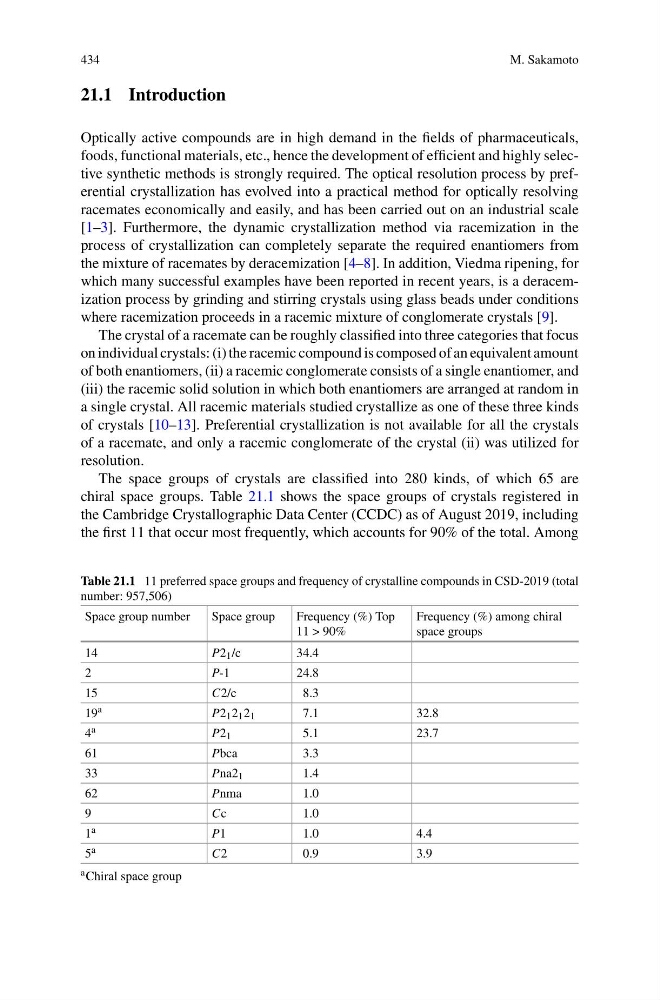
chiral space groups. Table 21.1 shows the space groups of crystals registered in
the Cambridge Crystallographic Data Center (CCDC) as of August 2019, including
the first 11 that occur most frequently, which accounts for 90% of the total. Among
Table 21.1 11 preferred space groups and frequency of crystalline compounds in CSD-2019 (total
number: 957,506)
Space group number
Space group
Frequency (%) Top
11 > 90%
Frequency (%) among chiral
space groups
14
P2 1 /c
34.4
2
P-1
24.8
15
C2/c
8.3
19 a
P2 1 2 1 2 1
7.1
32.8
4 a
P2 1
5.1
23.7
61
Pbca
3.3
33
Pna2 1
1.4
62
Pnma
1.0
9
Cc
1.0
1 a
P1
1.0
4.4
5 a
C2
0.9
3.9
a Chiral space group
M. Sakamoto
21.1 Introduction
Optically active compounds are in high demand in the fields of pharmaceuticals,
foods, functional materials, etc., hence the development of efficient and highly selective synthetic methods is strongly required. The optical resolution process by preferential crystallization has evolved into a practical method for optically resolving
racemates economically and easily, and has been carried out on an industrial scale
[1–3]. Furthermore, the dynamic crystallization method via racemization in the
process of crystallization can completely separate the required enantiomers from
the mixture of racemates by deracemization [4–8]. In addition, Viedma ripening, for
which many successful examples have been reported in recent years, is a deracemization process by grinding and stirring crystals using glass beads under conditions
where racemization proceeds in a racemic mixture of conglomerate crystals [9].
The crystal of a racemate can be roughly classified into three categories that focus
on individual crystals: (i) the racemic compound is composed of an equivalent amount
of both enantiomers, (ii) a racemic conglomerate consists of a single enantiomer, and
(iii) the racemic solid solution in which both enantiomers are arranged at random in
a single crystal. All racemic materials studied crystallize as one of these three kinds
of crystals [10–13]. Preferential crystallization is not available for all the crystals
of a racemate, and only a racemic conglomerate of the crystal (ii) was utilized for
resolution.
The space groups of crystals are classified into 280 kinds, of which 65 are
chiral space groups. Table 21.1 shows the space groups of crystals registered in
the Cambridge Crystallographic Data Center (CCDC) as of August 2019, including
the first 11 that occur most frequently, which accounts for 90% of the total. Among
Table 21.1 11 preferred space groups and frequency of crystalline compounds in CSD-2019 (total
number: 957,506)
Space group number
Space group
Frequency (%) Top
11 > 90%
Frequency (%) among chiral
space groups
14
P2 1 /c
34.4
2
P-1
24.8
15
C2/c
8.3
19 a
P2 1 2 1 2 1
7.1
32.8
4 a
P2 1
5.1
23.7
61
Pbca
3.3
33
Pna2 1
1.4
62
Pnma
1.0
9
Cc
1.0
1 a
P1
1.0
4.4
5 a
C2
0.9
3.9
a Chiral space group