

422
R. Tamura et al.
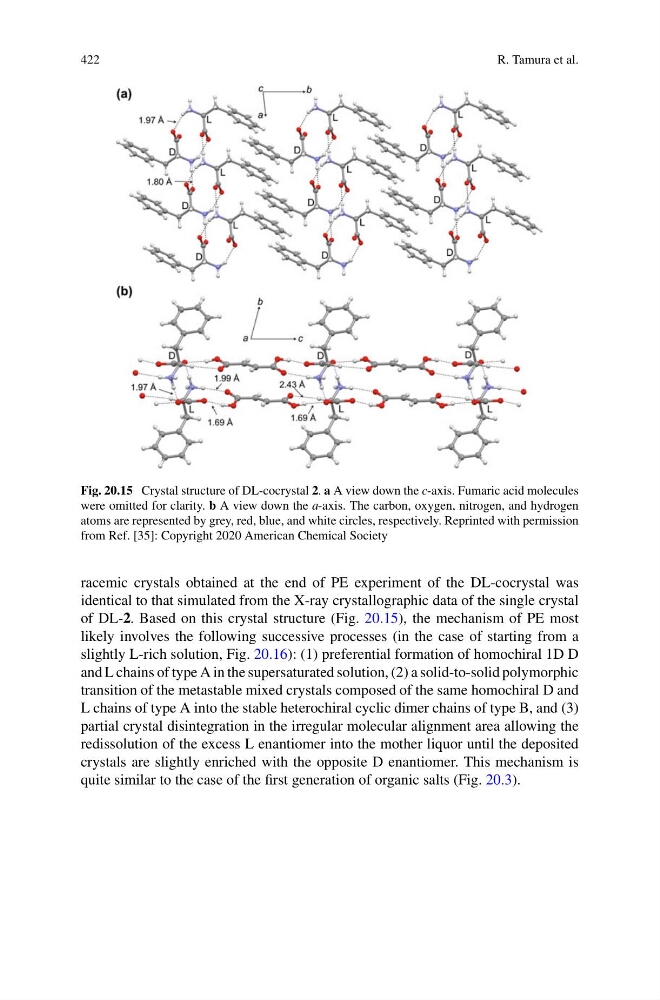
Fig. 20.15 Crystal structure of DL-cocrystal 2. a A view down the c-axis. Fumaric acid molecules
were omitted for clarity. b A view down the a-axis. The carbon, oxygen, nitrogen, and hydrogen
atoms are represented by grey, red, blue, and white circles, respectively. Reprinted with permission
from Ref. [35]: Copyright 2020 American Chemical Society
racemic crystals obtained at the end of PE experiment of the DL-cocrystal was
identical to that simulated from the X-ray crystallographic data of the single crystal
of DL-2. Based on this crystal structure (Fig. 20.15), the mechanism of PE most
likely involves the following successive processes (in the case of starting from a
slightly L-rich solution, Fig. 20.16): (1) preferential formation of homochiral 1D D
and L chains of type A in the supersaturated solution, (2) a solid-to-solid polymorphic
transition of the metastable mixed crystals composed of the same homochiral D and
L chains of type A into the stable heterochiral cyclic dimer chains of type B, and (3)
partial crystal disintegration in the irregular molecular alignment area allowing the
redissolution of the excess L enantiomer into the mother liquor until the deposited
crystals are slightly enriched with the opposite D enantiomer. This mechanism is
quite similar to the case of the first generation of organic salts (Fig. 20.3).
R. Tamura et al.
Fig. 20.15 Crystal structure of DL-cocrystal 2. a A view down the c-axis. Fumaric acid molecules
were omitted for clarity. b A view down the a-axis. The carbon, oxygen, nitrogen, and hydrogen
atoms are represented by grey, red, blue, and white circles, respectively. Reprinted with permission
from Ref. [35]: Copyright 2020 American Chemical Society
racemic crystals obtained at the end of PE experiment of the DL-cocrystal was
identical to that simulated from the X-ray crystallographic data of the single crystal
of DL-2. Based on this crystal structure (Fig. 20.15), the mechanism of PE most
likely involves the following successive processes (in the case of starting from a
slightly L-rich solution, Fig. 20.16): (1) preferential formation of homochiral 1D D
and L chains of type A in the supersaturated solution, (2) a solid-to-solid polymorphic
transition of the metastable mixed crystals composed of the same homochiral D and
L chains of type A into the stable heterochiral cyclic dimer chains of type B, and (3)
partial crystal disintegration in the irregular molecular alignment area allowing the
redissolution of the excess L enantiomer into the mother liquor until the deposited
crystals are slightly enriched with the opposite D enantiomer. This mechanism is
quite similar to the case of the first generation of organic salts (Fig. 20.3).