

408
R. Tamura et al.
dissipative self-organization, (b
) emergence of new order and chaos, (c
) phase transition between chaos and/or order, and (d
) chiral symmetry breaking and increasing
returns, respectively [1, 2, 4–8].
20.2 History and Features of PE
In 1993, accidentally Ushio and Tamura found an unprecedented spontaneous chiral
resolution phenomenon during recrystallization of a chiral racemic antiallergenic
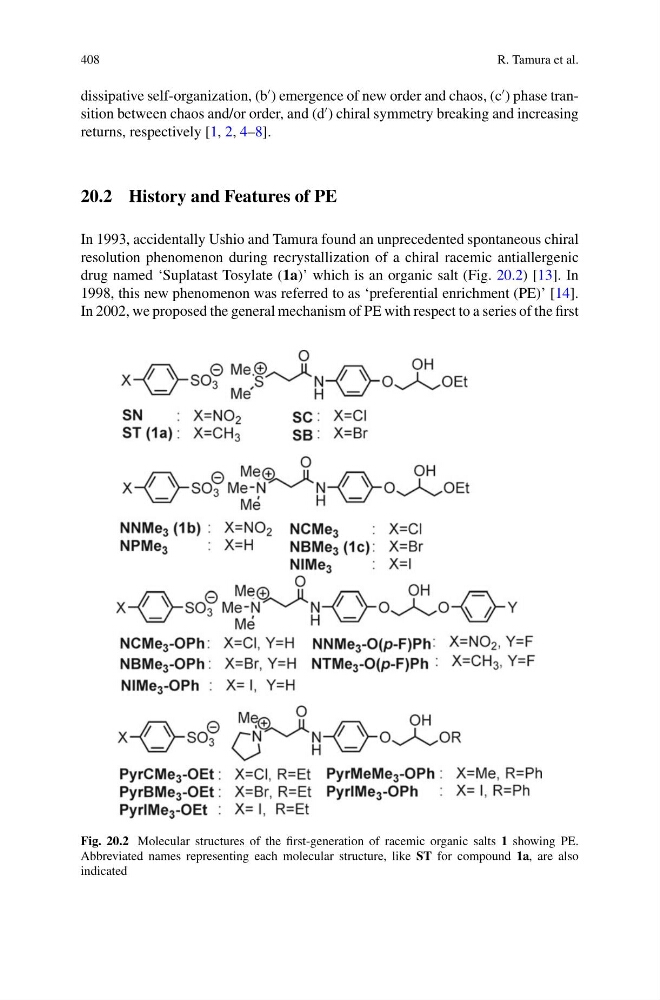
drug named ‘Suplatast Tosylate (1a)’ which is an organic salt (Fig. 20.2) [13]. In
1998, this new phenomenon was referred to as ‘preferential enrichment (PE)’ [14].
In 2002, we proposed the general mechanism of PE with respect to a series of the first
Fig. 20.2 Molecular structures of the first-generation of racemic organic salts 1 showing PE.
Abbreviated names representing each molecular structure, like ST for compound 1a, are also
indicated
R. Tamura et al.
dissipative self-organization, (b
) emergence of new order and chaos, (c
) phase transition between chaos and/or order, and (d
) chiral symmetry breaking and increasing
returns, respectively [1, 2, 4–8].
20.2 History and Features of PE
In 1993, accidentally Ushio and Tamura found an unprecedented spontaneous chiral
resolution phenomenon during recrystallization of a chiral racemic antiallergenic
drug named ‘Suplatast Tosylate (1a)’ which is an organic salt (Fig. 20.2) [13]. In
1998, this new phenomenon was referred to as ‘preferential enrichment (PE)’ [14].
In 2002, we proposed the general mechanism of PE with respect to a series of the first
Fig. 20.2 Molecular structures of the first-generation of racemic organic salts 1 showing PE.
Abbreviated names representing each molecular structure, like ST for compound 1a, are also
indicated