

384
E. R. T. Tiekink
The respective CSD [4] REFCODES are included in the captions of the figures.
Finally, while common names are employed in the text as much as possible, IUPAC
names are included in the captions of the figures, as determined by MarvinSketch
[20].
19.2 Genuine Kryptoracemates
A distinction is made herein between genuine and non-genuine kryptoracemates.
While the basic definition is the same for both classes of compound, the influence
of solvent or a counter-ion on the crystallisation outcome is virtually impossible
to determine with absolute confidence. Hence, kryptoracemic crystals comprising
enantiomorphic molecules are discussed first; in 19.3, kryptoracemic crystals having
additional species present in the crystal will be described.
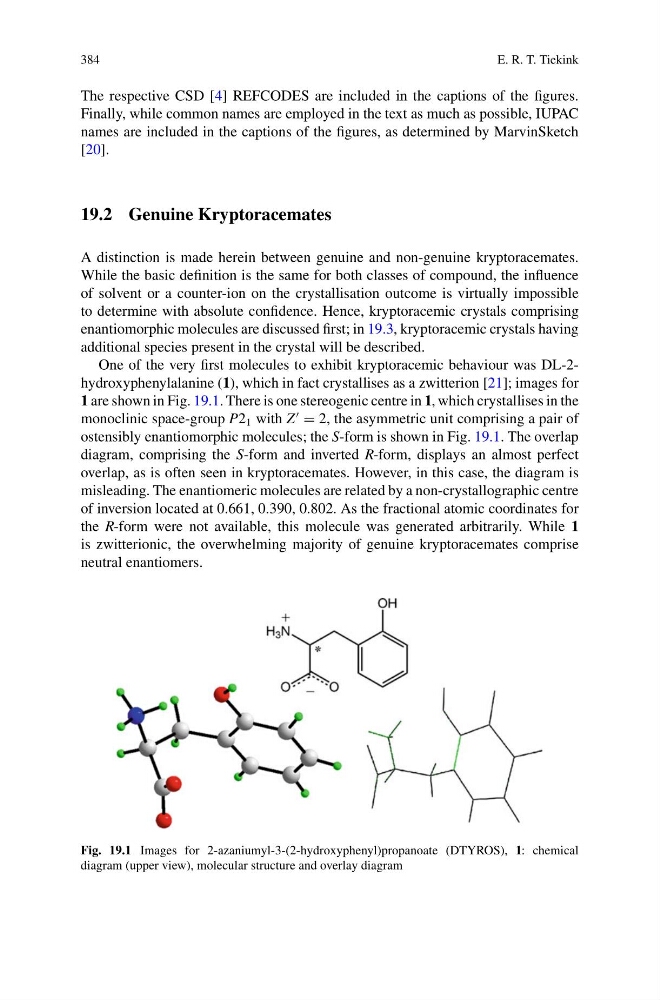
One of the very first molecules to exhibit kryptoracemic behaviour was DL-2hydroxyphenylalanine (1), which in fact crystallises as a zwitterion [21]; images for
1 are shown in Fig. 19.1. There is one stereogenic centre in 1, which crystallises in the
monoclinic space-group P2 1 with Z
= 2, the asymmetric unit comprising a pair of
ostensibly enantiomorphic molecules; the S-form is shown in Fig. 19.1. The overlap
diagram, comprising the S-form and inverted R-form, displays an almost perfect
overlap, as is often seen in kryptoracemates. However, in this case, the diagram is
misleading. The enantiomeric molecules are related by a non-crystallographic centre
of inversion located at 0.661, 0.390, 0.802. As the fractional atomic coordinates for
the R-form were not available, this molecule was generated arbitrarily. While 1
is zwitterionic, the overwhelming majority of genuine kryptoracemates comprise
neutral enantiomers.
Fig. 19.1 Images for 2-azaniumyl-3-(2-hydroxyphenyl)propanoate (DTYROS), 1: chemical
diagram (upper view), molecular structure and overlay diagram
E. R. T. Tiekink
The respective CSD [4] REFCODES are included in the captions of the figures.
Finally, while common names are employed in the text as much as possible, IUPAC
names are included in the captions of the figures, as determined by MarvinSketch
[20].
19.2 Genuine Kryptoracemates
A distinction is made herein between genuine and non-genuine kryptoracemates.
While the basic definition is the same for both classes of compound, the influence
of solvent or a counter-ion on the crystallisation outcome is virtually impossible
to determine with absolute confidence. Hence, kryptoracemic crystals comprising
enantiomorphic molecules are discussed first; in 19.3, kryptoracemic crystals having
additional species present in the crystal will be described.
One of the very first molecules to exhibit kryptoracemic behaviour was DL-2hydroxyphenylalanine (1), which in fact crystallises as a zwitterion [21]; images for
1 are shown in Fig. 19.1. There is one stereogenic centre in 1, which crystallises in the
monoclinic space-group P2 1 with Z
= 2, the asymmetric unit comprising a pair of
ostensibly enantiomorphic molecules; the S-form is shown in Fig. 19.1. The overlap
diagram, comprising the S-form and inverted R-form, displays an almost perfect
overlap, as is often seen in kryptoracemates. However, in this case, the diagram is
misleading. The enantiomeric molecules are related by a non-crystallographic centre
of inversion located at 0.661, 0.390, 0.802. As the fractional atomic coordinates for
the R-form were not available, this molecule was generated arbitrarily. While 1
is zwitterionic, the overwhelming majority of genuine kryptoracemates comprise
neutral enantiomers.
Fig. 19.1 Images for 2-azaniumyl-3-(2-hydroxyphenyl)propanoate (DTYROS), 1: chemical
diagram (upper view), molecular structure and overlay diagram