

374
M. Funahashi
d). The presence of ion-conductive sublayers is indispensable for efficient doping in
the columnar phases [34].
Compared to thin films of molecular crystals, macroscopic molecular alignment
is relatively easy in liquid crystalline thin films. While rubbed polyimide layer is
effective for uniaxial alignment of nematic phase, this method is not successful in
the uniaxial alignment of ordered smectic and columnar phases. For the columnar
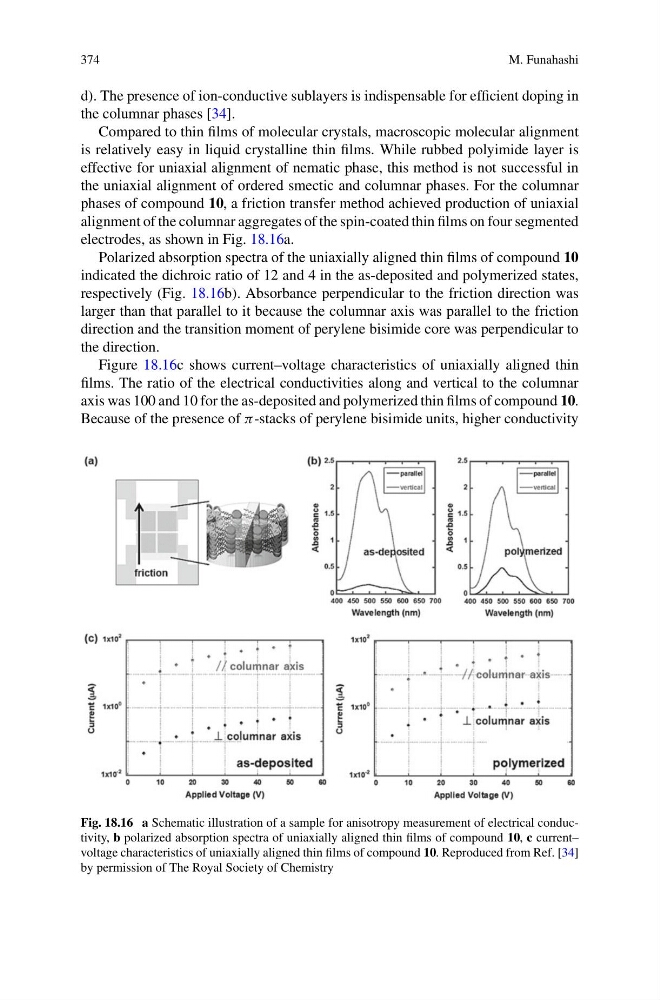
phases of compound 10, a friction transfer method achieved production of uniaxial
alignment of the columnar aggregates of the spin-coated thin films on four segmented
electrodes, as shown in Fig. 18.16a.
Polarized absorption spectra of the uniaxially aligned thin films of compound 10
indicated the dichroic ratio of 12 and 4 in the as-deposited and polymerized states,
respectively (Fig. 18.16b). Absorbance perpendicular to the friction direction was
larger than that parallel to it because the columnar axis was parallel to the friction
direction and the transition moment of perylene bisimide core was perpendicular to
the direction.
Figure 18.16c shows current–voltage characteristics of uniaxially aligned thin
films. The ratio of the electrical conductivities along and vertical to the columnar
axis was 100 and 10 for the as-deposited and polymerized thin films of compound 10.
Because of the presence of π-stacks of perylene bisimide units, higher conductivity
Fig. 18.16 a Schematic illustration of a sample for anisotropy measurement of electrical conductivity, b polarized absorption spectra of uniaxially aligned thin films of compound 10, c current–
voltage characteristics of uniaxially aligned thin films of compound 10. Reproduced from Ref. [34]
by permission of The Royal Society of Chemistry
M. Funahashi
d). The presence of ion-conductive sublayers is indispensable for efficient doping in
the columnar phases [34].
Compared to thin films of molecular crystals, macroscopic molecular alignment
is relatively easy in liquid crystalline thin films. While rubbed polyimide layer is
effective for uniaxial alignment of nematic phase, this method is not successful in
the uniaxial alignment of ordered smectic and columnar phases. For the columnar
phases of compound 10, a friction transfer method achieved production of uniaxial
alignment of the columnar aggregates of the spin-coated thin films on four segmented
electrodes, as shown in Fig. 18.16a.
Polarized absorption spectra of the uniaxially aligned thin films of compound 10
indicated the dichroic ratio of 12 and 4 in the as-deposited and polymerized states,
respectively (Fig. 18.16b). Absorbance perpendicular to the friction direction was
larger than that parallel to it because the columnar axis was parallel to the friction
direction and the transition moment of perylene bisimide core was perpendicular to
the direction.
Figure 18.16c shows current–voltage characteristics of uniaxially aligned thin
films. The ratio of the electrical conductivities along and vertical to the columnar
axis was 100 and 10 for the as-deposited and polymerized thin films of compound 10.
Because of the presence of π-stacks of perylene bisimide units, higher conductivity
Fig. 18.16 a Schematic illustration of a sample for anisotropy measurement of electrical conductivity, b polarized absorption spectra of uniaxially aligned thin films of compound 10, c current–
voltage characteristics of uniaxially aligned thin films of compound 10. Reproduced from Ref. [34]
by permission of The Royal Society of Chemistry