

18 Electrochemical Functions of Nanostructured Liquid Crystals …
365
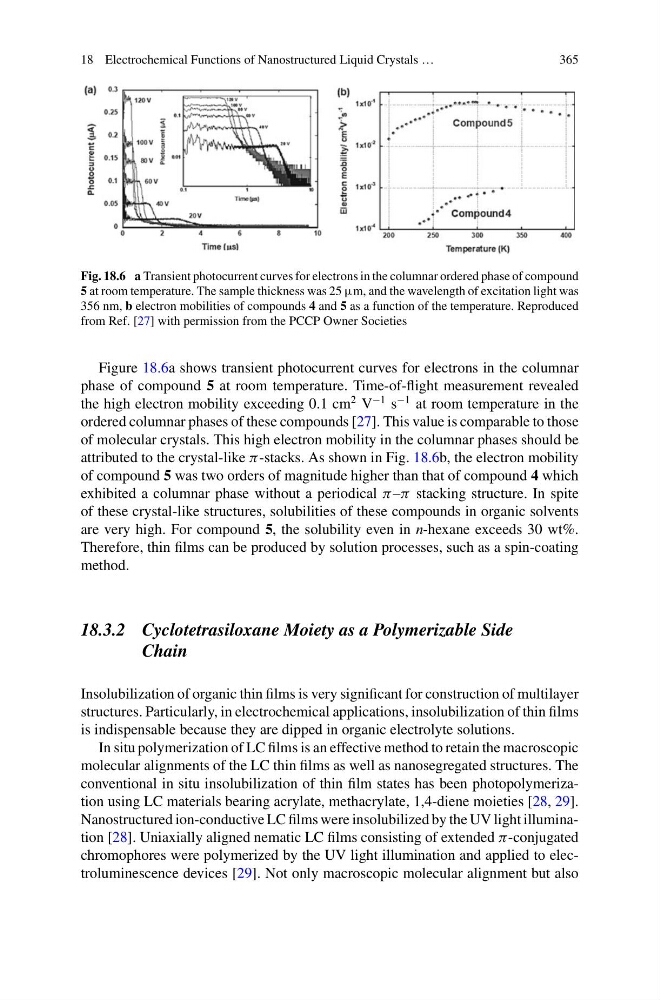
Fig. 18.6 a Transient photocurrent curves for electrons in the columnar ordered phase of compound
5 at room temperature. The sample thickness was 25 μm, and the wavelength of excitation light was
356 nm, b electron mobilities of compounds 4 and 5 as a function of the temperature. Reproduced
from Ref. [27] with permission from the PCCP Owner Societies
Figure 18.6a shows transient photocurrent curves for electrons in the columnar
phase of compound 5 at room temperature. Time-of-flight measurement revealed
the high electron mobility exceeding 0.1 cm
2 V
−1 s
−1 at room temperature in the
ordered columnar phases of these compounds [27]. This value is comparable to those
of molecular crystals. This high electron mobility in the columnar phases should be
attributed to the crystal-like π-stacks. As shown in Fig. 18.6b, the electron mobility
of compound 5 was two orders of magnitude higher than that of compound 4 which
exhibited a columnar phase without a periodical π –π stacking structure. In spite
of these crystal-like structures, solubilities of these compounds in organic solvents
are very high. For compound 5, the solubility even in n-hexane exceeds 30 wt%.
Therefore, thin films can be produced by solution processes, such as a spin-coating
method.
18.3.2 Cyclotetrasiloxane Moiety as a Polymerizable Side
Chain
Insolubilization of organic thin films is very significant for construction of multilayer
structures. Particularly, in electrochemical applications, insolubilization of thin films
is indispensable because they are dipped in organic electrolyte solutions.
In situ polymerization of LC films is an effective method to retain the macroscopic
molecular alignments of the LC thin films as well as nanosegregated structures. The
conventional in situ insolubilization of thin film states has been photopolymerization using LC materials bearing acrylate, methacrylate, 1,4-diene moieties [28, 29].
Nanostructured ion-conductive LC films were insolubilized by the UV light illumination [28]. Uniaxially aligned nematic LC films consisting of extended π-conjugated
chromophores were polymerized by the UV light illumination and applied to electroluminescence devices [29]. Not only macroscopic molecular alignment but also
365
Fig. 18.6 a Transient photocurrent curves for electrons in the columnar ordered phase of compound
5 at room temperature. The sample thickness was 25 μm, and the wavelength of excitation light was
356 nm, b electron mobilities of compounds 4 and 5 as a function of the temperature. Reproduced
from Ref. [27] with permission from the PCCP Owner Societies
Figure 18.6a shows transient photocurrent curves for electrons in the columnar
phase of compound 5 at room temperature. Time-of-flight measurement revealed
the high electron mobility exceeding 0.1 cm
2 V
−1 s
−1 at room temperature in the
ordered columnar phases of these compounds [27]. This value is comparable to those
of molecular crystals. This high electron mobility in the columnar phases should be
attributed to the crystal-like π-stacks. As shown in Fig. 18.6b, the electron mobility
of compound 5 was two orders of magnitude higher than that of compound 4 which
exhibited a columnar phase without a periodical π –π stacking structure. In spite
of these crystal-like structures, solubilities of these compounds in organic solvents
are very high. For compound 5, the solubility even in n-hexane exceeds 30 wt%.
Therefore, thin films can be produced by solution processes, such as a spin-coating
method.
18.3.2 Cyclotetrasiloxane Moiety as a Polymerizable Side
Chain
Insolubilization of organic thin films is very significant for construction of multilayer
structures. Particularly, in electrochemical applications, insolubilization of thin films
is indispensable because they are dipped in organic electrolyte solutions.
In situ polymerization of LC films is an effective method to retain the macroscopic
molecular alignments of the LC thin films as well as nanosegregated structures. The
conventional in situ insolubilization of thin film states has been photopolymerization using LC materials bearing acrylate, methacrylate, 1,4-diene moieties [28, 29].
Nanostructured ion-conductive LC films were insolubilized by the UV light illumination [28]. Uniaxially aligned nematic LC films consisting of extended π-conjugated
chromophores were polymerized by the UV light illumination and applied to electroluminescence devices [29]. Not only macroscopic molecular alignment but also