

348
H. Katagiri
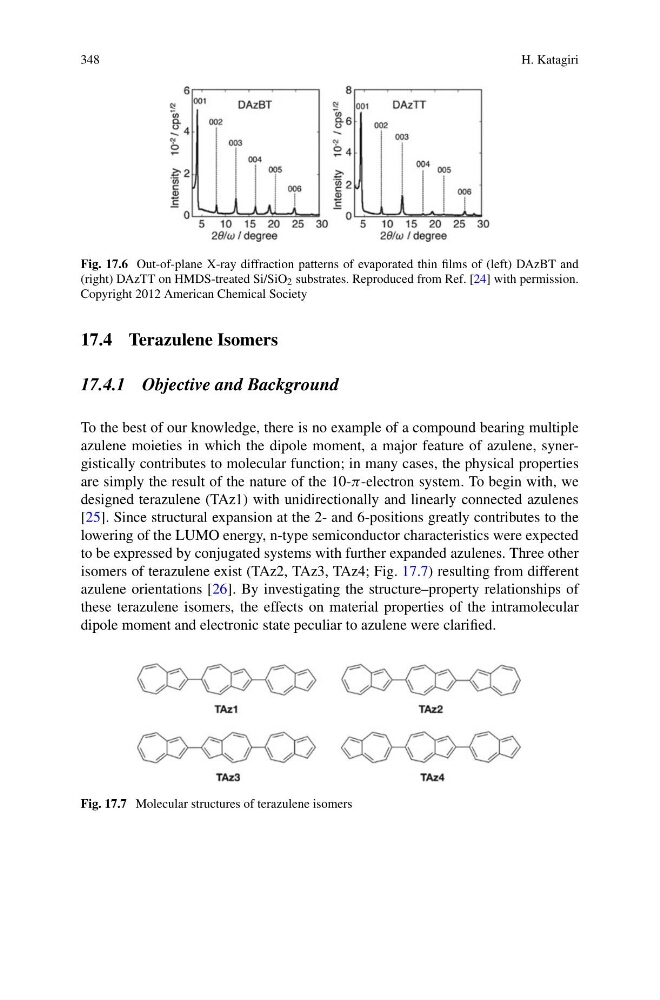
Fig. 17.6 Out-of-plane X-ray diffraction patterns of evaporated thin films of (left) DAzBT and
(right) DAzTT on HMDS-treated Si/SiO 2 substrates. Reproduced from Ref. [24] with permission.
Copyright 2012 American Chemical Society
17.4 Terazulene Isomers
17.4.1 Objective and Background
To the best of our knowledge, there is no example of a compound bearing multiple
azulene moieties in which the dipole moment, a major feature of azulene, synergistically contributes to molecular function; in many cases, the physical properties
are simply the result of the nature of the 10-π-electron system. To begin with, we
designed terazulene (TAz1) with unidirectionally and linearly connected azulenes
[25]. Since structural expansion at the 2- and 6-positions greatly contributes to the
lowering of the LUMO energy, n-type semiconductor characteristics were expected
to be expressed by conjugated systems with further expanded azulenes. Three other
isomers of terazulene exist (TAz2, TAz3, TAz4; Fig. 17.7) resulting from different
azulene orientations [26]. By investigating the structure–property relationships of
these terazulene isomers, the effects on material properties of the intramolecular
dipole moment and electronic state peculiar to azulene were clarified.
Fig. 17.7 Molecular structures of terazulene isomers
H. Katagiri
Fig. 17.6 Out-of-plane X-ray diffraction patterns of evaporated thin films of (left) DAzBT and
(right) DAzTT on HMDS-treated Si/SiO 2 substrates. Reproduced from Ref. [24] with permission.
Copyright 2012 American Chemical Society
17.4 Terazulene Isomers
17.4.1 Objective and Background
To the best of our knowledge, there is no example of a compound bearing multiple
azulene moieties in which the dipole moment, a major feature of azulene, synergistically contributes to molecular function; in many cases, the physical properties
are simply the result of the nature of the 10-π-electron system. To begin with, we
designed terazulene (TAz1) with unidirectionally and linearly connected azulenes
[25]. Since structural expansion at the 2- and 6-positions greatly contributes to the
lowering of the LUMO energy, n-type semiconductor characteristics were expected
to be expressed by conjugated systems with further expanded azulenes. Three other
isomers of terazulene exist (TAz2, TAz3, TAz4; Fig. 17.7) resulting from different
azulene orientations [26]. By investigating the structure–property relationships of
these terazulene isomers, the effects on material properties of the intramolecular
dipole moment and electronic state peculiar to azulene were clarified.
Fig. 17.7 Molecular structures of terazulene isomers