

342
H. Katagiri
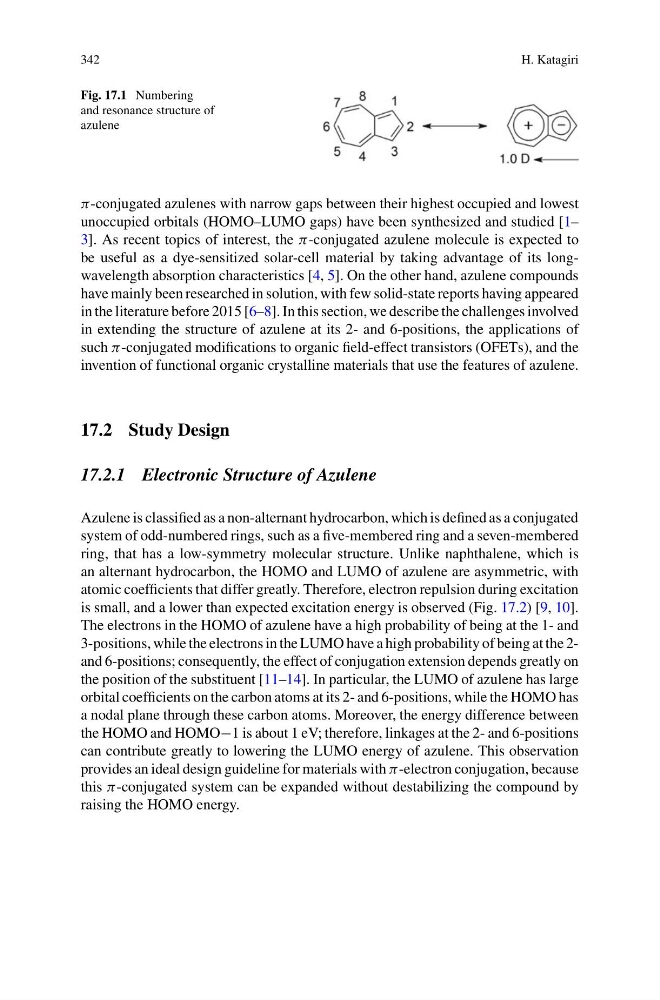
Fig. 17.1 Numbering
and resonance structure of
azulene
π-conjugated azulenes with narrow gaps between their highest occupied and lowest
unoccupied orbitals (HOMO–LUMO gaps) have been synthesized and studied [1–
3]. As recent topics of interest, the π-conjugated azulene molecule is expected to
be useful as a dye-sensitized solar-cell material by taking advantage of its longwavelength absorption characteristics [4, 5]. On the other hand, azulene compounds
have mainly been researched in solution, with few solid-state reports having appeared
in the literature before 2015 [6–8]. In this section, we describe the challenges involved
in extending the structure of azulene at its 2- and 6-positions, the applications of
such π-conjugated modifications to organic field-effect transistors (OFETs), and the
invention of functional organic crystalline materials that use the features of azulene.
17.2 Study Design
17.2.1 Electronic Structure of Azulene
Azulene is classified as a non-alternant hydrocarbon, which is defined as a conjugated
system of odd-numbered rings, such as a five-membered ring and a seven-membered
ring, that has a low-symmetry molecular structure. Unlike naphthalene, which is
an alternant hydrocarbon, the HOMO and LUMO of azulene are asymmetric, with
atomic coefficients that differ greatly. Therefore, electron repulsion during excitation
is small, and a lower than expected excitation energy is observed (Fig. 17.2) [9, 10].
The electrons in the HOMO of azulene have a high probability of being at the 1- and
3-positions, while the electrons in the LUMO have a high probability of being at the 2and 6-positions; consequently, the effect of conjugation extension depends greatly on
the position of the substituent [11–14]. In particular, the LUMO of azulene has large
orbital coefficients on the carbon atoms at its 2- and 6-positions, while the HOMO has
a nodal plane through these carbon atoms. Moreover, the energy difference between
the HOMO and HOMO−1 is about 1 eV; therefore, linkages at the 2- and 6-positions
can contribute greatly to lowering the LUMO energy of azulene. This observation
provides an ideal design guideline for materials with π-electron conjugation, because
this π-conjugated system can be expanded without destabilizing the compound by
raising the HOMO energy.
H. Katagiri
Fig. 17.1 Numbering
and resonance structure of
azulene
π-conjugated azulenes with narrow gaps between their highest occupied and lowest
unoccupied orbitals (HOMO–LUMO gaps) have been synthesized and studied [1–
3]. As recent topics of interest, the π-conjugated azulene molecule is expected to
be useful as a dye-sensitized solar-cell material by taking advantage of its longwavelength absorption characteristics [4, 5]. On the other hand, azulene compounds
have mainly been researched in solution, with few solid-state reports having appeared
in the literature before 2015 [6–8]. In this section, we describe the challenges involved
in extending the structure of azulene at its 2- and 6-positions, the applications of
such π-conjugated modifications to organic field-effect transistors (OFETs), and the
invention of functional organic crystalline materials that use the features of azulene.
17.2 Study Design
17.2.1 Electronic Structure of Azulene
Azulene is classified as a non-alternant hydrocarbon, which is defined as a conjugated
system of odd-numbered rings, such as a five-membered ring and a seven-membered
ring, that has a low-symmetry molecular structure. Unlike naphthalene, which is
an alternant hydrocarbon, the HOMO and LUMO of azulene are asymmetric, with
atomic coefficients that differ greatly. Therefore, electron repulsion during excitation
is small, and a lower than expected excitation energy is observed (Fig. 17.2) [9, 10].
The electrons in the HOMO of azulene have a high probability of being at the 1- and
3-positions, while the electrons in the LUMO have a high probability of being at the 2and 6-positions; consequently, the effect of conjugation extension depends greatly on
the position of the substituent [11–14]. In particular, the LUMO of azulene has large
orbital coefficients on the carbon atoms at its 2- and 6-positions, while the HOMO has
a nodal plane through these carbon atoms. Moreover, the energy difference between
the HOMO and HOMO−1 is about 1 eV; therefore, linkages at the 2- and 6-positions
can contribute greatly to lowering the LUMO energy of azulene. This observation
provides an ideal design guideline for materials with π-electron conjugation, because
this π-conjugated system can be expanded without destabilizing the compound by
raising the HOMO energy.