

338
Y. Imai
a)
(R)-6
7-F
b)
A
B
C
D
7-F
7-F
a axis
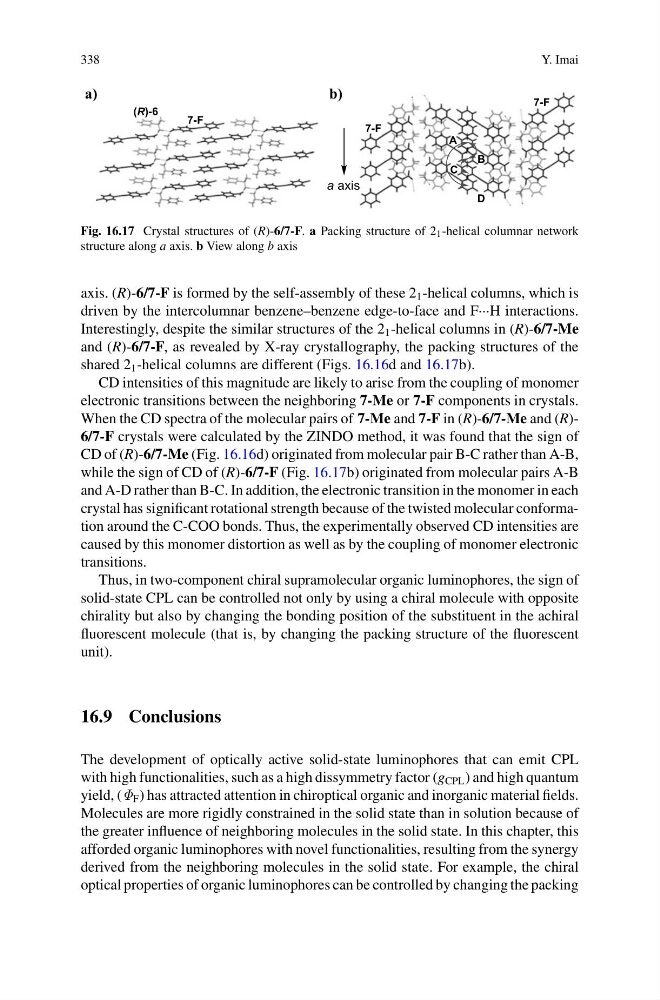
Fig. 16.17 Crystal structures of (R)-6/7-F. a Packing structure of 2 1 -helical columnar network
structure along a axis. b View along b axis
axis. (R)-6/7-F is formed by the self-assembly of these 2 1 -helical columns, which is
driven by the intercolumnar benzene–benzene edge-to-face and F···H interactions.
Interestingly, despite the similar structures of the 2 1 -helical columns in (R)-6/7-Me
and (R)-6/7-F, as revealed by X-ray crystallography, the packing structures of the
shared 2 1 -helical columns are different (Figs. 16.16d and 16.17b).
CD intensities of this magnitude are likely to arise from the coupling of monomer
electronic transitions between the neighboring 7-Me or 7-F components in crystals.
When the CD spectra of the molecular pairs of 7-Me and 7-F in (R)-6/7-Me and (R)6/7-F crystals were calculated by the ZINDO method, it was found that the sign of
CD of (R)-6/7-Me (Fig. 16.16d) originated from molecular pair B-C rather than A-B,
while the sign of CD of (R)-6/7-F (Fig. 16.17b) originated from molecular pairs A-B
and A-D rather than B-C. In addition, the electronic transition in the monomer in each
crystal has significant rotational strength because of the twisted molecular conformation around the C-COO bonds. Thus, the experimentally observed CD intensities are
caused by this monomer distortion as well as by the coupling of monomer electronic
transitions.
Thus, in two-component chiral supramolecular organic luminophores, the sign of
solid-state CPL can be controlled not only by using a chiral molecule with opposite
chirality but also by changing the bonding position of the substituent in the achiral
fluorescent molecule (that is, by changing the packing structure of the fluorescent
unit).
16.9 Conclusions
The development of optically active solid-state luminophores that can emit CPL
with high functionalities, such as a high dissymmetry factor (g CPL ) and high quantum
yield, (F F ) has attracted attention in chiroptical organic and inorganic material fields.
Molecules are more rigidly constrained in the solid state than in solution because of
the greater influence of neighboring molecules in the solid state. In this chapter, this
afforded organic luminophores with novel functionalities, resulting from the synergy
derived from the neighboring molecules in the solid state. For example, the chiral
optical properties of organic luminophores can be controlled by changing the packing
Y. Imai
a)
(R)-6
7-F
b)
A
B
C
D
7-F
7-F
a axis
Fig. 16.17 Crystal structures of (R)-6/7-F. a Packing structure of 2 1 -helical columnar network
structure along a axis. b View along b axis
axis. (R)-6/7-F is formed by the self-assembly of these 2 1 -helical columns, which is
driven by the intercolumnar benzene–benzene edge-to-face and F···H interactions.
Interestingly, despite the similar structures of the 2 1 -helical columns in (R)-6/7-Me
and (R)-6/7-F, as revealed by X-ray crystallography, the packing structures of the
shared 2 1 -helical columns are different (Figs. 16.16d and 16.17b).
CD intensities of this magnitude are likely to arise from the coupling of monomer
electronic transitions between the neighboring 7-Me or 7-F components in crystals.
When the CD spectra of the molecular pairs of 7-Me and 7-F in (R)-6/7-Me and (R)6/7-F crystals were calculated by the ZINDO method, it was found that the sign of
CD of (R)-6/7-Me (Fig. 16.16d) originated from molecular pair B-C rather than A-B,
while the sign of CD of (R)-6/7-F (Fig. 16.17b) originated from molecular pairs A-B
and A-D rather than B-C. In addition, the electronic transition in the monomer in each
crystal has significant rotational strength because of the twisted molecular conformation around the C-COO bonds. Thus, the experimentally observed CD intensities are
caused by this monomer distortion as well as by the coupling of monomer electronic
transitions.
Thus, in two-component chiral supramolecular organic luminophores, the sign of
solid-state CPL can be controlled not only by using a chiral molecule with opposite
chirality but also by changing the bonding position of the substituent in the achiral
fluorescent molecule (that is, by changing the packing structure of the fluorescent
unit).
16.9 Conclusions
The development of optically active solid-state luminophores that can emit CPL
with high functionalities, such as a high dissymmetry factor (g CPL ) and high quantum
yield, (F F ) has attracted attention in chiroptical organic and inorganic material fields.
Molecules are more rigidly constrained in the solid state than in solution because of
the greater influence of neighboring molecules in the solid state. In this chapter, this
afforded organic luminophores with novel functionalities, resulting from the synergy
derived from the neighboring molecules in the solid state. For example, the chiral
optical properties of organic luminophores can be controlled by changing the packing