

14 Luminescent Crystal–Control of Excited-State …
281
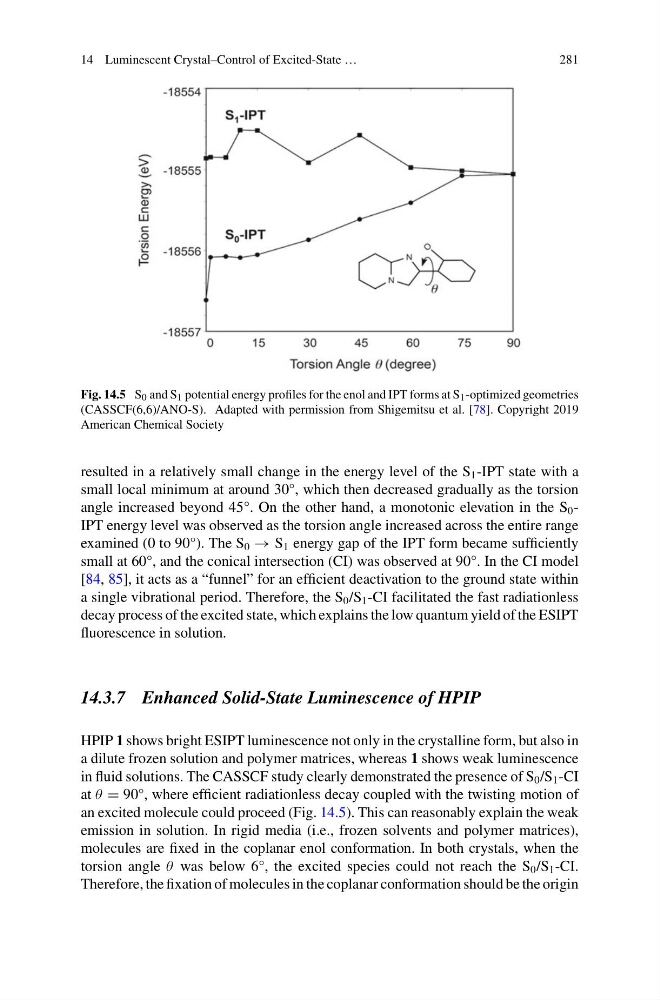
Fig. 14.5 S 0 and S 1 potential energy profiles for the enol and IPT forms at S 1 -optimized geometries
(CASSCF(6,6)/ANO-S). Adapted with permission from Shigemitsu et al. [78]. Copyright 2019
American Chemical Society
resulted in a relatively small change in the energy level of the S 1 -IPT state with a
small local minimum at around 30°, which then decreased gradually as the torsion
angle increased beyond 45°. On the other hand, a monotonic elevation in the S 0 -
IPT energy level was observed as the torsion angle increased across the entire range
examined (0 to 90°). The S 0 → S 1 energy gap of the IPT form became sufficiently
small at 60°, and the conical intersection (CI) was observed at 90°. In the CI model
[84, 85], it acts as a “funnel” for an efficient deactivation to the ground state within
a single vibrational period. Therefore, the S 0 /S 1 -CI facilitated the fast radiationless
decay process of the excited state, which explains the low quantum yield of the ESIPT
fluorescence in solution.
14.3.7 Enhanced Solid-State Luminescence of HPIP
HPIP 1 shows bright ESIPT luminescence not only in the crystalline form, but also in
a dilute frozen solution and polymer matrices, whereas 1 shows weak luminescence
in fluid solutions. The CASSCF study clearly demonstrated the presence of S 0 /S 1 -CI
at θ = 90°, where efficient radiationless decay coupled with the twisting motion of
an excited molecule could proceed (Fig. 14.5). This can reasonably explain the weak
emission in solution. In rigid media (i.e., frozen solvents and polymer matrices),
molecules are fixed in the coplanar enol conformation. In both crystals, when the
torsion angle θ was below 6°, the excited species could not reach the S 0 /S 1 -CI.
Therefore, the fixation of molecules in the coplanar conformation should be the origin
281
Fig. 14.5 S 0 and S 1 potential energy profiles for the enol and IPT forms at S 1 -optimized geometries
(CASSCF(6,6)/ANO-S). Adapted with permission from Shigemitsu et al. [78]. Copyright 2019
American Chemical Society
resulted in a relatively small change in the energy level of the S 1 -IPT state with a
small local minimum at around 30°, which then decreased gradually as the torsion
angle increased beyond 45°. On the other hand, a monotonic elevation in the S 0 -
IPT energy level was observed as the torsion angle increased across the entire range
examined (0 to 90°). The S 0 → S 1 energy gap of the IPT form became sufficiently
small at 60°, and the conical intersection (CI) was observed at 90°. In the CI model
[84, 85], it acts as a “funnel” for an efficient deactivation to the ground state within
a single vibrational period. Therefore, the S 0 /S 1 -CI facilitated the fast radiationless
decay process of the excited state, which explains the low quantum yield of the ESIPT
fluorescence in solution.
14.3.7 Enhanced Solid-State Luminescence of HPIP
HPIP 1 shows bright ESIPT luminescence not only in the crystalline form, but also in
a dilute frozen solution and polymer matrices, whereas 1 shows weak luminescence
in fluid solutions. The CASSCF study clearly demonstrated the presence of S 0 /S 1 -CI
at θ = 90°, where efficient radiationless decay coupled with the twisting motion of
an excited molecule could proceed (Fig. 14.5). This can reasonably explain the weak
emission in solution. In rigid media (i.e., frozen solvents and polymer matrices),
molecules are fixed in the coplanar enol conformation. In both crystals, when the
torsion angle θ was below 6°, the excited species could not reach the S 0 /S 1 -CI.
Therefore, the fixation of molecules in the coplanar conformation should be the origin