

14 Luminescent Crystal–Control of Excited-State …
279
14.3.4 Thermal Properties and Luminescence Color
Switching
Blue-green and yellow ESIPT luminescence is switchable by heat-mode control of
the polymorphic states.
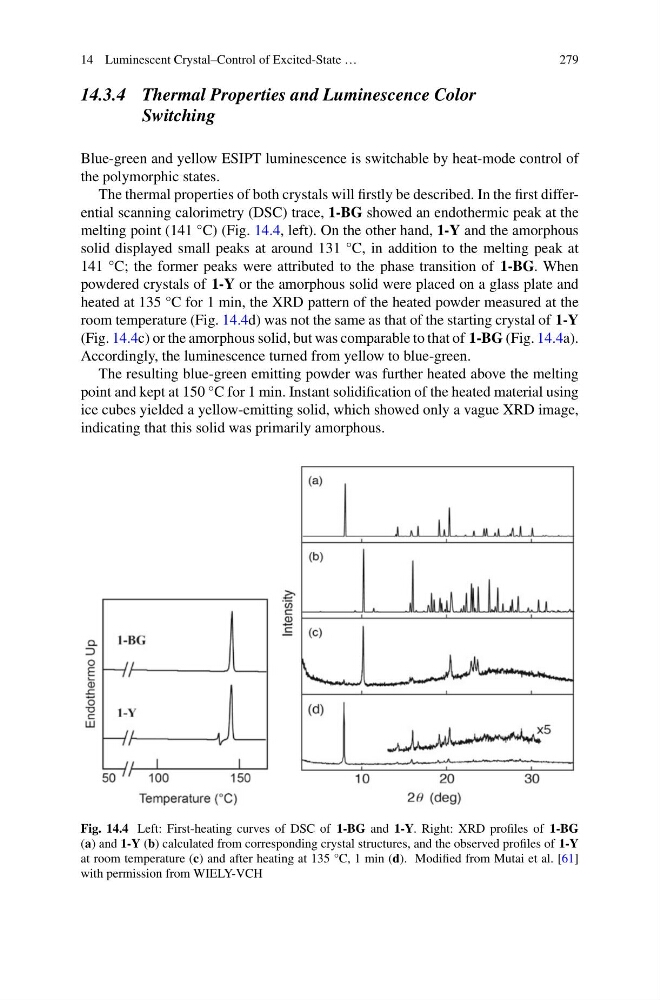
The thermal properties of both crystals will firstly be described. In the first differential scanning calorimetry (DSC) trace, 1-BG showed an endothermic peak at the
melting point (141 °C) (Fig. 14.4, left). On the other hand, 1-Y and the amorphous
solid displayed small peaks at around 131 °C, in addition to the melting peak at
141 °C; the former peaks were attributed to the phase transition of 1-BG. When
powdered crystals of 1-Y or the amorphous solid were placed on a glass plate and
heated at 135 °C for 1 min, the XRD pattern of the heated powder measured at the
room temperature (Fig. 14.4d) was not the same as that of the starting crystal of 1-Y
(Fig. 14.4c) or the amorphous solid, but was comparable to that of 1-BG (Fig. 14.4a).
Accordingly, the luminescence turned from yellow to blue-green.
The resulting blue-green emitting powder was further heated above the melting
point and kept at 150 °C for 1 min. Instant solidification of the heated material using
ice cubes yielded a yellow-emitting solid, which showed only a vague XRD image,
indicating that this solid was primarily amorphous.
Fig. 14.4 Left: First-heating curves of DSC of 1-BG and 1-Y. Right: XRD profiles of 1-BG
(a) and 1-Y (b) calculated from corresponding crystal structures, and the observed profiles of 1-Y
at room temperature (c) and after heating at 135 °C, 1 min (d). Modified from Mutai et al. [61]
with permission from WIELY-VCH
279
14.3.4 Thermal Properties and Luminescence Color
Switching
Blue-green and yellow ESIPT luminescence is switchable by heat-mode control of
the polymorphic states.
The thermal properties of both crystals will firstly be described. In the first differential scanning calorimetry (DSC) trace, 1-BG showed an endothermic peak at the
melting point (141 °C) (Fig. 14.4, left). On the other hand, 1-Y and the amorphous
solid displayed small peaks at around 131 °C, in addition to the melting peak at
141 °C; the former peaks were attributed to the phase transition of 1-BG. When
powdered crystals of 1-Y or the amorphous solid were placed on a glass plate and
heated at 135 °C for 1 min, the XRD pattern of the heated powder measured at the
room temperature (Fig. 14.4d) was not the same as that of the starting crystal of 1-Y
(Fig. 14.4c) or the amorphous solid, but was comparable to that of 1-BG (Fig. 14.4a).
Accordingly, the luminescence turned from yellow to blue-green.
The resulting blue-green emitting powder was further heated above the melting
point and kept at 150 °C for 1 min. Instant solidification of the heated material using
ice cubes yielded a yellow-emitting solid, which showed only a vague XRD image,
indicating that this solid was primarily amorphous.
Fig. 14.4 Left: First-heating curves of DSC of 1-BG and 1-Y. Right: XRD profiles of 1-BG
(a) and 1-Y (b) calculated from corresponding crystal structures, and the observed profiles of 1-Y
at room temperature (c) and after heating at 135 °C, 1 min (d). Modified from Mutai et al. [61]
with permission from WIELY-VCH