

14 Luminescent Crystal–Control of Excited-State …
275
X
N
ESIPT
hν
O
H
X
N
O
H
X
N
O
H
Enol form
Keto form
N-H
O
S
X
*
*
(HBI)
(HBO)
(HBT)
Scheme 14.3 Molecular structure of intramolecular hydrogen-bonded benzazoles (HBI, HBO, and
HBT), and enol-to-keto tautomerization via ESIPT by photoexcitation
compounds to date are 2-(2
-hydroxyphenyl)benzimidazole (HBI) [33, 40–44], 2-(2
-
hydroxyphenyl) benzoxazole (HBO) [45–48], 2-(2
-hydroxyphenyl)benzothiazole
(HBT) [49–54], salicylideneaniline [55–57], and their analogs.
ESIPT luminescence in the solid state [33, 49, 58–61] is a significant topic, and
there have been some recent reports of basic applications in electroluminescent
devices [49, 62–66], as well as white luminescent materials [64–70].
14.2.3 2-(2 -Hydroxyphenyl)Imidazo[1,2-a]Pyridine (HPIP)
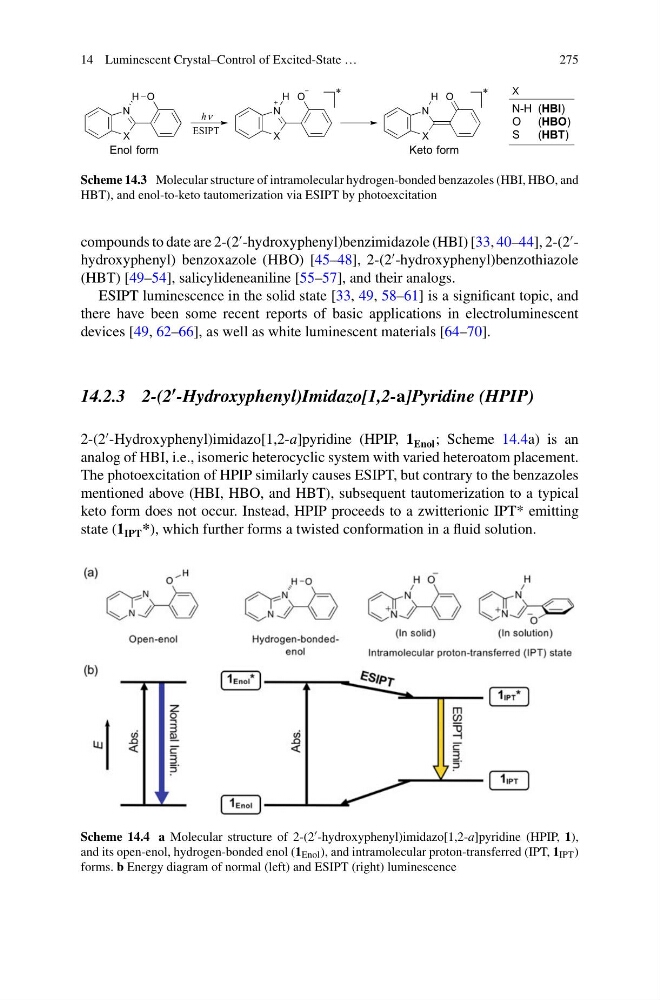
2-(2
-Hydroxyphenyl)imidazo[1,2-a]pyridine (HPIP, 1 Enol ; Scheme 14.4a) is an
analog of HBI, i.e., isomeric heterocyclic system with varied heteroatom placement.
The photoexcitation of HPIP similarly causes ESIPT, but contrary to the benzazoles
mentioned above (HBI, HBO, and HBT), subsequent tautomerization to a typical
keto form does not occur. Instead, HPIP proceeds to a zwitterionic IPT* emitting
state (1 IPT *), which further forms a twisted conformation in a fluid solution.
Scheme 14.4 a Molecular structure of 2-(2 -hydroxyphenyl)imidazo[1,2-a]pyridine (HPIP, 1),
and its open-enol, hydrogen-bonded enol (1 Enol ), and intramolecular proton-transferred (IPT, 1 IPT )
forms. b Energy diagram of normal (left) and ESIPT (right) luminescence
275
X
N
ESIPT
hν
O
H
X
N
O
H
X
N
O
H
Enol form
Keto form
N-H
O
S
X
*
*
(HBI)
(HBO)
(HBT)
Scheme 14.3 Molecular structure of intramolecular hydrogen-bonded benzazoles (HBI, HBO, and
HBT), and enol-to-keto tautomerization via ESIPT by photoexcitation
compounds to date are 2-(2
-hydroxyphenyl)benzimidazole (HBI) [33, 40–44], 2-(2
-
hydroxyphenyl) benzoxazole (HBO) [45–48], 2-(2
-hydroxyphenyl)benzothiazole
(HBT) [49–54], salicylideneaniline [55–57], and their analogs.
ESIPT luminescence in the solid state [33, 49, 58–61] is a significant topic, and
there have been some recent reports of basic applications in electroluminescent
devices [49, 62–66], as well as white luminescent materials [64–70].
14.2.3 2-(2 -Hydroxyphenyl)Imidazo[1,2-a]Pyridine (HPIP)
2-(2
-Hydroxyphenyl)imidazo[1,2-a]pyridine (HPIP, 1 Enol ; Scheme 14.4a) is an
analog of HBI, i.e., isomeric heterocyclic system with varied heteroatom placement.
The photoexcitation of HPIP similarly causes ESIPT, but contrary to the benzazoles
mentioned above (HBI, HBO, and HBT), subsequent tautomerization to a typical
keto form does not occur. Instead, HPIP proceeds to a zwitterionic IPT* emitting
state (1 IPT *), which further forms a twisted conformation in a fluid solution.
Scheme 14.4 a Molecular structure of 2-(2 -hydroxyphenyl)imidazo[1,2-a]pyridine (HPIP, 1),
and its open-enol, hydrogen-bonded enol (1 Enol ), and intramolecular proton-transferred (IPT, 1 IPT )
forms. b Energy diagram of normal (left) and ESIPT (right) luminescence