

262
T. Onodera et al.
13.3 Optical Properties of Hybridized PDA Nanocrystal
Fibers
13.3.1 Solid Thin Films and Linear Optical Properties
It is much important to fabricate well-defined solid thin films of PDA NCFs as well
as hybridized PDA NCFs with highly optical quality in order to evaluate linear and
nonlinear optical properties, and hybridized nanostructure correlations toward NLO
devices applications. PDA NCFs- and/or hybridized PDA NCFs were loaded into
polyvinyl alcohol (PVA, DP = 3100, degree of saponification = above 96%) matrix
composites thin films in the present study. Actually, an aqueous dispersion liquid
of PDA NCFs or hybridized PDA NCFs was mixed with PVA aq., and then water
medium was evaporated quickly on a quartz substrate (KU1) around at 100 °C so
as to possibly avoid aggregation and orientation. This fabrication process has the
advantage to easily produce a large-area thin film without using a large amount of
sample dispersion liquid in layer-by-layer method, etc.
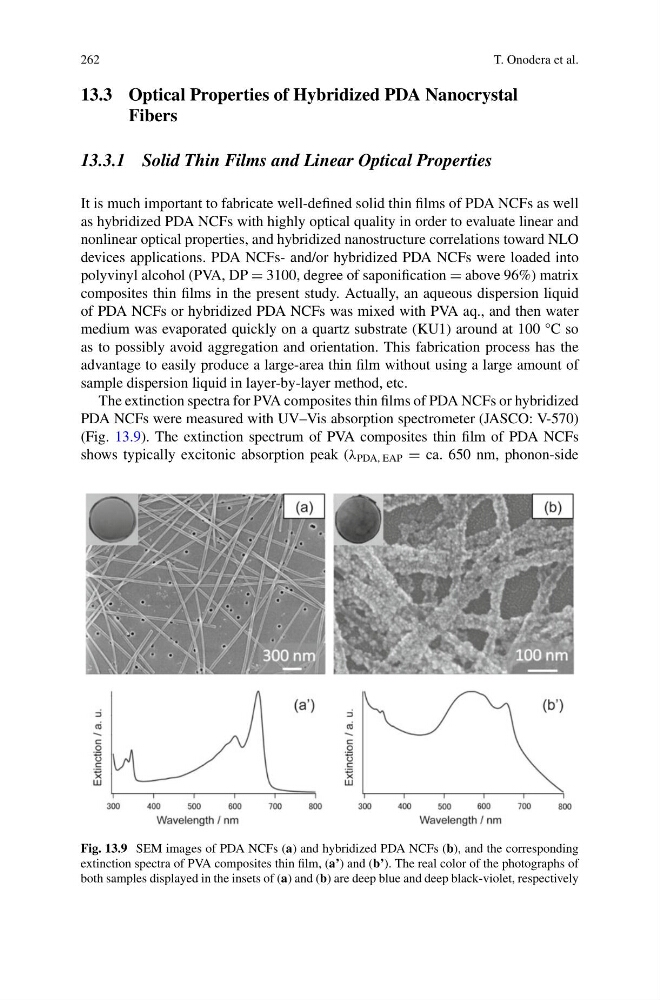
The extinction spectra for PVA composites thin films of PDA NCFs or hybridized
PDA NCFs were measured with UV–Vis absorption spectrometer (JASCO: V-570)
(Fig. 13.9). The extinction spectrum of PVA composites thin film of PDA NCFs
shows typically excitonic absorption peak (λ PDA, EAP = ca. 650 nm, phonon-side
Fig. 13.9 SEM images of PDA NCFs (a) and hybridized PDA NCFs (b), and the corresponding
extinction spectra of PVA composites thin film, (a’) and (b’). The real color of the photographs of
both samples displayed in the insets of (a) and (b) are deep blue and deep black-violet, respectively
T. Onodera et al.
13.3 Optical Properties of Hybridized PDA Nanocrystal
Fibers
13.3.1 Solid Thin Films and Linear Optical Properties
It is much important to fabricate well-defined solid thin films of PDA NCFs as well
as hybridized PDA NCFs with highly optical quality in order to evaluate linear and
nonlinear optical properties, and hybridized nanostructure correlations toward NLO
devices applications. PDA NCFs- and/or hybridized PDA NCFs were loaded into
polyvinyl alcohol (PVA, DP = 3100, degree of saponification = above 96%) matrix
composites thin films in the present study. Actually, an aqueous dispersion liquid
of PDA NCFs or hybridized PDA NCFs was mixed with PVA aq., and then water
medium was evaporated quickly on a quartz substrate (KU1) around at 100 °C so
as to possibly avoid aggregation and orientation. This fabrication process has the
advantage to easily produce a large-area thin film without using a large amount of
sample dispersion liquid in layer-by-layer method, etc.
The extinction spectra for PVA composites thin films of PDA NCFs or hybridized
PDA NCFs were measured with UV–Vis absorption spectrometer (JASCO: V-570)
(Fig. 13.9). The extinction spectrum of PVA composites thin film of PDA NCFs
shows typically excitonic absorption peak (λ PDA, EAP = ca. 650 nm, phonon-side
Fig. 13.9 SEM images of PDA NCFs (a) and hybridized PDA NCFs (b), and the corresponding
extinction spectra of PVA composites thin film, (a’) and (b’). The real color of the photographs of
both samples displayed in the insets of (a) and (b) are deep blue and deep black-violet, respectively