

12 Kinetic Assembly of Porous Coordination Networks …
241
cyclic trimers to give two kinds of bent-S 3 species, one still bound to the network
iodide sites and the other physisorbed inside the pore.
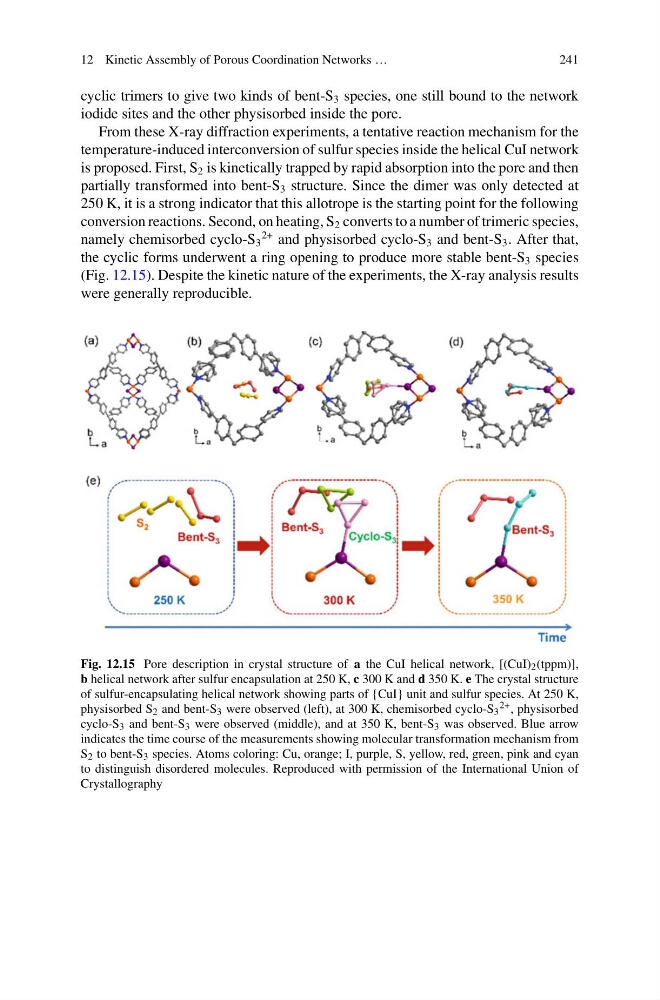
From these X-ray diffraction experiments, a tentative reaction mechanism for the
temperature-induced interconversion of sulfur species inside the helical CuI network
is proposed. First, S 2 is kinetically trapped by rapid absorption into the pore and then
partially transformed into bent-S 3 structure. Since the dimer was only detected at
250 K, it is a strong indicator that this allotrope is the starting point for the following
conversion reactions. Second, on heating, S 2 converts to a number of trimeric species,
namely chemisorbed cyclo-S 3
2+ and physisorbed cyclo-S 3 and bent-S 3 . After that,
the cyclic forms underwent a ring opening to produce more stable bent-S 3 species
(Fig. 12.15). Despite the kinetic nature of the experiments, the X-ray analysis results
were generally reproducible.
Fig. 12.15 Pore description in crystal structure of a the CuI helical network, [(CuI) 2 (tppm)],
b helical network after sulfur encapsulation at 250 K, c 300 K and d 350 K. e The crystal structure
of sulfur-encapsulating helical network showing parts of {CuI} unit and sulfur species. At 250 K,
physisorbed S 2 and bent-S 3 were observed (left), at 300 K, chemisorbed cyclo-S 3
2+ , physisorbed
cyclo-S 3 and bent-S 3 were observed (middle), and at 350 K, bent-S 3 was observed. Blue arrow
indicates the time course of the measurements showing molecular transformation mechanism from
S 2 to bent-S 3 species. Atoms coloring: Cu, orange; I, purple, S, yellow, red, green, pink and cyan
to distinguish disordered molecules. Reproduced with permission of the International Union of
Crystallography
241
cyclic trimers to give two kinds of bent-S 3 species, one still bound to the network
iodide sites and the other physisorbed inside the pore.
From these X-ray diffraction experiments, a tentative reaction mechanism for the
temperature-induced interconversion of sulfur species inside the helical CuI network
is proposed. First, S 2 is kinetically trapped by rapid absorption into the pore and then
partially transformed into bent-S 3 structure. Since the dimer was only detected at
250 K, it is a strong indicator that this allotrope is the starting point for the following
conversion reactions. Second, on heating, S 2 converts to a number of trimeric species,
namely chemisorbed cyclo-S 3
2+ and physisorbed cyclo-S 3 and bent-S 3 . After that,
the cyclic forms underwent a ring opening to produce more stable bent-S 3 species
(Fig. 12.15). Despite the kinetic nature of the experiments, the X-ray analysis results
were generally reproducible.
Fig. 12.15 Pore description in crystal structure of a the CuI helical network, [(CuI) 2 (tppm)],
b helical network after sulfur encapsulation at 250 K, c 300 K and d 350 K. e The crystal structure
of sulfur-encapsulating helical network showing parts of {CuI} unit and sulfur species. At 250 K,
physisorbed S 2 and bent-S 3 were observed (left), at 300 K, chemisorbed cyclo-S 3
2+ , physisorbed
cyclo-S 3 and bent-S 3 were observed (middle), and at 350 K, bent-S 3 was observed. Blue arrow
indicates the time course of the measurements showing molecular transformation mechanism from
S 2 to bent-S 3 species. Atoms coloring: Cu, orange; I, purple, S, yellow, red, green, pink and cyan
to distinguish disordered molecules. Reproduced with permission of the International Union of
Crystallography