

154
O. D. Putra and H. Uekusa
9.1 Introduction
9.1.1 Solid Active Pharmaceutical Ingredients (APIs)
Active pharmaceutical ingredients (APIs) are classified in numerous ways, based on
the existing pharmaceutical disciplines. In general, APIs can be classified based on
their chemical nature, source, target organ, therapeutic uses, physiological system,
physical effect, phase, etc. [1]. In this chapter, we will focus on the classification that is
based on the phase system. In the pharmaceutical field, APIs can be grouped into three
phases: solid, liquid, and gas (i.e., nitrous oxide) [2, 3]. APIs are most commonly
formulated in the solid-state, in which their physical and chemical stabilities are
typically better. Moreover, solid-state preparation of APIs is more practical due
to ease of handling, processing, and packaging during the various stages of drug
development and preparation [4, 5].
The study of solid APIs involves many scientific disciplines because many
phenomena influence the physicochemical properties of solid APIs: stability, hygroscopicity, dissolution rate, color, etc. [6–10]. Solid APIs can generally be classified as
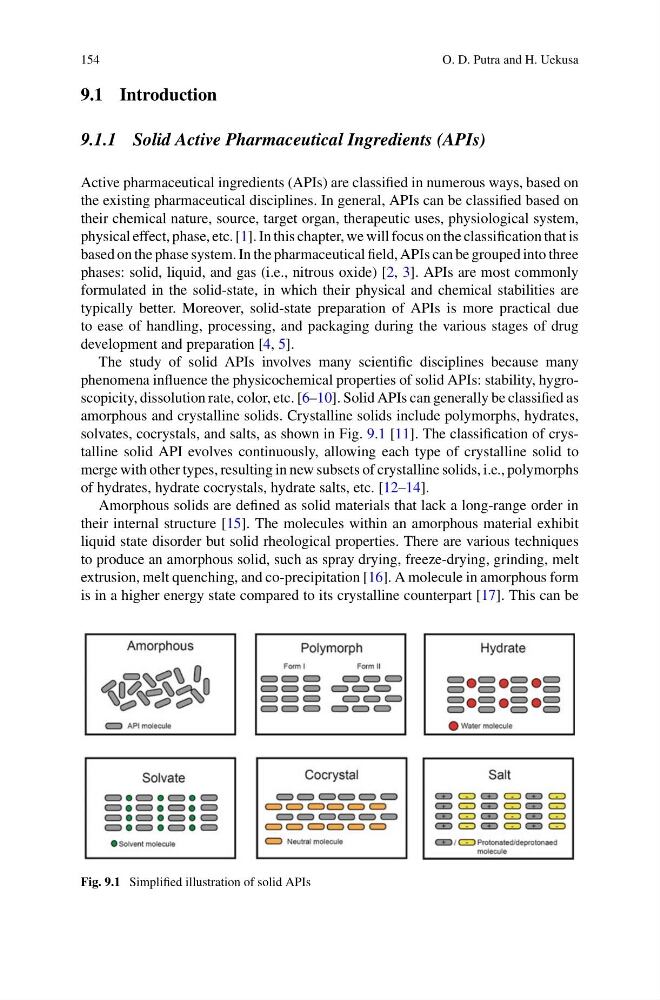
amorphous and crystalline solids. Crystalline solids include polymorphs, hydrates,
solvates, cocrystals, and salts, as shown in Fig. 9.1 [11]. The classification of crystalline solid API evolves continuously, allowing each type of crystalline solid to
merge with other types, resulting in new subsets of crystalline solids, i.e., polymorphs
of hydrates, hydrate cocrystals, hydrate salts, etc. [12–14].
Amorphous solids are defined as solid materials that lack a long-range order in
their internal structure [15]. The molecules within an amorphous material exhibit
liquid state disorder but solid rheological properties. There are various techniques
to produce an amorphous solid, such as spray drying, freeze-drying, grinding, melt
extrusion, melt quenching, and co-precipitation [16]. A molecule in amorphous form
is in a higher energy state compared to its crystalline counterpart [17]. This can be
Fig. 9.1 Simplified illustration of solid APIs
O. D. Putra and H. Uekusa
9.1 Introduction
9.1.1 Solid Active Pharmaceutical Ingredients (APIs)
Active pharmaceutical ingredients (APIs) are classified in numerous ways, based on
the existing pharmaceutical disciplines. In general, APIs can be classified based on
their chemical nature, source, target organ, therapeutic uses, physiological system,
physical effect, phase, etc. [1]. In this chapter, we will focus on the classification that is
based on the phase system. In the pharmaceutical field, APIs can be grouped into three
phases: solid, liquid, and gas (i.e., nitrous oxide) [2, 3]. APIs are most commonly
formulated in the solid-state, in which their physical and chemical stabilities are
typically better. Moreover, solid-state preparation of APIs is more practical due
to ease of handling, processing, and packaging during the various stages of drug
development and preparation [4, 5].
The study of solid APIs involves many scientific disciplines because many
phenomena influence the physicochemical properties of solid APIs: stability, hygroscopicity, dissolution rate, color, etc. [6–10]. Solid APIs can generally be classified as
amorphous and crystalline solids. Crystalline solids include polymorphs, hydrates,
solvates, cocrystals, and salts, as shown in Fig. 9.1 [11]. The classification of crystalline solid API evolves continuously, allowing each type of crystalline solid to
merge with other types, resulting in new subsets of crystalline solids, i.e., polymorphs
of hydrates, hydrate cocrystals, hydrate salts, etc. [12–14].
Amorphous solids are defined as solid materials that lack a long-range order in
their internal structure [15]. The molecules within an amorphous material exhibit
liquid state disorder but solid rheological properties. There are various techniques
to produce an amorphous solid, such as spray drying, freeze-drying, grinding, melt
extrusion, melt quenching, and co-precipitation [16]. A molecule in amorphous form
is in a higher energy state compared to its crystalline counterpart [17]. This can be
Fig. 9.1 Simplified illustration of solid APIs