

146
S. Tsuzuki
molecules is −12.06 kcal/mol. They are about the double of the hydrogen bond of the
water dimer. The calculated E disp show that the strong dispersion interactions exist
between parallel adjacent molecules in the crystals. The analysis of the intermolecular
interactions in the crystals of polycyclic aromatic molecules also shows that it is
dangerous to discuss the intermolecular interactions in crystals solely based on the
presence or absence of short atom–atom contact.
8.6 Intermolecular Interactions of n-hexane
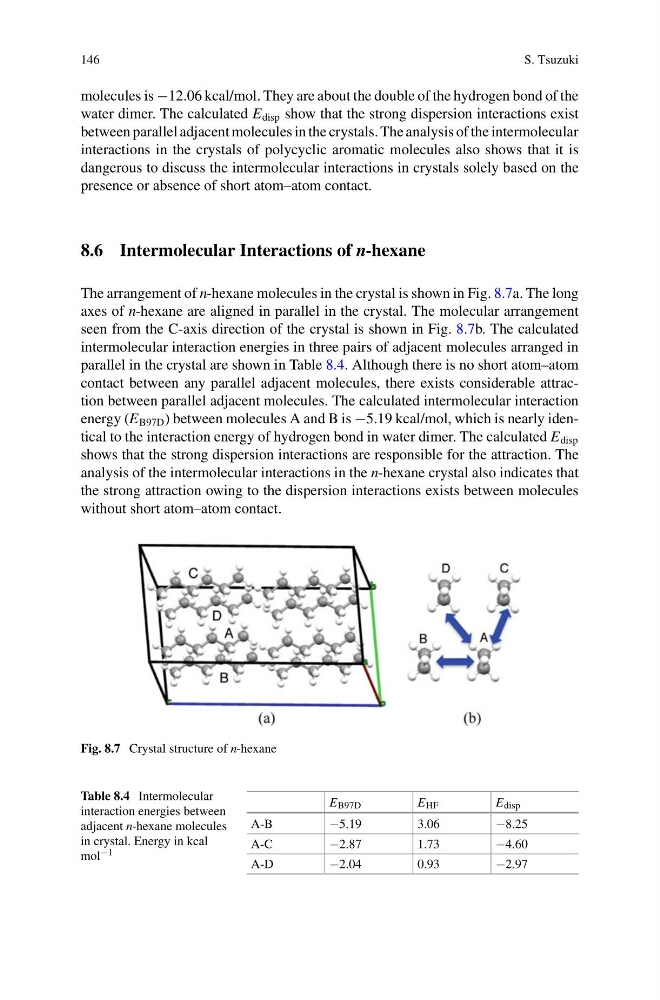
The arrangement of n-hexane molecules in the crystal is shown in Fig. 8.7a. The long
axes of n-hexane are aligned in parallel in the crystal. The molecular arrangement
seen from the C-axis direction of the crystal is shown in Fig. 8.7b. The calculated
intermolecular interaction energies in three pairs of adjacent molecules arranged in
parallel in the crystal are shown in Table 8.4. Although there is no short atom–atom
contact between any parallel adjacent molecules, there exists considerable attraction between parallel adjacent molecules. The calculated intermolecular interaction
energy (E B97D ) between molecules A and B is −5.19 kcal/mol, which is nearly identical to the interaction energy of hydrogen bond in water dimer. The calculated E disp
shows that the strong dispersion interactions are responsible for the attraction. The
analysis of the intermolecular interactions in the n-hexane crystal also indicates that
the strong attraction owing to the dispersion interactions exists between molecules
without short atom–atom contact.
Fig. 8.7 Crystal structure of n-hexane
Table 8.4 Intermolecular
interaction energies between
adjacent n-hexane molecules
in crystal. Energy in kcal
mol −1
E B97D
E HF
E disp
A-B
−5.19
3.06
−8.25
A-C
−2.87
1.73
−4.60
A-D
−2.04
0.93
−2.97
S. Tsuzuki
molecules is −12.06 kcal/mol. They are about the double of the hydrogen bond of the
water dimer. The calculated E disp show that the strong dispersion interactions exist
between parallel adjacent molecules in the crystals. The analysis of the intermolecular
interactions in the crystals of polycyclic aromatic molecules also shows that it is
dangerous to discuss the intermolecular interactions in crystals solely based on the
presence or absence of short atom–atom contact.
8.6 Intermolecular Interactions of n-hexane
The arrangement of n-hexane molecules in the crystal is shown in Fig. 8.7a. The long
axes of n-hexane are aligned in parallel in the crystal. The molecular arrangement
seen from the C-axis direction of the crystal is shown in Fig. 8.7b. The calculated
intermolecular interaction energies in three pairs of adjacent molecules arranged in
parallel in the crystal are shown in Table 8.4. Although there is no short atom–atom
contact between any parallel adjacent molecules, there exists considerable attraction between parallel adjacent molecules. The calculated intermolecular interaction
energy (E B97D ) between molecules A and B is −5.19 kcal/mol, which is nearly identical to the interaction energy of hydrogen bond in water dimer. The calculated E disp
shows that the strong dispersion interactions are responsible for the attraction. The
analysis of the intermolecular interactions in the n-hexane crystal also indicates that
the strong attraction owing to the dispersion interactions exists between molecules
without short atom–atom contact.
Fig. 8.7 Crystal structure of n-hexane
Table 8.4 Intermolecular
interaction energies between
adjacent n-hexane molecules
in crystal. Energy in kcal
mol −1
E B97D
E HF
E disp
A-B
−5.19
3.06
−8.25
A-C
−2.87
1.73
−4.60
A-D
−2.04
0.93
−2.97