

1 X-Ray Birefringence Imaging (XBI): A New Technique …
7
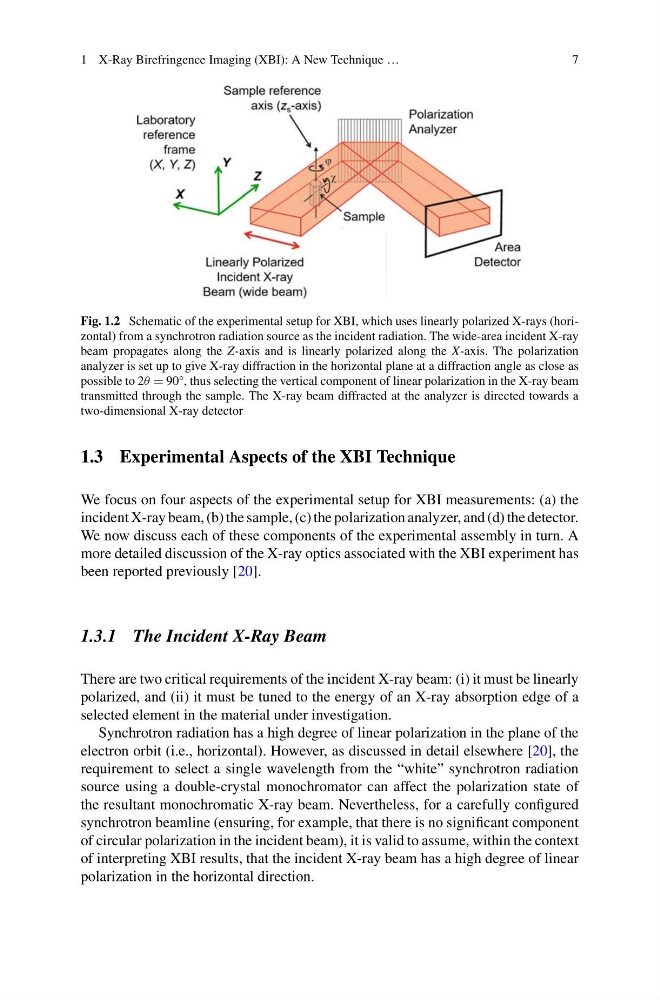
Fig. 1.2 Schematic of the experimental setup for XBI, which uses linearly polarized X-rays (horizontal) from a synchrotron radiation source as the incident radiation. The wide-area incident X-ray
beam propagates along the Z-axis and is linearly polarized along the X-axis. The polarization
analyzer is set up to give X-ray diffraction in the horizontal plane at a diffraction angle as close as
possible to 2θ = 90°, thus selecting the vertical component of linear polarization in the X-ray beam
transmitted through the sample. The X-ray beam diffracted at the analyzer is directed towards a
two-dimensional X-ray detector
1.3 Experimental Aspects of the XBI Technique
We focus on four aspects of the experimental setup for XBI measurements: (a) the
incident X-ray beam, (b) the sample, (c) the polarization analyzer, and (d) the detector.
We now discuss each of these components of the experimental assembly in turn. A
more detailed discussion of the X-ray optics associated with the XBI experiment has
been reported previously [20].
1.3.1 The Incident X-Ray Beam
There are two critical requirements of the incident X-ray beam: (i) it must be linearly
polarized, and (ii) it must be tuned to the energy of an X-ray absorption edge of a
selected element in the material under investigation.
Synchrotron radiation has a high degree of linear polarization in the plane of the
electron orbit (i.e., horizontal). However, as discussed in detail elsewhere [20], the
requirement to select a single wavelength from the “white” synchrotron radiation
source using a double-crystal monochromator can affect the polarization state of
the resultant monochromatic X-ray beam. Nevertheless, for a carefully configured
synchrotron beamline (ensuring, for example, that there is no significant component
of circular polarization in the incident beam), it is valid to assume, within the context
of interpreting XBI results, that the incident X-ray beam has a high degree of linear
polarization in the horizontal direction.
7
Fig. 1.2 Schematic of the experimental setup for XBI, which uses linearly polarized X-rays (horizontal) from a synchrotron radiation source as the incident radiation. The wide-area incident X-ray
beam propagates along the Z-axis and is linearly polarized along the X-axis. The polarization
analyzer is set up to give X-ray diffraction in the horizontal plane at a diffraction angle as close as
possible to 2θ = 90°, thus selecting the vertical component of linear polarization in the X-ray beam
transmitted through the sample. The X-ray beam diffracted at the analyzer is directed towards a
two-dimensional X-ray detector
1.3 Experimental Aspects of the XBI Technique
We focus on four aspects of the experimental setup for XBI measurements: (a) the
incident X-ray beam, (b) the sample, (c) the polarization analyzer, and (d) the detector.
We now discuss each of these components of the experimental assembly in turn. A
more detailed discussion of the X-ray optics associated with the XBI experiment has
been reported previously [20].
1.3.1 The Incident X-Ray Beam
There are two critical requirements of the incident X-ray beam: (i) it must be linearly
polarized, and (ii) it must be tuned to the energy of an X-ray absorption edge of a
selected element in the material under investigation.
Synchrotron radiation has a high degree of linear polarization in the plane of the
electron orbit (i.e., horizontal). However, as discussed in detail elsewhere [20], the
requirement to select a single wavelength from the “white” synchrotron radiation
source using a double-crystal monochromator can affect the polarization state of
the resultant monochromatic X-ray beam. Nevertheless, for a carefully configured
synchrotron beamline (ensuring, for example, that there is no significant component
of circular polarization in the incident beam), it is valid to assume, within the context
of interpreting XBI results, that the incident X-ray beam has a high degree of linear
polarization in the horizontal direction.