

126
M. Miyata and S. Tsuzuki
%nprocshared=4
%chk=Benzene(Rr)(Rr)Dimer(trala-column).chk
#p b3lyp/6-311g(d,p) empiricaldispersion=gd3 counterpoise=2
Benzene(Rr)(Rr)Dimer(trala-column) (DFT)(GD3)(6-311G**)
0 1 0 1 0 1
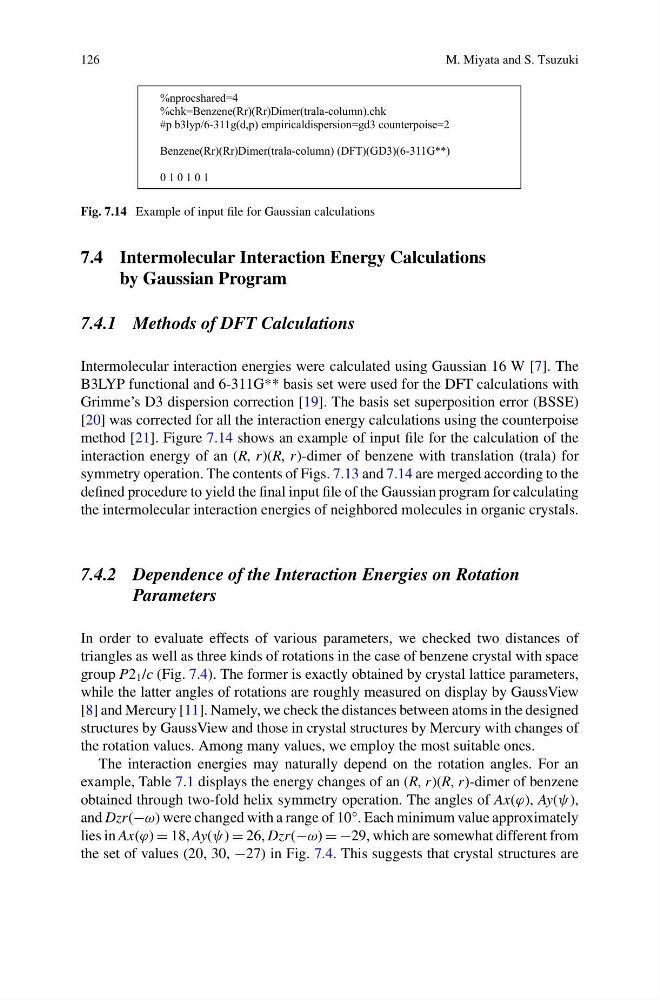
Fig. 7.14 Example of input file for Gaussian calculations
7.4 Intermolecular Interaction Energy Calculations
by Gaussian Program
7.4.1 Methods of DFT Calculations
Intermolecular interaction energies were calculated using Gaussian 16 W [7]. The
B3LYP functional and 6-311G** basis set were used for the DFT calculations with
Grimme’s D3 dispersion correction [19]. The basis set superposition error (BSSE)
[20] was corrected for all the interaction energy calculations using the counterpoise
method [21]. Figure 7.14 shows an example of input file for the calculation of the
interaction energy of an (R, r)(R, r)-dimer of benzene with translation (trala) for
symmetry operation. The contents of Figs. 7.13 and 7.14 are merged according to the
defined procedure to yield the final input file of the Gaussian program for calculating
the intermolecular interaction energies of neighbored molecules in organic crystals.
7.4.2 Dependence of the Interaction Energies on Rotation
Parameters
In order to evaluate effects of various parameters, we checked two distances of
triangles as well as three kinds of rotations in the case of benzene crystal with space
group P2 1 /c (Fig. 7.4). The former is exactly obtained by crystal lattice parameters,
while the latter angles of rotations are roughly measured on display by GaussView
[8] and Mercury [11]. Namely, we check the distances between atoms in the designed
structures by GaussView and those in crystal structures by Mercury with changes of
the rotation values. Among many values, we employ the most suitable ones.
The interaction energies may naturally depend on the rotation angles. For an
example, Table 7.1 displays the energy changes of an (R, r)(R, r)-dimer of benzene
obtained through two-fold helix symmetry operation. The angles of Ax(ϕ), Ay(ψ),
and Dzr(−ω) were changed with a range of 10°. Each minimum value approximately
lies in Ax(ϕ) = 18, Ay(ψ) = 26, Dzr(−ω) = −29, which are somewhat different from
the set of values (20, 30, −27) in Fig. 7.4. This suggests that crystal structures are
M. Miyata and S. Tsuzuki
%nprocshared=4
%chk=Benzene(Rr)(Rr)Dimer(trala-column).chk
#p b3lyp/6-311g(d,p) empiricaldispersion=gd3 counterpoise=2
Benzene(Rr)(Rr)Dimer(trala-column) (DFT)(GD3)(6-311G**)
0 1 0 1 0 1
Fig. 7.14 Example of input file for Gaussian calculations
7.4 Intermolecular Interaction Energy Calculations
by Gaussian Program
7.4.1 Methods of DFT Calculations
Intermolecular interaction energies were calculated using Gaussian 16 W [7]. The
B3LYP functional and 6-311G** basis set were used for the DFT calculations with
Grimme’s D3 dispersion correction [19]. The basis set superposition error (BSSE)
[20] was corrected for all the interaction energy calculations using the counterpoise
method [21]. Figure 7.14 shows an example of input file for the calculation of the
interaction energy of an (R, r)(R, r)-dimer of benzene with translation (trala) for
symmetry operation. The contents of Figs. 7.13 and 7.14 are merged according to the
defined procedure to yield the final input file of the Gaussian program for calculating
the intermolecular interaction energies of neighbored molecules in organic crystals.
7.4.2 Dependence of the Interaction Energies on Rotation
Parameters
In order to evaluate effects of various parameters, we checked two distances of
triangles as well as three kinds of rotations in the case of benzene crystal with space
group P2 1 /c (Fig. 7.4). The former is exactly obtained by crystal lattice parameters,
while the latter angles of rotations are roughly measured on display by GaussView
[8] and Mercury [11]. Namely, we check the distances between atoms in the designed
structures by GaussView and those in crystal structures by Mercury with changes of
the rotation values. Among many values, we employ the most suitable ones.
The interaction energies may naturally depend on the rotation angles. For an
example, Table 7.1 displays the energy changes of an (R, r)(R, r)-dimer of benzene
obtained through two-fold helix symmetry operation. The angles of Ax(ϕ), Ay(ψ),
and Dzr(−ω) were changed with a range of 10°. Each minimum value approximately
lies in Ax(ϕ) = 18, Ay(ψ) = 26, Dzr(−ω) = −29, which are somewhat different from
the set of values (20, 30, −27) in Fig. 7.4. This suggests that crystal structures are