

116
M. Miyata and S. Tsuzuki
7.1 Introduction
Organic crystals are analyzed by using a large amount of reflection data according
to X-ray crystallography which bases on symmetry theory in mathematics [1]. This
indicates that the analysis has no relation to interaction energies among molecules.
Substantially, the crystals are formed due to intermolecular interactions among
organic molecules [2]. Conventionally, such interaction energies have been calculated
with powerful supercomputers using high-level ab initio calculations by specialists
in quantum chemistry. This mainly comes from the fact that a large basis set and electron correlation correction are necessary for an accurate evaluation of the dispersion
interactions. Therefore, an accurate evaluation of the dispersion energies demands a
vast amount of computational resources, introducing much difficulty to understand
energetic aspect of organic crystals [3–5].
However, recent progresses in personal computers and computational methods
give us a challenging time to overcome this difficulty as for the evaluation of the
dispersion energies. Namely, new personal computers with multicore CPU perform
rapid calculations for intermolecular interactions of organic molecules with more
than a hundred carbons using dispersion-corrected DFT method [6]. Therefore, the
interaction energies between two neighbored molecules in crystals can be briefly
evaluated. Gaussian is one of the well-known ab initio molecular orbital and DFT
calculation program [7]. GaussView is graphical user interface (GUI) program for
Gaussian [8]. We can easily evaluate intermolecular interaction energies between
molecules in organic crystals using Gaussian and GaussView programs.
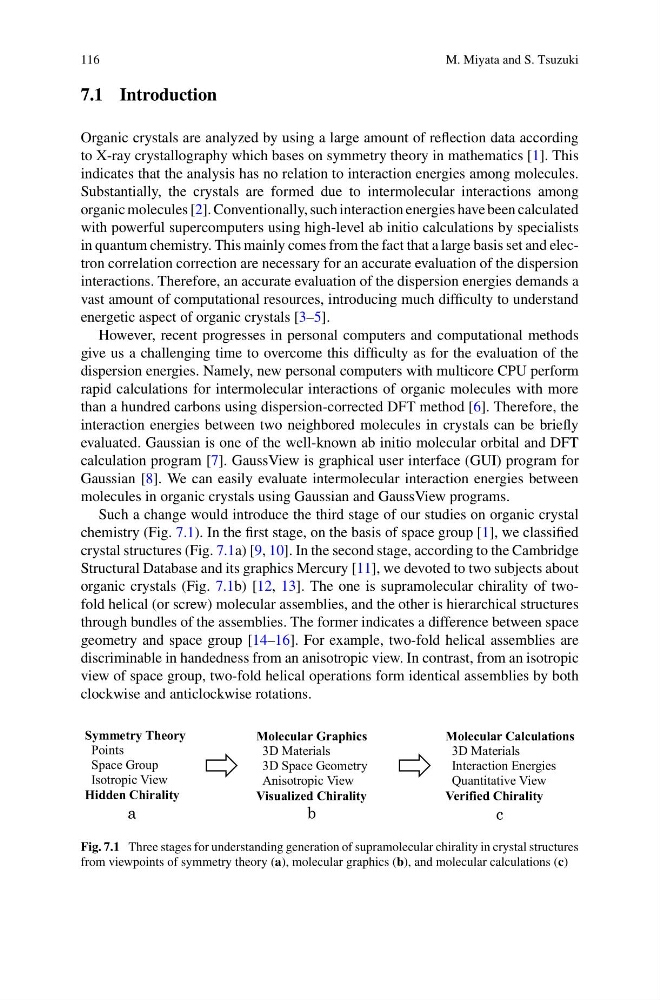
Such a change would introduce the third stage of our studies on organic crystal
chemistry (Fig. 7.1). In the first stage, on the basis of space group [1], we classified
crystal structures (Fig. 7.1a) [9, 10]. In the second stage, according to the Cambridge
Structural Database and its graphics Mercury [11], we devoted to two subjects about
organic crystals (Fig. 7.1b) [12, 13]. The one is supramolecular chirality of twofold helical (or screw) molecular assemblies, and the other is hierarchical structures
through bundles of the assemblies. The former indicates a difference between space
geometry and space group [14–16]. For example, two-fold helical assemblies are
discriminable in handedness from an anisotropic view. In contrast, from an isotropic
view of space group, two-fold helical operations form identical assemblies by both
clockwise and anticlockwise rotations.
Symmetry Theory
Points
Space Group
Isotropic View
Hidden Chirality
Molecular Calculations
3D Materials
Interaction Energies
Quantitative View
Verified Chirality
Molecular Graphics
3D Materials
3D Space Geometry
Anisotropic View
Visualized Chirality
c
a
b
Fig. 7.1 Three stages for understanding generation of supramolecular chirality in crystal structures
from viewpoints of symmetry theory (a), molecular graphics (b), and molecular calculations (c)
M. Miyata and S. Tsuzuki
7.1 Introduction
Organic crystals are analyzed by using a large amount of reflection data according
to X-ray crystallography which bases on symmetry theory in mathematics [1]. This
indicates that the analysis has no relation to interaction energies among molecules.
Substantially, the crystals are formed due to intermolecular interactions among
organic molecules [2]. Conventionally, such interaction energies have been calculated
with powerful supercomputers using high-level ab initio calculations by specialists
in quantum chemistry. This mainly comes from the fact that a large basis set and electron correlation correction are necessary for an accurate evaluation of the dispersion
interactions. Therefore, an accurate evaluation of the dispersion energies demands a
vast amount of computational resources, introducing much difficulty to understand
energetic aspect of organic crystals [3–5].
However, recent progresses in personal computers and computational methods
give us a challenging time to overcome this difficulty as for the evaluation of the
dispersion energies. Namely, new personal computers with multicore CPU perform
rapid calculations for intermolecular interactions of organic molecules with more
than a hundred carbons using dispersion-corrected DFT method [6]. Therefore, the
interaction energies between two neighbored molecules in crystals can be briefly
evaluated. Gaussian is one of the well-known ab initio molecular orbital and DFT
calculation program [7]. GaussView is graphical user interface (GUI) program for
Gaussian [8]. We can easily evaluate intermolecular interaction energies between
molecules in organic crystals using Gaussian and GaussView programs.
Such a change would introduce the third stage of our studies on organic crystal
chemistry (Fig. 7.1). In the first stage, on the basis of space group [1], we classified
crystal structures (Fig. 7.1a) [9, 10]. In the second stage, according to the Cambridge
Structural Database and its graphics Mercury [11], we devoted to two subjects about
organic crystals (Fig. 7.1b) [12, 13]. The one is supramolecular chirality of twofold helical (or screw) molecular assemblies, and the other is hierarchical structures
through bundles of the assemblies. The former indicates a difference between space
geometry and space group [14–16]. For example, two-fold helical assemblies are
discriminable in handedness from an anisotropic view. In contrast, from an isotropic
view of space group, two-fold helical operations form identical assemblies by both
clockwise and anticlockwise rotations.
Symmetry Theory
Points
Space Group
Isotropic View
Hidden Chirality
Molecular Calculations
3D Materials
Interaction Energies
Quantitative View
Verified Chirality
Molecular Graphics
3D Materials
3D Space Geometry
Anisotropic View
Visualized Chirality
c
a
b
Fig. 7.1 Three stages for understanding generation of supramolecular chirality in crystal structures
from viewpoints of symmetry theory (a), molecular graphics (b), and molecular calculations (c)