

100
K. Kawakami
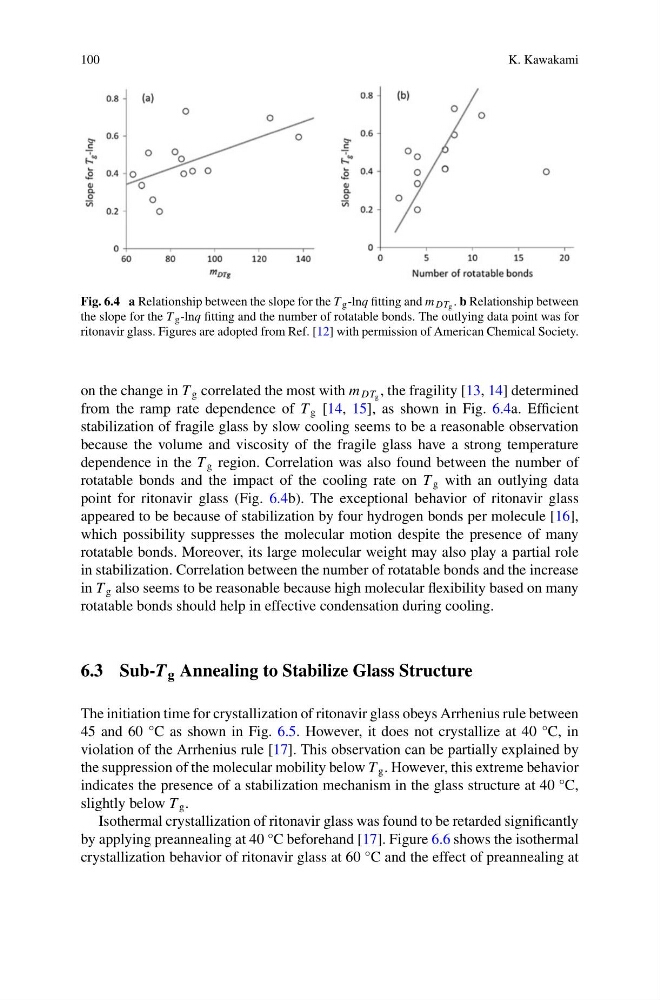
Fig. 6.4 a Relationship between the slope for the T g -lnq fitting and m DTg . b Relationship between
the slope for the T g -lnq fitting and the number of rotatable bonds. The outlying data point was for
ritonavir glass. Figures are adopted from Ref. [12] with permission of American Chemical Society.
on the change in T g correlated the most with m DT g , the fragility [13, 14] determined
from the ramp rate dependence of T g [14, 15], as shown in Fig. 6.4a. Efficient
stabilization of fragile glass by slow cooling seems to be a reasonable observation
because the volume and viscosity of the fragile glass have a strong temperature
dependence in the T g region. Correlation was also found between the number of
rotatable bonds and the impact of the cooling rate on T g with an outlying data
point for ritonavir glass (Fig. 6.4b). The exceptional behavior of ritonavir glass
appeared to be because of stabilization by four hydrogen bonds per molecule [16],
which possibility suppresses the molecular motion despite the presence of many
rotatable bonds. Moreover, its large molecular weight may also play a partial role
in stabilization. Correlation between the number of rotatable bonds and the increase
in T g also seems to be reasonable because high molecular flexibility based on many
rotatable bonds should help in effective condensation during cooling.
6.3 Sub-T g Annealing to Stabilize Glass Structure
The initiation time for crystallization of ritonavir glass obeys Arrhenius rule between
45 and 60 °C as shown in Fig. 6.5. However, it does not crystallize at 40 °C, in
violation of the Arrhenius rule [17]. This observation can be partially explained by
the suppression of the molecular mobility below T g . However, this extreme behavior
indicates the presence of a stabilization mechanism in the glass structure at 40 °C,
slightly below T g .
Isothermal crystallization of ritonavir glass was found to be retarded significantly
by applying preannealing at 40 °C beforehand [17]. Figure 6.6 shows the isothermal
crystallization behavior of ritonavir glass at 60 °C and the effect of preannealing at
K. Kawakami
Fig. 6.4 a Relationship between the slope for the T g -lnq fitting and m DTg . b Relationship between
the slope for the T g -lnq fitting and the number of rotatable bonds. The outlying data point was for
ritonavir glass. Figures are adopted from Ref. [12] with permission of American Chemical Society.
on the change in T g correlated the most with m DT g , the fragility [13, 14] determined
from the ramp rate dependence of T g [14, 15], as shown in Fig. 6.4a. Efficient
stabilization of fragile glass by slow cooling seems to be a reasonable observation
because the volume and viscosity of the fragile glass have a strong temperature
dependence in the T g region. Correlation was also found between the number of
rotatable bonds and the impact of the cooling rate on T g with an outlying data
point for ritonavir glass (Fig. 6.4b). The exceptional behavior of ritonavir glass
appeared to be because of stabilization by four hydrogen bonds per molecule [16],
which possibility suppresses the molecular motion despite the presence of many
rotatable bonds. Moreover, its large molecular weight may also play a partial role
in stabilization. Correlation between the number of rotatable bonds and the increase
in T g also seems to be reasonable because high molecular flexibility based on many
rotatable bonds should help in effective condensation during cooling.
6.3 Sub-T g Annealing to Stabilize Glass Structure
The initiation time for crystallization of ritonavir glass obeys Arrhenius rule between
45 and 60 °C as shown in Fig. 6.5. However, it does not crystallize at 40 °C, in
violation of the Arrhenius rule [17]. This observation can be partially explained by
the suppression of the molecular mobility below T g . However, this extreme behavior
indicates the presence of a stabilization mechanism in the glass structure at 40 °C,
slightly below T g .
Isothermal crystallization of ritonavir glass was found to be retarded significantly
by applying preannealing at 40 °C beforehand [17]. Figure 6.6 shows the isothermal
crystallization behavior of ritonavir glass at 60 °C and the effect of preannealing at