

A recent study based on opportunistic sightings assessed the suitability of
IMMAs for cetacean conservation in the Western Mediterranean Sea. In this same
study, Báez et al. (2019) demonstrated the higher abundance of cetaceans in IMMAs
of the Alboran Sea compared to those in other Mediterranean IMMAs.
25.3 Important Bird and Biodiversity Areas
The Important Bird and Biodiversity Areas (IBAs) are sites of international importance for bird conservation on land and sea, which have worldwide recognition as
practical conservation and management tools (Donald et al. 2018). The concept of
IBA has been applied during the last decades, and a big effort has been made to agree
on a robust and simple criterion to be applied consistently worldwide. The selection
of these important areas has been completed through the use of quantitative ornithological data and considering up-to-date knowledge of the sizes and trends of bird
populations. In this way, it is ensured that all selected IBAs are of high interest for
bird conservation at the international levelling terms of the presence and abundance
of species that occur there seasonally or all year-round (Heath et al. 2000).
At present, 1873 out of 13,599 existing worldwide IBAs are exclusively marine
IBAs (www.birdlife.org/datazone/site, accessed April 3, 2020). Spain and Portugal
were pioneers in the design of marine IBAs in the open sea, where these important
areas for birds typically coincide with areas of interest for other organisms, such as
cetaceans or marine turtles (Arcos et al. 2009). The Alboran Sea hosts nine marine
IBAs, which cover an area of 718,766 km
2 and include representatives of “areas of
high-intensity use at sea,” “seaward extensions of breeding colonies” and “migration
hotspots.” Furthermore, there are six IBAs in the Alboran Sea occupying inshore
(coastal) waters (see Table 25.2).
The Strait of Gibraltar, in the western limit of the Alboran Sea, is the only
connection between the Atlantic Ocean and the Mediterranean Sea and represents
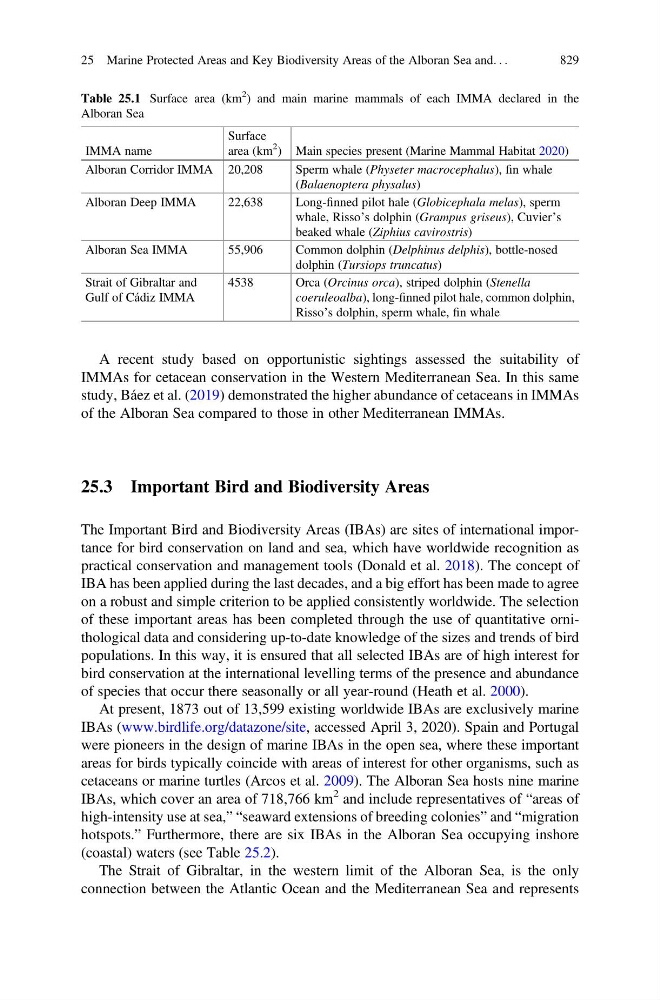
Table 25.1 Surface area (km
2
) and main marine mammals of each IMMA declared in the
Alboran Sea
IMMA name
Surface
area (km
2
) Main species present (Marine Mammal Habitat 2020)
Alboran Corridor IMMA 20,208
Sperm whale (Physeter macrocephalus), fin whale
(Balaenoptera physalus)
Alboran Deep IMMA
22,638
Long-finned pilot hale (Globicephala melas), sperm
whale, Risso’s dolphin (Grampus griseus), Cuvier’s
beaked whale (Ziphius cavirostris)
Alboran Sea IMMA
55,906
Common dolphin (Delphinus delphis), bottle-nosed
dolphin (Tursiops truncatus)
Strait of Gibraltar and
Gulf of Cádiz IMMA
4538
Orca (Orcinus orca), striped dolphin (Stenella
coeruleoalba), long-finned pilot hale, common dolphin,
Risso’s dolphin, sperm whale, fin whale
25 Marine Protected Areas and Key Biodiversity Areas of the Alboran Sea and. . .
829