

highly focused short-term sector-by-sector resource assessment and management
approach in general practice today by natural resource stewardship agencies, to the
broader more encompassing ecosystem approach that moves spatially from smaller
to larger scales, and from short-term to longer-term management practice.”
This change in management practice was not exclusive of fisheries or marine
ecosystems. Terrestrial ecosystem-based management (often referred to as ecosystem management) came into its own during the conflicts over endangered species
protection and forest and wildlife resources in the United States in the 1990s
(Slocombe 1993; Boyce and Haney 1997).
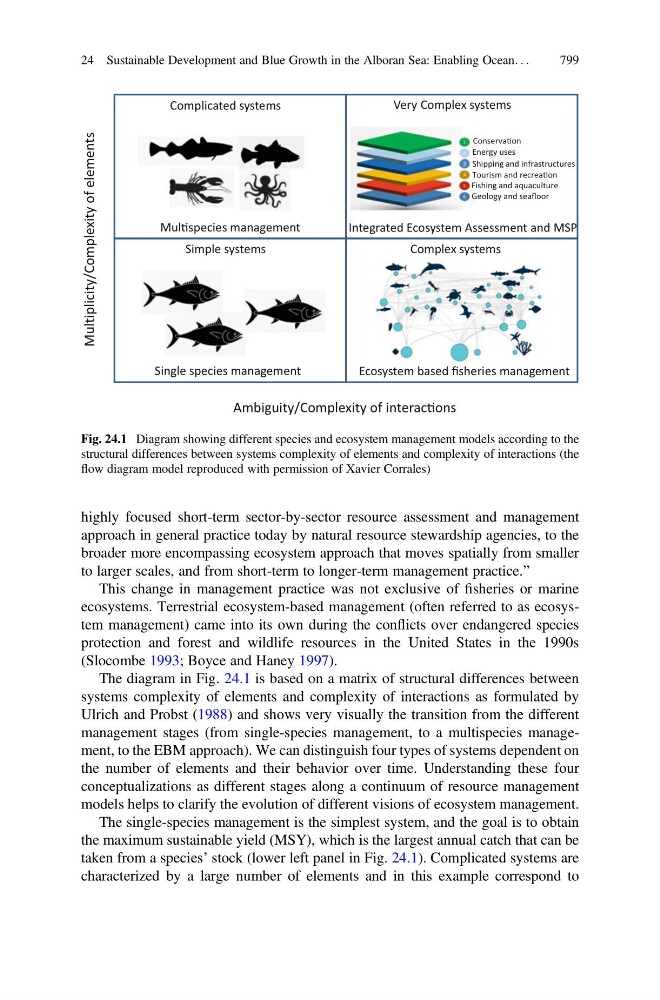
The diagram in Fig. 24.1 is based on a matrix of structural differences between
systems complexity of elements and complexity of interactions as formulated by
Ulrich and Probst (1988) and shows very visually the transition from the different
management stages (from single-species management, to a multispecies management, to the EBM approach). We can distinguish four types of systems dependent on
the number of elements and their behavior over time. Understanding these four
conceptualizations as different stages along a continuum of resource management
models helps to clarify the evolution of different visions of ecosystem management.
The single-species management is the simplest system, and the goal is to obtain
the maximum sustainable yield (MSY), which is the largest annual catch that can be
taken from a species’ stock (lower left panel in Fig. 24.1). Complicated systems are
characterized by a large number of elements and in this example correspond to
Ambiguity/Complexity of interacƟons
y
t
i
c
i
l
p
i
t
l
u
M
/
y
t
i
x
e
l
p
m
o
C
o f
s
t
n
e
m
e
l
e
Simple systems
Complicated systems
Complex systems
Very Complex systems
Single species management
MulƟspecies management
Ecosystem based fisheries management
Integrated Ecosystem Assessment and MSP
ConservaƟon
Energy uses
Shipping and infrastructures
Tourism and recreaƟon
Fishing and aquaculture
Geology and seafloor
Fig. 24.1 Diagram showing different species and ecosystem management models according to the
structural differences between systems complexity of elements and complexity of interactions (the
flow diagram model reproduced with permission of Xavier Corrales)
24 Sustainable Development and Blue Growth in the Alboran Sea: Enabling Ocean. . .
799