

Cartagena) areas. There were 1952 fishing vessels of a total tonnage of 6250 GRT
employing 13,529 fishermen in 1940. Rowing and sailing vessels represented 82%
of the fleet with a total tonnage of 2827 GRT-almost half the tonnage-; however, this
fleet segment almost disappeared in the end of the 1970s (1% of the tonnage). The
evolution of the fleet in different subareas of Northern Alboran Sea shows a similar
pattern. A first phase is characterized by a moderate increase of fishing power until
the 1950s. A second expansion phase is characterized by the construction and
modernization of new fishing units that strengthen the trawling fleet based in
Algeciras, Malaga, and Almeria. These vessels targeted different fish species in
the fishing grounds of Morocco. A third sharp decreasing phase that finished with the
end of high seas fishing fleet in the 1990s; and finally an adjustment fourth phase of
coastal and high seas fishing fleets. Nowadays, it involves 764 fishing vessels for a
total tonnage of 10,739 GRT and employs 2605 fishermen.
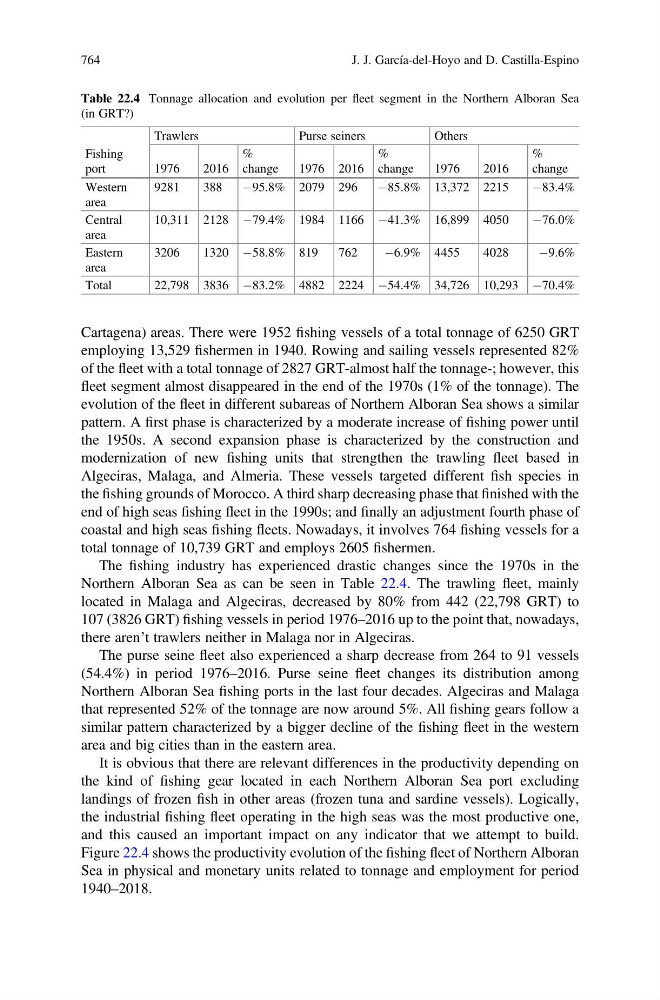
The fishing industry has experienced drastic changes since the 1970s in the
Northern Alboran Sea as can be seen in Table 22.4. The trawling fleet, mainly
located in Malaga and Algeciras, decreased by 80% from 442 (22,798 GRT) to
107 (3826 GRT) fishing vessels in period 1976–2016 up to the point that, nowadays,
there aren’t trawlers neither in Malaga nor in Algeciras.
The purse seine fleet also experienced a sharp decrease from 264 to 91 vessels
(54.4%) in period 1976–2016. Purse seine fleet changes its distribution among
Northern Alboran Sea fishing ports in the last four decades. Algeciras and Malaga
that represented 52% of the tonnage are now around 5%. All fishing gears follow a
similar pattern characterized by a bigger decline of the fishing fleet in the western
area and big cities than in the eastern area.
It is obvious that there are relevant differences in the productivity depending on
the kind of fishing gear located in each Northern Alboran Sea port excluding
landings of frozen fish in other areas (frozen tuna and sardine vessels). Logically,
the industrial fishing fleet operating in the high seas was the most productive one,
and this caused an important impact on any indicator that we attempt to build.
Figure 22.4 shows the productivity evolution of the fishing fleet of Northern Alboran
Sea in physical and monetary units related to tonnage and employment for period
1940–2018.
Table 22.4 Tonnage allocation and evolution per fleet segment in the Northern Alboran Sea
(in GRT?)
Fishing
port
Trawlers
Purse seiners
Others
1976
2016
%
change
1976 2016
%
change
1976
2016
%
change
Western
area
9281
388
À95.8% 2079 296
À85.8% 13,372 2215
À83.4%
Central
area
10,311 2128 À79.4% 1984 1166 À41.3% 16,899 4050
À76.0%
Eastern
area
3206
1320 À58.8% 819
762
À6.9% 4455
4028
À9.6%
Total
22,798 3836 À83.2% 4882 2224 À54.4% 34,726 10,293 À70.4%
764
J. J. García-del-Hoyo and D. Castilla-Espino