

the coastal mountain ranges, are able to organize quasi-stationary low-level warm
and moist inflows toward an area of potential ascending motion and potential
convective instability, and organize, primary in fall, mesoscale convective systems
that can produce heavy rainfalls.
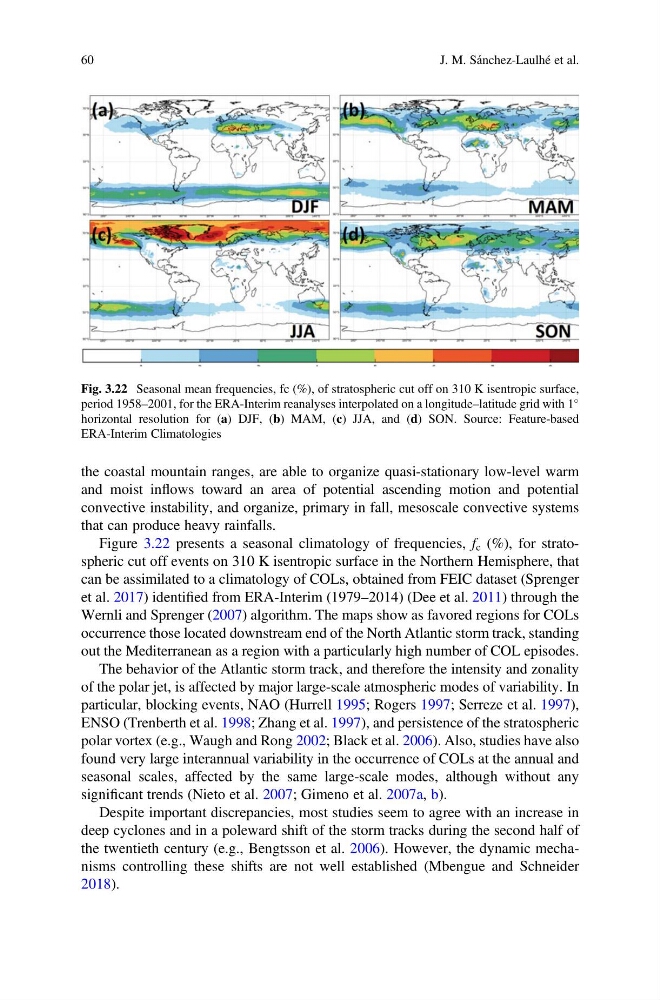
Figure 3.22 presents a seasonal climatology of frequencies, f c (%), for stratospheric cut off events on 310 K isentropic surface in the Northern Hemisphere, that
can be assimilated to a climatology of COLs, obtained from FEIC dataset (Sprenger
et al. 2017) identified from ERA-Interim (1979–2014) (Dee et al. 2011) through the
Wernli and Sprenger (2007) algorithm. The maps show as favored regions for COLs
occurrence those located downstream end of the North Atlantic storm track, standing
out the Mediterranean as a region with a particularly high number of COL episodes.
The behavior of the Atlantic storm track, and therefore the intensity and zonality
of the polar jet, is affected by major large-scale atmospheric modes of variability. In
particular, blocking events, NAO (Hurrell 1995; Rogers 1997; Serreze et al. 1997),
ENSO (Trenberth et al. 1998; Zhang et al. 1997), and persistence of the stratospheric
polar vortex (e.g., Waugh and Rong 2002; Black et al. 2006). Also, studies have also
found very large interannual variability in the occurrence of COLs at the annual and
seasonal scales, affected by the same large-scale modes, although without any
significant trends (Nieto et al. 2007; Gimeno et al. 2007a, b).
Despite important discrepancies, most studies seem to agree with an increase in
deep cyclones and in a poleward shift of the storm tracks during the second half of
the twentieth century (e.g., Bengtsson et al. 2006). However, the dynamic mechanisms controlling these shifts are not well established (Mbengue and Schneider
2018).
Fig. 3.22 Seasonal mean frequencies, fc (%), of stratospheric cut off on 310 K isentropic surface,
period 1958–2001, for the ERA-Interim reanalyses interpolated on a longitude–latitude grid with 1
horizontal resolution for (a) DJF, (b) MAM, (c) JJA, and (d) SON. Source: Feature-based
ERA-Interim Climatologies
60
J. M. Sánchez-Laulhé et al.
and moist inflows toward an area of potential ascending motion and potential
convective instability, and organize, primary in fall, mesoscale convective systems
that can produce heavy rainfalls.
Figure 3.22 presents a seasonal climatology of frequencies, f c (%), for stratospheric cut off events on 310 K isentropic surface in the Northern Hemisphere, that
can be assimilated to a climatology of COLs, obtained from FEIC dataset (Sprenger
et al. 2017) identified from ERA-Interim (1979–2014) (Dee et al. 2011) through the
Wernli and Sprenger (2007) algorithm. The maps show as favored regions for COLs
occurrence those located downstream end of the North Atlantic storm track, standing
out the Mediterranean as a region with a particularly high number of COL episodes.
The behavior of the Atlantic storm track, and therefore the intensity and zonality
of the polar jet, is affected by major large-scale atmospheric modes of variability. In
particular, blocking events, NAO (Hurrell 1995; Rogers 1997; Serreze et al. 1997),
ENSO (Trenberth et al. 1998; Zhang et al. 1997), and persistence of the stratospheric
polar vortex (e.g., Waugh and Rong 2002; Black et al. 2006). Also, studies have also
found very large interannual variability in the occurrence of COLs at the annual and
seasonal scales, affected by the same large-scale modes, although without any
significant trends (Nieto et al. 2007; Gimeno et al. 2007a, b).
Despite important discrepancies, most studies seem to agree with an increase in
deep cyclones and in a poleward shift of the storm tracks during the second half of
the twentieth century (e.g., Bengtsson et al. 2006). However, the dynamic mechanisms controlling these shifts are not well established (Mbengue and Schneider
2018).
Fig. 3.22 Seasonal mean frequencies, fc (%), of stratospheric cut off on 310 K isentropic surface,
period 1958–2001, for the ERA-Interim reanalyses interpolated on a longitude–latitude grid with 1
horizontal resolution for (a) DJF, (b) MAM, (c) JJA, and (d) SON. Source: Feature-based
ERA-Interim Climatologies
60
J. M. Sánchez-Laulhé et al.