

stayed until the end of July, after which it returned to the Alboran Sea reaching the
Strait of Gibraltar in September.
In addition to the published data presented here, other data are available from
dedicated websites that gather telemetry data on highly migratory marine mammals,
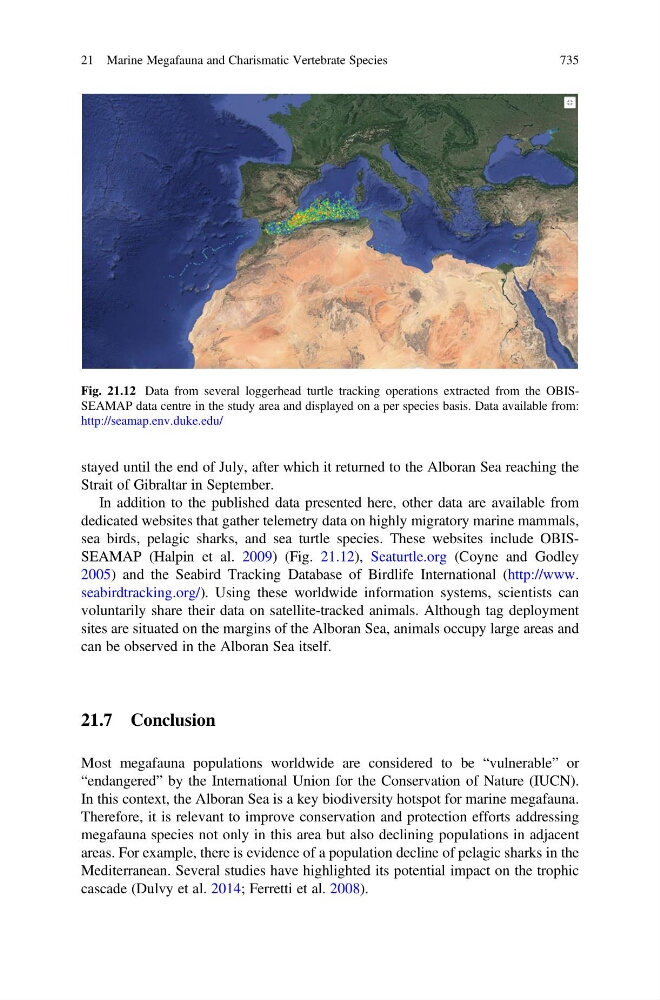
sea birds, pelagic sharks, and sea turtle species. These websites include OBISSEAMAP (Halpin et al. 2009) (Fig. 21.12), Seaturtle.org (Coyne and Godley
2005) and the Seabird Tracking Database of Birdlife International (http://www.
seabirdtracking.org/). Using these worldwide information systems, scientists can
voluntarily share their data on satellite-tracked animals. Although tag deployment
sites are situated on the margins of the Alboran Sea, animals occupy large areas and
can be observed in the Alboran Sea itself.
21.7 Conclusion
Most megafauna populations worldwide are considered to be “vulnerable” or
“endangered” by the International Union for the Conservation of Nature (IUCN).
In this context, the Alboran Sea is a key biodiversity hotspot for marine megafauna.
Therefore, it is relevant to improve conservation and protection efforts addressing
megafauna species not only in this area but also declining populations in adjacent
areas. For example, there is evidence of a population decline of pelagic sharks in the
Mediterranean. Several studies have highlighted its potential impact on the trophic
cascade (Dulvy et al. 2014; Ferretti et al. 2008).
Fig. 21.12 Data from several loggerhead turtle tracking operations extracted from the OBISSEAMAP data centre in the study area and displayed on a per species basis. Data available from:
http://seamap.env.duke.edu/
21 Marine Megafauna and Charismatic Vertebrate Species
735