

associated currents, which could be used by species, such as silver eels (Anguilla
anguilla), to pass through the Gibraltar Strait (Lacombe and Richez 1982).
A critical situation has arisen in the Mediterranean Sea regarding the protection of
megafauna from fishing activities due to the lack of effective management interventions by policy makers, Regional Fisheries Management Organizations, the General
Fisheries Commission for the Mediterranean (GFCM), and the International Commission for the Conservation of Atlantic Tunas (CICTA). This situation has affected
many populations of sharks (Dulvy et al. 2016), marine mammals (Jaume et al. 1999;
Panou et al. 1993; Reeves et al. 2001), sea turtles (Clusa et al. 2016; Kasparek et al.
2001), and seabirds (Ancha 2008; Belda and Sánchez 2001).
Anthropic threats to the sustainability of living resources in the Mediterranean
Sea are higher than ever, including the presence of chemical elements (D’Ilio et al.
2011), marine debris (Darmon et al. 2017), and collisions in the case of whales
(Bentaleb et al. 2011) and sea turtles (Tomás et al. 2008).
Marine vertebrates, such as marine mammals, sea turtles, large pelagic sharks,
and seabirds, migrate over long distances crossing many national boundaries and
exclusive economic zone (EEZ) waters. They have a widespread distribution and
occur in various oceanographic areas that are mainly characterized by their marine
productivity. Better knowledge of their spatial ecology is needed in order to protect
and manage declining populations and marine ecosystems. Such knowledge would
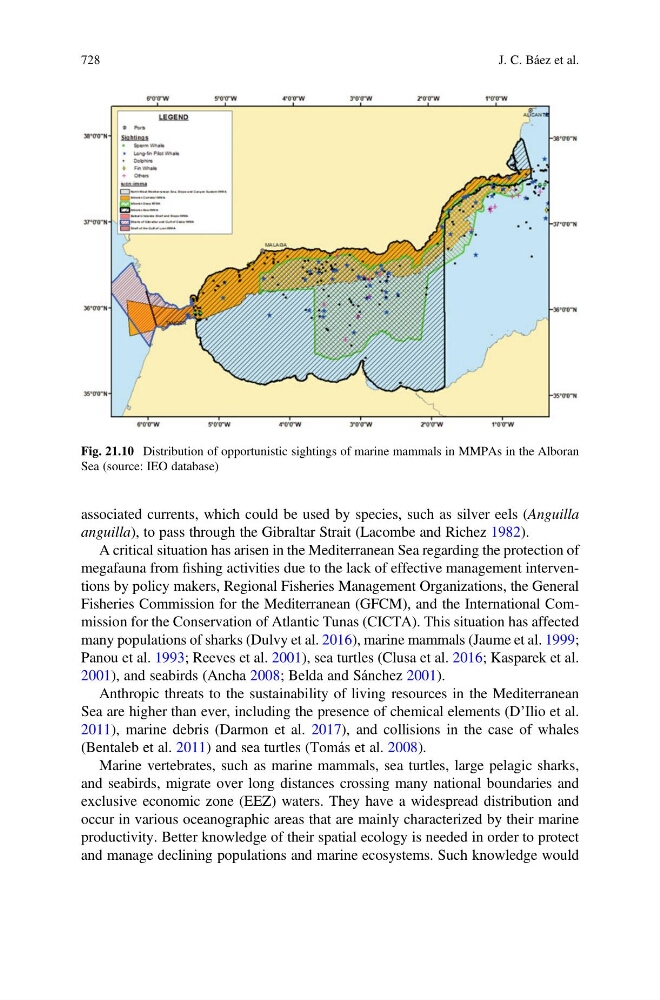
Fig. 21.10 Distribution of opportunistic sightings of marine mammals in MMPAs in the Alboran
Sea (source: IEO database)
728
J. C. Báez et al.