

was 141.6 cm (SD ¼ 35.88). The proportion of females to the total was 0.5 (Valeiras
and de la Serna 2003). Between 2000 and 2012, the shortfin mako was the second
most-caught shark species in the northern Alboran Sea (Macías et al. 2004)
(Fig. 21.4). Báez et al. (2009) observed a bycatch per unit effort of sharks in the
northern Alboran Sea of 1.41 blue sharks per 1000 hooks, 0.26 shortfin mako per
1000 hooks, and 0.07 bigeye thresher shark (Alopias superciliosus) per 1000 hooks
(Fig. 21.5).
The Moroccan and Spanish driftnet fisheries are no longer in operation. However,
Tudela et al. (2005) reported that the highest catch rates in the Moroccan driftnet
fishery were for shortfin mako. In fact, the catch rate per fishing operation for this
species was almost three times higher in active shark fishing boats (0.6 Pinto1.9 N/
fishing operation), and the catch per km net was similar (0.06–0.14 N/km). These
results (Tudela et al. 2005) are in sharp contrast to the information available on the
activity of the former Spanish driftnet fleet in the Alboran Sea. For example, Silvani
et al. (1999) reported only anecdotal occurrence of shortfin mako and blue shark in
the catch (i.e. 3 shortfin mako and 4 blue shark in 1994 from a total 54 fishing
operations monitored). They did not report any capture of thresher shark. These
results suggest that sharks are directly targeted in the Alboran Sea.
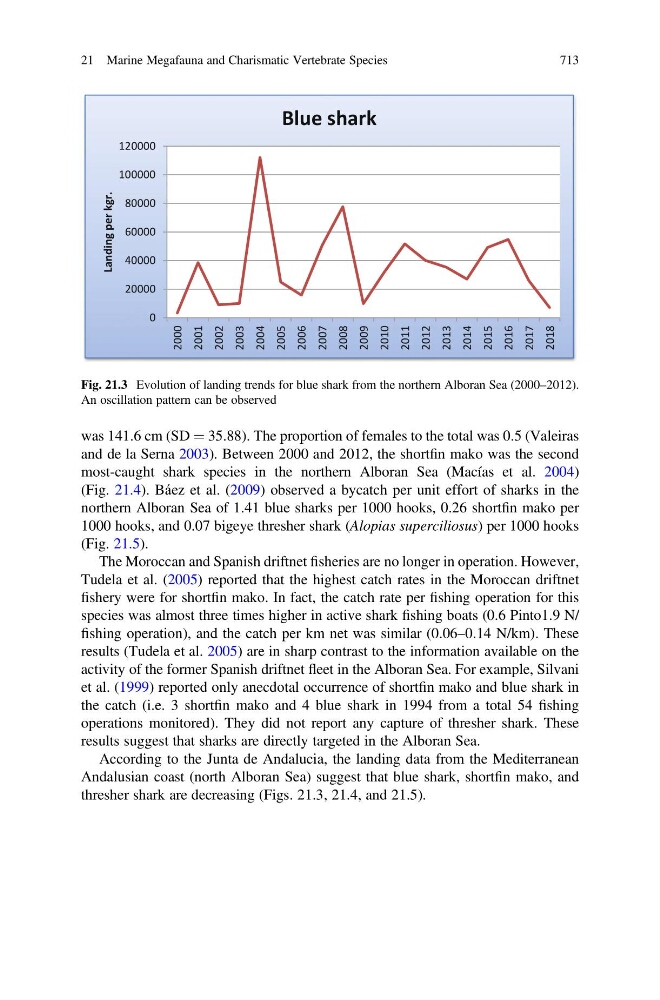
According to the Junta de Andalucia, the landing data from the Mediterranean
Andalusian coast (north Alboran Sea) suggest that blue shark, shortfin mako, and
thresher shark are decreasing (Figs. 21.3, 21.4, and 21.5).
0
20000
40000
60000
80000
100000
120000
2000
2001
2002
2003
2004
2005
2006
2007
2008
2009
2010
2011
2012
2013
2014
2015
2016
2017
2018
Landing per kgr.
Blue shark
Fig. 21.3 Evolution of landing trends for blue shark from the northern Alboran Sea (2000–2012).
An oscillation pattern can be observed
21 Marine Megafauna and Charismatic Vertebrate Species
713