

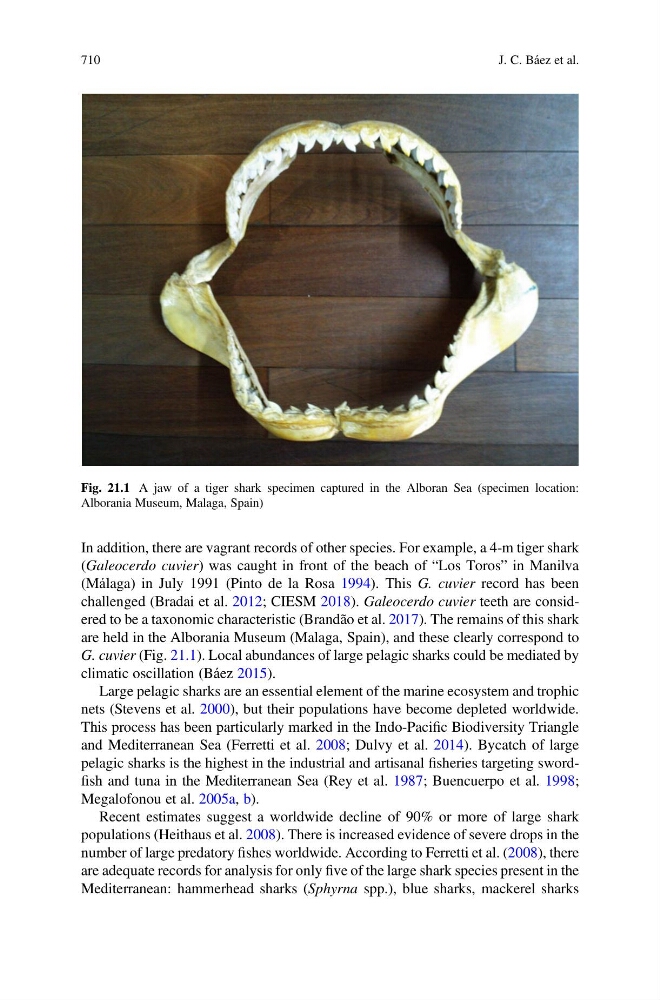
In addition, there are vagrant records of other species. For example, a 4-m tiger shark
(Galeocerdo cuvier) was caught in front of the beach of “Los Toros” in Manilva
(Málaga) in July 1991 (Pinto de la Rosa 1994). This G. cuvier record has been
challenged (Bradai et al. 2012; CIESM 2018). Galeocerdo cuvier teeth are considered to be a taxonomic characteristic (Brandão et al. 2017). The remains of this shark
are held in the Alborania Museum (Malaga, Spain), and these clearly correspond to
G. cuvier (Fig. 21.1). Local abundances of large pelagic sharks could be mediated by
climatic oscillation (Báez 2015).
Large pelagic sharks are an essential element of the marine ecosystem and trophic
nets (Stevens et al. 2000), but their populations have become depleted worldwide.
This process has been particularly marked in the Indo-Pacific Biodiversity Triangle
and Mediterranean Sea (Ferretti et al. 2008; Dulvy et al. 2014). Bycatch of large
pelagic sharks is the highest in the industrial and artisanal fisheries targeting swordfish and tuna in the Mediterranean Sea (Rey et al. 1987; Buencuerpo et al. 1998;
Megalofonou et al. 2005a, b).
Recent estimates suggest a worldwide decline of 90% or more of large shark
populations (Heithaus et al. 2008). There is increased evidence of severe drops in the
number of large predatory fishes worldwide. According to Ferretti et al. (2008), there
are adequate records for analysis for only five of the large shark species present in the
Mediterranean: hammerhead sharks (Sphyrna spp.), blue sharks, mackerel sharks
Fig. 21.1 A jaw of a tiger shark specimen captured in the Alboran Sea (specimen location:
Alborania Museum, Malaga, Spain)
710
J. C. Báez et al.