

βv ¼ f
∂ω
∂p
:
ð3:1Þ
In Eq. (3.1), v is meridional wind, f is the Coriolis parameter and β its meridional
gradient, and ω the vertical velocity in pressure coordinates in the vertical. Low
(upper) tropospheric ascents, associated with poleward flows, exist between
low-pressure troughs (ridges) at west and anticyclones (lows) at east. Conversely,
tropospheric descents, associated with equatorward flows, exist in lower levels
between high (low) pressure systems at west and low (high) pressure systems at east.
Consequently, Atlantic midlatitudes trough in lower levels (Fig. 3.18b), or
alternatively the Icelandic low in surface (Fig. 3.19a), stands downstream the
upper-level North America trough (Fig. 3.18a), and the eastern North Atlantic
ridge at 850 hPa is located downstream the upper-level ridge. However, the subtropical Azores high is located under the subtropical North Atlantic trough.
In summer, southwards gradients of ψ, and therefore westerlies, decrease considerably because of the reduction of pole-to-equator temperature gradients
(as compared to winter), and amplitudes of extratropical stationary waves reduce
accordingly. On the contrary, monsoons cause that asymmetries of the tropical–
subtropical zone be more marked, extending the Sverdrup regime up to about 40
N.
Thus, low latitude upper levels circulation is characterized by two oceanic troughs
and two anticyclones, the Mexican anticyclone, associated to the North American
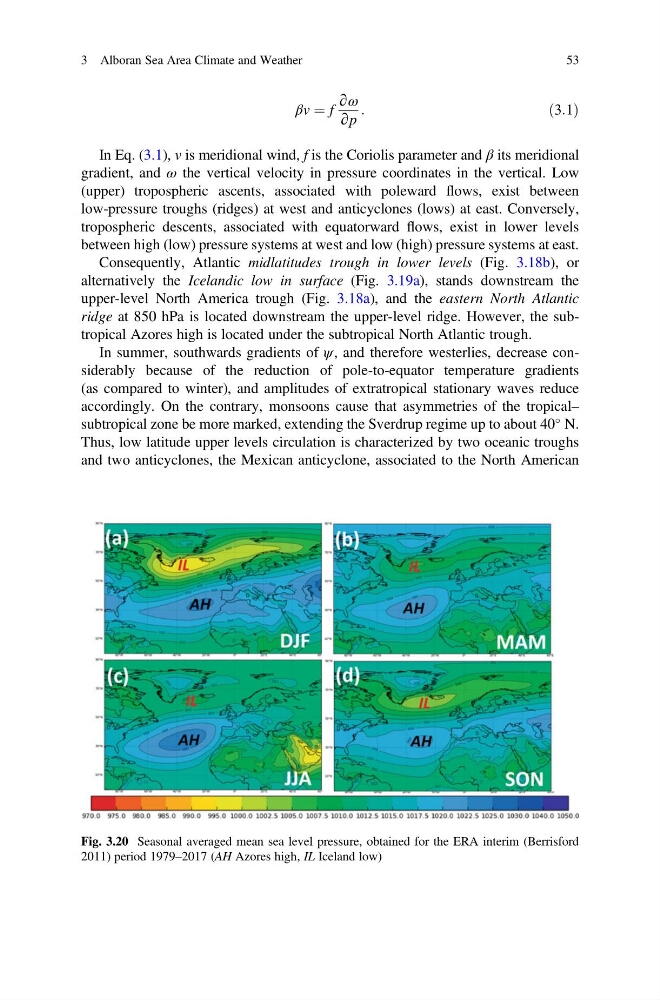
Fig. 3.20 Seasonal averaged mean sea level pressure, obtained for the ERA interim (Berrisford
2011) period 1979–2017 (AH Azores high, IL Iceland low)
3 Alboran Sea Area Climate and Weather
53
∂ω
∂p
:
ð3:1Þ
In Eq. (3.1), v is meridional wind, f is the Coriolis parameter and β its meridional
gradient, and ω the vertical velocity in pressure coordinates in the vertical. Low
(upper) tropospheric ascents, associated with poleward flows, exist between
low-pressure troughs (ridges) at west and anticyclones (lows) at east. Conversely,
tropospheric descents, associated with equatorward flows, exist in lower levels
between high (low) pressure systems at west and low (high) pressure systems at east.
Consequently, Atlantic midlatitudes trough in lower levels (Fig. 3.18b), or
alternatively the Icelandic low in surface (Fig. 3.19a), stands downstream the
upper-level North America trough (Fig. 3.18a), and the eastern North Atlantic
ridge at 850 hPa is located downstream the upper-level ridge. However, the subtropical Azores high is located under the subtropical North Atlantic trough.
In summer, southwards gradients of ψ, and therefore westerlies, decrease considerably because of the reduction of pole-to-equator temperature gradients
(as compared to winter), and amplitudes of extratropical stationary waves reduce
accordingly. On the contrary, monsoons cause that asymmetries of the tropical–
subtropical zone be more marked, extending the Sverdrup regime up to about 40
N.
Thus, low latitude upper levels circulation is characterized by two oceanic troughs
and two anticyclones, the Mexican anticyclone, associated to the North American
Fig. 3.20 Seasonal averaged mean sea level pressure, obtained for the ERA interim (Berrisford
2011) period 1979–2017 (AH Azores high, IL Iceland low)
3 Alboran Sea Area Climate and Weather
53