

ability to produce the byssus throughout their lives, since they live in areas with
strong currents.
In the Alboran Sea, collectors must be submerged from January to May, when
larvae of the three species are most abundant in the water column. The collector
needs to be immersed for approximately 1 month for its maturation before the spat
settlement. Five months after immersion, the surface of the collector is no longer
suitable due to the aging process (Campos et al. 2007; Cano-Pérez et al. 2009;
Lozano-Fernández et al. 2009).
The optimal time for deploying the collectors depends on the species: the three
species are settled together in the collectors. Although settlement occurs throughout
the year, the main fixing peaks take place during the months of June and July for the
king scallop, from April to June for the queen scallop, and from May to July for the
black scallop.
The seed of the three species must be detached from the collectors between the
months of August and November, when the average shell height is between 10 and
20 mm, as they are easier to handle.
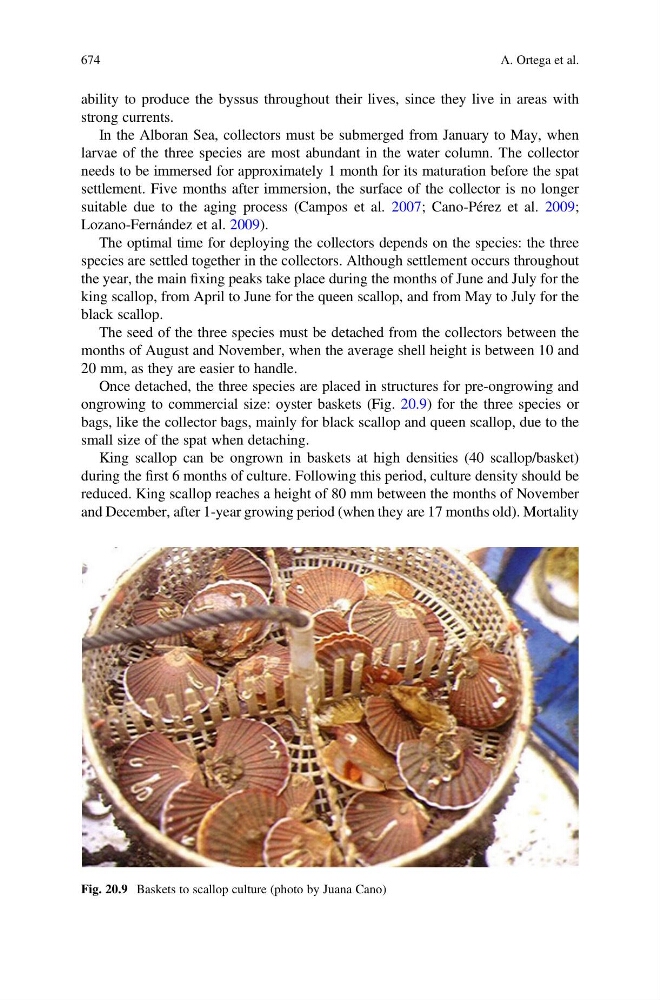
Once detached, the three species are placed in structures for pre-ongrowing and
ongrowing to commercial size: oyster baskets (Fig. 20.9) for the three species or
bags, like the collector bags, mainly for black scallop and queen scallop, due to the
small size of the spat when detaching.
King scallop can be ongrown in baskets at high densities (40 scallop/basket)
during the first 6 months of culture. Following this period, culture density should be
reduced. King scallop reaches a height of 80 mm between the months of November
and December, after 1-year growing period (when they are 17 months old). Mortality
Fig. 20.9 Baskets to scallop culture (photo by Juana Cano)
674
A. Ortega et al.