

and Los Mellizos Fish Farm in the province of Malaga and ALMINA FISH S.A., and
the Iberian Aqua System platform (which only worked for a couple of years and then
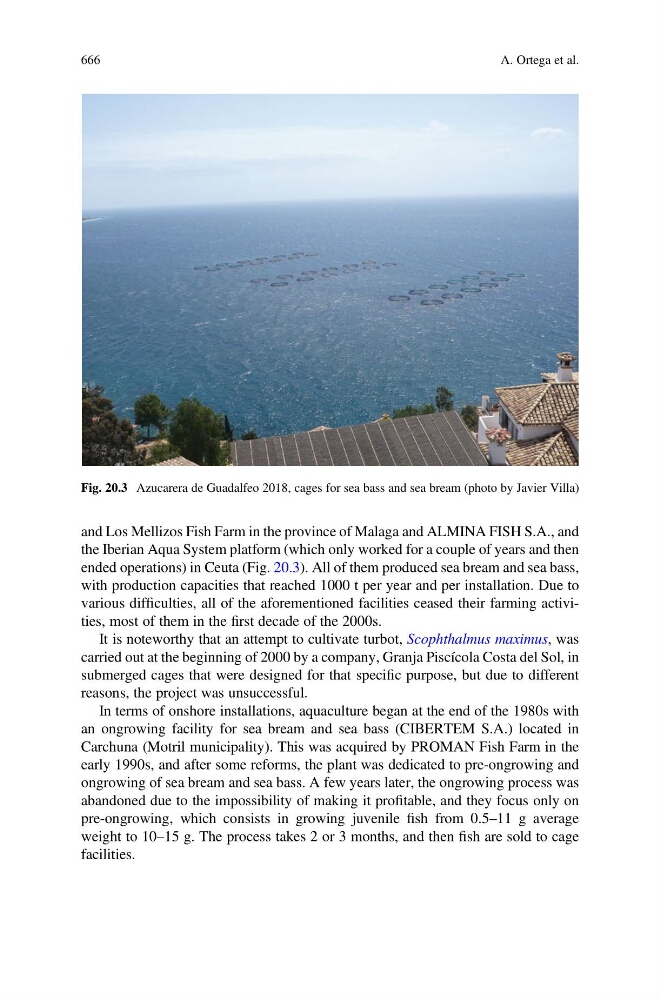
ended operations) in Ceuta (Fig. 20.3). All of them produced sea bream and sea bass,
with production capacities that reached 1000 t per year and per installation. Due to
various difficulties, all of the aforementioned facilities ceased their farming activities, most of them in the first decade of the 2000s.
It is noteworthy that an attempt to cultivate turbot, Scophthalmus maximus, was
carried out at the beginning of 2000 by a company, Granja Piscícola Costa del Sol, in
submerged cages that were designed for that specific purpose, but due to different
reasons, the project was unsuccessful.
In terms of onshore installations, aquaculture began at the end of the 1980s with
an ongrowing facility for sea bream and sea bass (CIBERTEM S.A.) located in
Carchuna (Motril municipality). This was acquired by PROMAN Fish Farm in the
early 1990s, and after some reforms, the plant was dedicated to pre-ongrowing and
ongrowing of sea bream and sea bass. A few years later, the ongrowing process was
abandoned due to the impossibility of making it profitable, and they focus only on
pre-ongrowing, which consists in growing juvenile fish from 0.5–11 g average
weight to 10–15 g. The process takes 2 or 3 months, and then fish are sold to cage
facilities.
Fig. 20.3 Azucarera de Guadalfeo 2018, cages for sea bass and sea bream (photo by Javier Villa)
666
A. Ortega et al.