

+ at time t ¼ 0 (between 20 and 45 t), the parameters of the Ricker stock-recruitment
relationship, and the percentages of spawn in the spawning period (from January to
March).
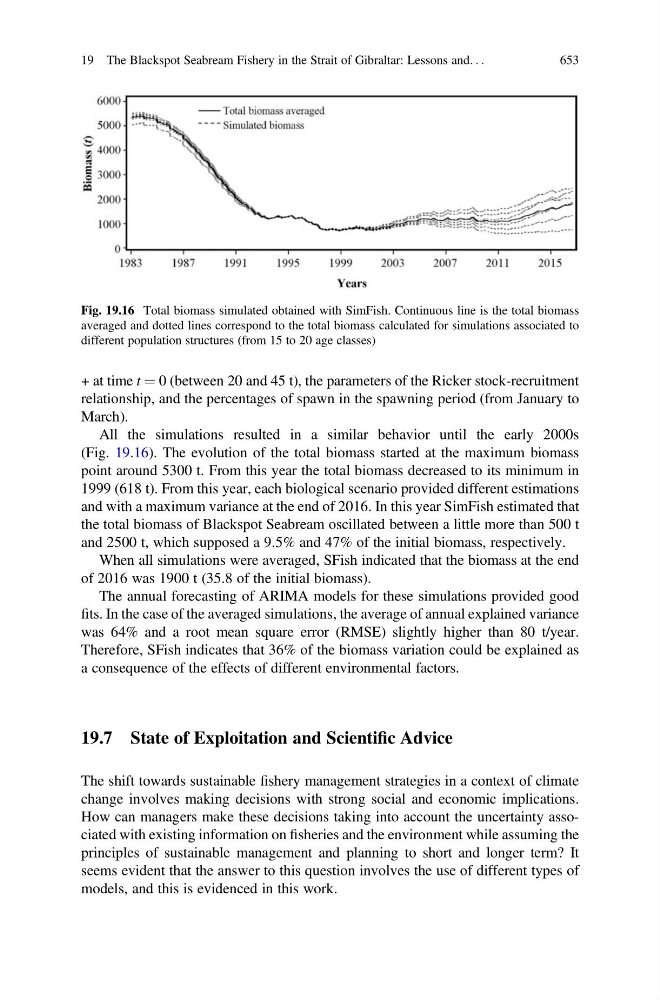
All the simulations resulted in a similar behavior until the early 2000s
(Fig. 19.16). The evolution of the total biomass started at the maximum biomass
point around 5300 t. From this year the total biomass decreased to its minimum in
1999 (618 t). From this year, each biological scenario provided different estimations
and with a maximum variance at the end of 2016. In this year SimFish estimated that
the total biomass of Blackspot Seabream oscillated between a little more than 500 t
and 2500 t, which supposed a 9.5% and 47% of the initial biomass, respectively.
When all simulations were averaged, SFish indicated that the biomass at the end
of 2016 was 1900 t (35.8 of the initial biomass).
The annual forecasting of ARIMA models for these simulations provided good
fits. In the case of the averaged simulations, the average of annual explained variance
was 64% and a root mean square error (RMSE) slightly higher than 80 t/year.
Therefore, SFish indicates that 36% of the biomass variation could be explained as
a consequence of the effects of different environmental factors.
19.7 State of Exploitation and Scientific Advice
The shift towards sustainable fishery management strategies in a context of climate
change involves making decisions with strong social and economic implications.
How can managers make these decisions taking into account the uncertainty associated with existing information on fisheries and the environment while assuming the
principles of sustainable management and planning to short and longer term? It
seems evident that the answer to this question involves the use of different types of
models, and this is evidenced in this work.
Fig. 19.16 Total biomass simulated obtained with SimFish. Continuous line is the total biomass
averaged and dotted lines correspond to the total biomass calculated for simulations associated to
different population structures (from 15 to 20 age classes)
19 The Blackspot Seabream Fishery in the Strait of Gibraltar: Lessons and. . .
653