

of the biomass of the class 0+ at the moment t ¼ 0 and a mean natural mortality (M).
Once established the parameters that provide a baseline simulation, the simulation
process is repeated but subtracting the real catches.
Under this scenario of environmental stability, the variations in biomass at time
t + 1 depend exclusively on the biomass and the catch made at time t, so autoregression behavior of the simulated biomass series is assumed. For that, ARIMA
(Autoregressive Integrated Moving Average) models are used. These models assume
that a time series is a linear combination of its own past values and current and past
values of an error term. Later, the program calculates the residual time series
between the abundance simulated and ARIMA estimation and correlates it with
the different time series of environmental variables if these time series are available.
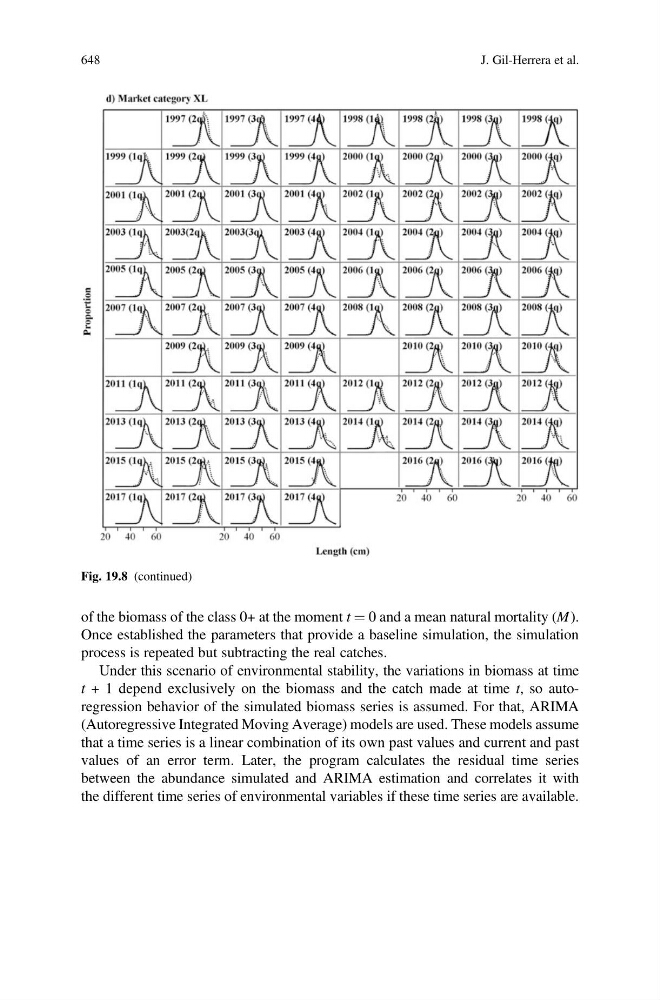
Fig. 19.8 (continued)
648
J. Gil-Herrera et al.