

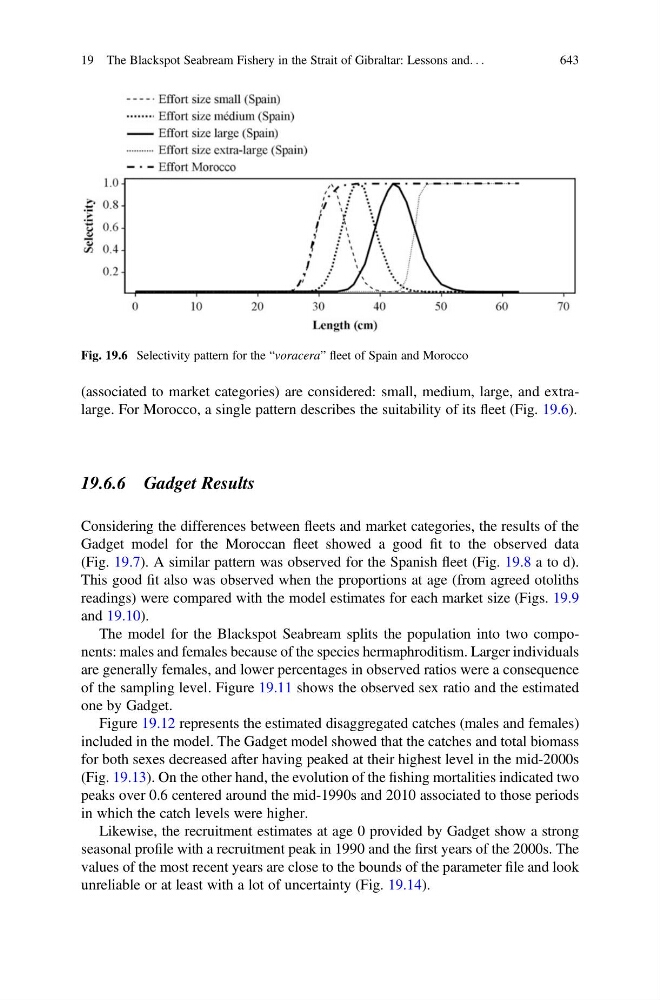
(associated to market categories) are considered: small, medium, large, and extralarge. For Morocco, a single pattern describes the suitability of its fleet (Fig. 19.6).
19.6.6 Gadget Results
Considering the differences between fleets and market categories, the results of the
Gadget model for the Moroccan fleet showed a good fit to the observed data
(Fig. 19.7). A similar pattern was observed for the Spanish fleet (Fig. 19.8 a to d).
This good fit also was observed when the proportions at age (from agreed otoliths
readings) were compared with the model estimates for each market size (Figs. 19.9
and 19.10).
The model for the Blackspot Seabream splits the population into two components: males and females because of the species hermaphroditism. Larger individuals
are generally females, and lower percentages in observed ratios were a consequence
of the sampling level. Figure 19.11 shows the observed sex ratio and the estimated
one by Gadget.
Figure 19.12 represents the estimated disaggregated catches (males and females)
included in the model. The Gadget model showed that the catches and total biomass
for both sexes decreased after having peaked at their highest level in the mid-2000s
(Fig. 19.13). On the other hand, the evolution of the fishing mortalities indicated two
peaks over 0.6 centered around the mid-1990s and 2010 associated to those periods
in which the catch levels were higher.
Likewise, the recruitment estimates at age 0 provided by Gadget show a strong
seasonal profile with a recruitment peak in 1990 and the first years of the 2000s. The
values of the most recent years are close to the bounds of the parameter file and look
unreliable or at least with a lot of uncertainty (Fig. 19.14).
Fig. 19.6 Selectivity pattern for the “voracera” fleet of Spain and Morocco
19 The Blackspot Seabream Fishery in the Strait of Gibraltar: Lessons and. . .
643