

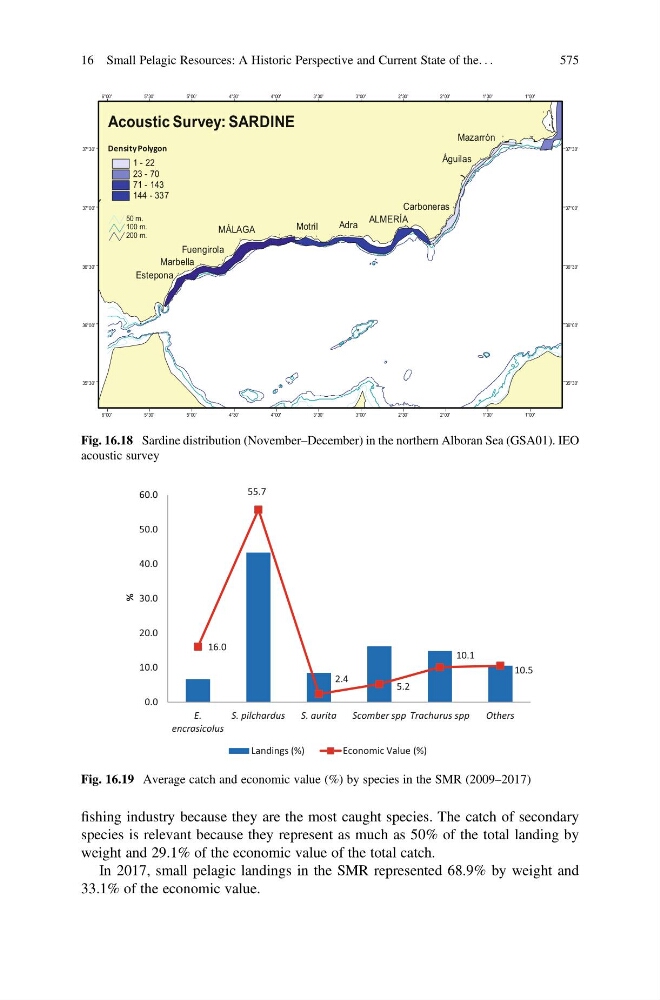
fishing industry because they are the most caught species. The catch of secondary
species is relevant because they represent as much as 50% of the total landing by
weight and 29.1% of the economic value of the total catch.
In 2017, small pelagic landings in the SMR represented 68.9% by weight and
33.1% of the economic value.
#
#
#
#
#
#
#
#
#
#
#
#
#
Estepona
Mazarrón
Águilas
Carboneras
ALMERÍA
Adra
Motril
MÁLAGA
Fuengirola
Marbella
35°30'
35°30'
36°00'
36°00'
36°30'
36°30'
37°00'
37°00'
37°30'
37°30'
6°00'
6°00'
5°30'
5°30'
5°00'
5°00'
4°30'
4°30'
4°00'
4°00'
3°30'
3°30'
3°00'
3°00'
2°30'
2°30'
2°00'
2°00'
1°30'
1°30'
1°00'
1°00'
Isóbatas Mediterráneo
50 m.
100 m.
200 m.
Polig. SARDINA
1 - 22
23 - 70
71 - 143
144 - 337
Acoustic Survey: SARDINE
Density Polygon
Fig. 16.18 Sardine distribution (November–December) in the northern Alboran Sea (GSA01). IEO
acoustic survey
16.0
55.7
2.4
5.2
10.1
10.5
0.0
10.0
20.0
30.0
40.0
50.0
60.0
E.
encrasicolus
S. pilchardus
S. aurita
Scomber spp Trachurus spp
Others
%
Landings (%)
Economic Value (%)
Fig. 16.19 Average catch and economic value (%) by species in the SMR (2009–2017)
16 Small Pelagic Resources: A Historic Perspective and Current State of the. . .
575
species is relevant because they represent as much as 50% of the total landing by
weight and 29.1% of the economic value of the total catch.
In 2017, small pelagic landings in the SMR represented 68.9% by weight and
33.1% of the economic value.
#
#
#
#
#
#
#
#
#
#
#
#
#
Estepona
Mazarrón
Águilas
Carboneras
ALMERÍA
Adra
Motril
MÁLAGA
Fuengirola
Marbella
35°30'
35°30'
36°00'
36°00'
36°30'
36°30'
37°00'
37°00'
37°30'
37°30'
6°00'
6°00'
5°30'
5°30'
5°00'
5°00'
4°30'
4°30'
4°00'
4°00'
3°30'
3°30'
3°00'
3°00'
2°30'
2°30'
2°00'
2°00'
1°30'
1°30'
1°00'
1°00'
Isóbatas Mediterráneo
50 m.
100 m.
200 m.
Polig. SARDINA
1 - 22
23 - 70
71 - 143
144 - 337
Acoustic Survey: SARDINE
Density Polygon
Fig. 16.18 Sardine distribution (November–December) in the northern Alboran Sea (GSA01). IEO
acoustic survey
16.0
55.7
2.4
5.2
10.1
10.5
0.0
10.0
20.0
30.0
40.0
50.0
60.0
E.
encrasicolus
S. pilchardus
S. aurita
Scomber spp Trachurus spp
Others
%
Landings (%)
Economic Value (%)
Fig. 16.19 Average catch and economic value (%) by species in the SMR (2009–2017)
16 Small Pelagic Resources: A Historic Perspective and Current State of the. . .
575