

Direct employment generated by artisanal fisheries throughout Andalusia, shows
positive growth in the period 2009–2016 compared to the total number of employees
in the global fleet, growing from 33.7% to 40.7% (data from the Council of
Agriculture, Fishing and Rural Development of the Andalusia Regional Government). This growth is mainly due to the increase observed in the so-called “artes
menores” and hydraulic dredges, the latter not used in the Alboran Sea, since in the
mechanized dredge fleet, which is the most important of the coast, there is a
progressive decrease going from 6.6% to 4.4%, in the indicated period. These data
do not result in a net increase of workers, which is negative, however, it shows that
the artisanal sector is more stable in the consolidation of employment than other
fishing modalities where there is a sharper decrease.
The average number of crew members per vessel is variable but quite low given
the types of boats used and it is basically conditioned by the size of the vessels and
the fishing methods. The port of Algeciras with four crew members per boat is the
one with the highest average, followed by Roquetas de Mar with three and the rest of
the ports with only 2.
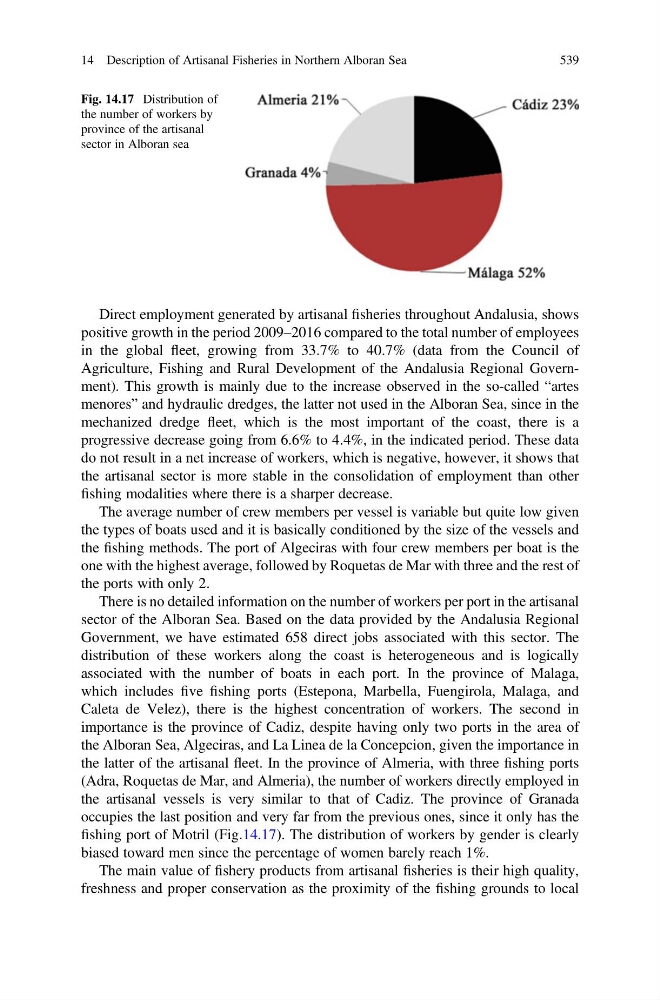
There is no detailed information on the number of workers per port in the artisanal
sector of the Alboran Sea. Based on the data provided by the Andalusia Regional
Government, we have estimated 658 direct jobs associated with this sector. The
distribution of these workers along the coast is heterogeneous and is logically
associated with the number of boats in each port. In the province of Malaga,
which includes five fishing ports (Estepona, Marbella, Fuengirola, Malaga, and
Caleta de Velez), there is the highest concentration of workers. The second in
importance is the province of Cadiz, despite having only two ports in the area of
the Alboran Sea, Algeciras, and La Linea de la Concepcion, given the importance in
the latter of the artisanal fleet. In the province of Almeria, with three fishing ports
(Adra, Roquetas de Mar, and Almeria), the number of workers directly employed in
the artisanal vessels is very similar to that of Cadiz. The province of Granada
occupies the last position and very far from the previous ones, since it only has the
fishing port of Motril (Fig.14.17). The distribution of workers by gender is clearly
biased toward men since the percentage of women barely reach 1%.
The main value of fishery products from artisanal fisheries is their high quality,
freshness and proper conservation as the proximity of the fishing grounds to local
Fig. 14.17 Distribution of
the number of workers by
province of the artisanal
sector in Alboran sea
14 Description of Artisanal Fisheries in Northern Alboran Sea
539
positive growth in the period 2009–2016 compared to the total number of employees
in the global fleet, growing from 33.7% to 40.7% (data from the Council of
Agriculture, Fishing and Rural Development of the Andalusia Regional Government). This growth is mainly due to the increase observed in the so-called “artes
menores” and hydraulic dredges, the latter not used in the Alboran Sea, since in the
mechanized dredge fleet, which is the most important of the coast, there is a
progressive decrease going from 6.6% to 4.4%, in the indicated period. These data
do not result in a net increase of workers, which is negative, however, it shows that
the artisanal sector is more stable in the consolidation of employment than other
fishing modalities where there is a sharper decrease.
The average number of crew members per vessel is variable but quite low given
the types of boats used and it is basically conditioned by the size of the vessels and
the fishing methods. The port of Algeciras with four crew members per boat is the
one with the highest average, followed by Roquetas de Mar with three and the rest of
the ports with only 2.
There is no detailed information on the number of workers per port in the artisanal
sector of the Alboran Sea. Based on the data provided by the Andalusia Regional
Government, we have estimated 658 direct jobs associated with this sector. The
distribution of these workers along the coast is heterogeneous and is logically
associated with the number of boats in each port. In the province of Malaga,
which includes five fishing ports (Estepona, Marbella, Fuengirola, Malaga, and
Caleta de Velez), there is the highest concentration of workers. The second in
importance is the province of Cadiz, despite having only two ports in the area of
the Alboran Sea, Algeciras, and La Linea de la Concepcion, given the importance in
the latter of the artisanal fleet. In the province of Almeria, with three fishing ports
(Adra, Roquetas de Mar, and Almeria), the number of workers directly employed in
the artisanal vessels is very similar to that of Cadiz. The province of Granada
occupies the last position and very far from the previous ones, since it only has the
fishing port of Motril (Fig.14.17). The distribution of workers by gender is clearly
biased toward men since the percentage of women barely reach 1%.
The main value of fishery products from artisanal fisheries is their high quality,
freshness and proper conservation as the proximity of the fishing grounds to local
Fig. 14.17 Distribution of
the number of workers by
province of the artisanal
sector in Alboran sea
14 Description of Artisanal Fisheries in Northern Alboran Sea
539