

double, is explained by the high value of sales achieved by the products obtained due
to its high quality, and the great esteem that many of the species have in the local
markets.
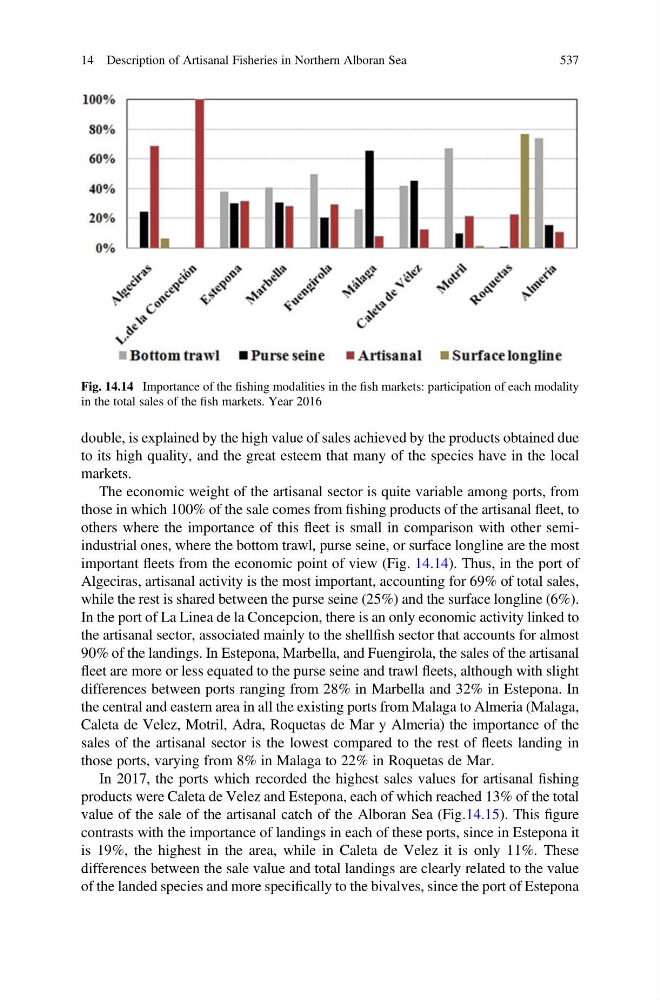
The economic weight of the artisanal sector is quite variable among ports, from
those in which 100% of the sale comes from fishing products of the artisanal fleet, to
others where the importance of this fleet is small in comparison with other semiindustrial ones, where the bottom trawl, purse seine, or surface longline are the most
important fleets from the economic point of view (Fig. 14.14). Thus, in the port of
Algeciras, artisanal activity is the most important, accounting for 69% of total sales,
while the rest is shared between the purse seine (25%) and the surface longline (6%).
In the port of La Linea de la Concepcion, there is an only economic activity linked to
the artisanal sector, associated mainly to the shellfish sector that accounts for almost
90% of the landings. In Estepona, Marbella, and Fuengirola, the sales of the artisanal
fleet are more or less equated to the purse seine and trawl fleets, although with slight
differences between ports ranging from 28% in Marbella and 32% in Estepona. In
the central and eastern area in all the existing ports from Malaga to Almeria (Malaga,
Caleta de Velez, Motril, Adra, Roquetas de Mar y Almeria) the importance of the
sales of the artisanal sector is the lowest compared to the rest of fleets landing in
those ports, varying from 8% in Malaga to 22% in Roquetas de Mar.
In 2017, the ports which recorded the highest sales values for artisanal fishing
products were Caleta de Velez and Estepona, each of which reached 13% of the total
value of the sale of the artisanal catch of the Alboran Sea (Fig.14.15). This figure
contrasts with the importance of landings in each of these ports, since in Estepona it
is 19%, the highest in the area, while in Caleta de Velez it is only 11%. These
differences between the sale value and total landings are clearly related to the value
of the landed species and more specifically to the bivalves, since the port of Estepona
Fig. 14.14 Importance of the fishing modalities in the fish markets: participation of each modality
in the total sales of the fish markets. Year 2016
14 Description of Artisanal Fisheries in Northern Alboran Sea
537
to its high quality, and the great esteem that many of the species have in the local
markets.
The economic weight of the artisanal sector is quite variable among ports, from
those in which 100% of the sale comes from fishing products of the artisanal fleet, to
others where the importance of this fleet is small in comparison with other semiindustrial ones, where the bottom trawl, purse seine, or surface longline are the most
important fleets from the economic point of view (Fig. 14.14). Thus, in the port of
Algeciras, artisanal activity is the most important, accounting for 69% of total sales,
while the rest is shared between the purse seine (25%) and the surface longline (6%).
In the port of La Linea de la Concepcion, there is an only economic activity linked to
the artisanal sector, associated mainly to the shellfish sector that accounts for almost
90% of the landings. In Estepona, Marbella, and Fuengirola, the sales of the artisanal
fleet are more or less equated to the purse seine and trawl fleets, although with slight
differences between ports ranging from 28% in Marbella and 32% in Estepona. In
the central and eastern area in all the existing ports from Malaga to Almeria (Malaga,
Caleta de Velez, Motril, Adra, Roquetas de Mar y Almeria) the importance of the
sales of the artisanal sector is the lowest compared to the rest of fleets landing in
those ports, varying from 8% in Malaga to 22% in Roquetas de Mar.
In 2017, the ports which recorded the highest sales values for artisanal fishing
products were Caleta de Velez and Estepona, each of which reached 13% of the total
value of the sale of the artisanal catch of the Alboran Sea (Fig.14.15). This figure
contrasts with the importance of landings in each of these ports, since in Estepona it
is 19%, the highest in the area, while in Caleta de Velez it is only 11%. These
differences between the sale value and total landings are clearly related to the value
of the landed species and more specifically to the bivalves, since the port of Estepona
Fig. 14.14 Importance of the fishing modalities in the fish markets: participation of each modality
in the total sales of the fish markets. Year 2016
14 Description of Artisanal Fisheries in Northern Alboran Sea
537