

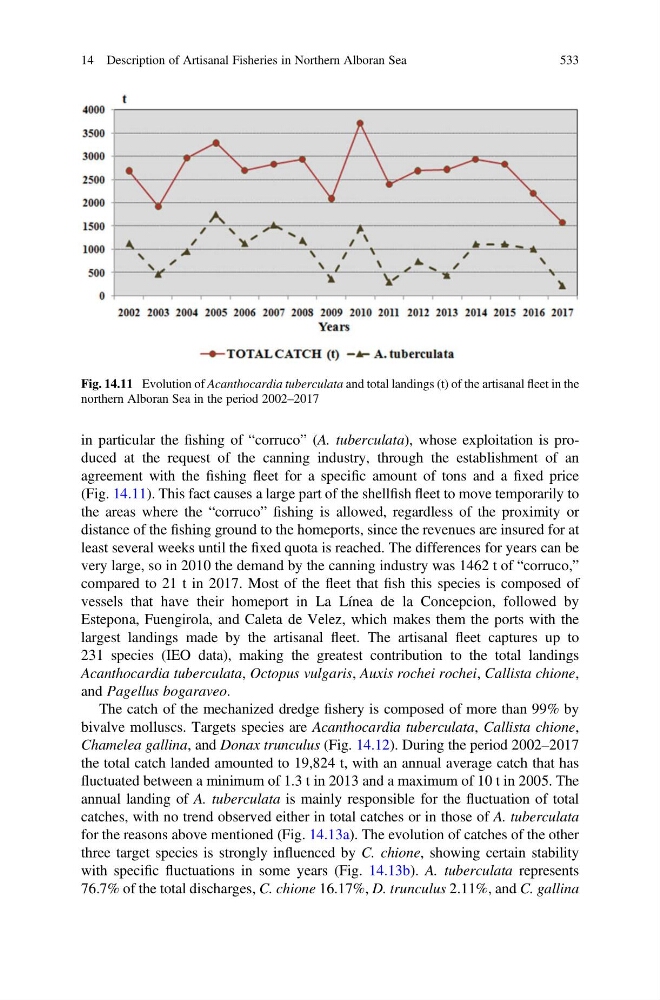
in particular the fishing of “corruco” (A. tuberculata), whose exploitation is produced at the request of the canning industry, through the establishment of an
agreement with the fishing fleet for a specific amount of tons and a fixed price
(Fig. 14.11). This fact causes a large part of the shellfish fleet to move temporarily to
the areas where the “corruco” fishing is allowed, regardless of the proximity or
distance of the fishing ground to the homeports, since the revenues are insured for at
least several weeks until the fixed quota is reached. The differences for years can be
very large, so in 2010 the demand by the canning industry was 1462 t of “corruco,”
compared to 21 t in 2017. Most of the fleet that fish this species is composed of
vessels that have their homeport in La Línea de la Concepcion, followed by
Estepona, Fuengirola, and Caleta de Velez, which makes them the ports with the
largest landings made by the artisanal fleet. The artisanal fleet captures up to
231 species (IEO data), making the greatest contribution to the total landings
Acanthocardia tuberculata, Octopus vulgaris, Auxis rochei rochei, Callista chione,
and Pagellus bogaraveo.
The catch of the mechanized dredge fishery is composed of more than 99% by
bivalve molluscs. Targets species are Acanthocardia tuberculata, Callista chione,
Chamelea gallina, and Donax trunculus (Fig. 14.12). During the period 2002–2017
the total catch landed amounted to 19,824 t, with an annual average catch that has
fluctuated between a minimum of 1.3 t in 2013 and a maximum of 10 t in 2005. The
annual landing of A. tuberculata is mainly responsible for the fluctuation of total
catches, with no trend observed either in total catches or in those of A. tuberculata
for the reasons above mentioned (Fig. 14.13a). The evolution of catches of the other
three target species is strongly influenced by C. chione, showing certain stability
with specific fluctuations in some years (Fig. 14.13b). A. tuberculata represents
76.7% of the total discharges, C. chione 16.17%, D. trunculus 2.11%, and C. gallina
Fig. 14.11 Evolution of Acanthocardia tuberculata and total landings (t) of the artisanal fleet in the
northern Alboran Sea in the period 2002–2017
14 Description of Artisanal Fisheries in Northern Alboran Sea
533
agreement with the fishing fleet for a specific amount of tons and a fixed price
(Fig. 14.11). This fact causes a large part of the shellfish fleet to move temporarily to
the areas where the “corruco” fishing is allowed, regardless of the proximity or
distance of the fishing ground to the homeports, since the revenues are insured for at
least several weeks until the fixed quota is reached. The differences for years can be
very large, so in 2010 the demand by the canning industry was 1462 t of “corruco,”
compared to 21 t in 2017. Most of the fleet that fish this species is composed of
vessels that have their homeport in La Línea de la Concepcion, followed by
Estepona, Fuengirola, and Caleta de Velez, which makes them the ports with the
largest landings made by the artisanal fleet. The artisanal fleet captures up to
231 species (IEO data), making the greatest contribution to the total landings
Acanthocardia tuberculata, Octopus vulgaris, Auxis rochei rochei, Callista chione,
and Pagellus bogaraveo.
The catch of the mechanized dredge fishery is composed of more than 99% by
bivalve molluscs. Targets species are Acanthocardia tuberculata, Callista chione,
Chamelea gallina, and Donax trunculus (Fig. 14.12). During the period 2002–2017
the total catch landed amounted to 19,824 t, with an annual average catch that has
fluctuated between a minimum of 1.3 t in 2013 and a maximum of 10 t in 2005. The
annual landing of A. tuberculata is mainly responsible for the fluctuation of total
catches, with no trend observed either in total catches or in those of A. tuberculata
for the reasons above mentioned (Fig. 14.13a). The evolution of catches of the other
three target species is strongly influenced by C. chione, showing certain stability
with specific fluctuations in some years (Fig. 14.13b). A. tuberculata represents
76.7% of the total discharges, C. chione 16.17%, D. trunculus 2.11%, and C. gallina
Fig. 14.11 Evolution of Acanthocardia tuberculata and total landings (t) of the artisanal fleet in the
northern Alboran Sea in the period 2002–2017
14 Description of Artisanal Fisheries in Northern Alboran Sea
533