

a snake was usually sculpted. It has no engine and its use was limited to fishing with
the beach seines called “jábega” or “media jábega.”
The “chalanas” and “pateras” (Fig. 14.1b) are vessels with a hull without chines
with a gradually curved section and a flat or rounded stern. They do not have
generally cover although some have small spaces to bow and to stern closed with
bulkheads, to keep diverse fishing tools. They have a length between 5 and 7 m and a
beam between 2 and 2.5 m. They are made of wood or fiberglass.
With the name of “motoras” (motorboats) (Fig. 14.1c) are known all boats that
have an inboard engine, deck, ship’s hold, and in many cases a cabin that serves as a
cockpit. They have between 6 and 8 m in length and 2–3 m in width. Its gross
tonnage always exceeds two tons and the power of the engine sometimes reaches
90 HP. These types of boats are the best technically equipped and can have
multipurpose use.
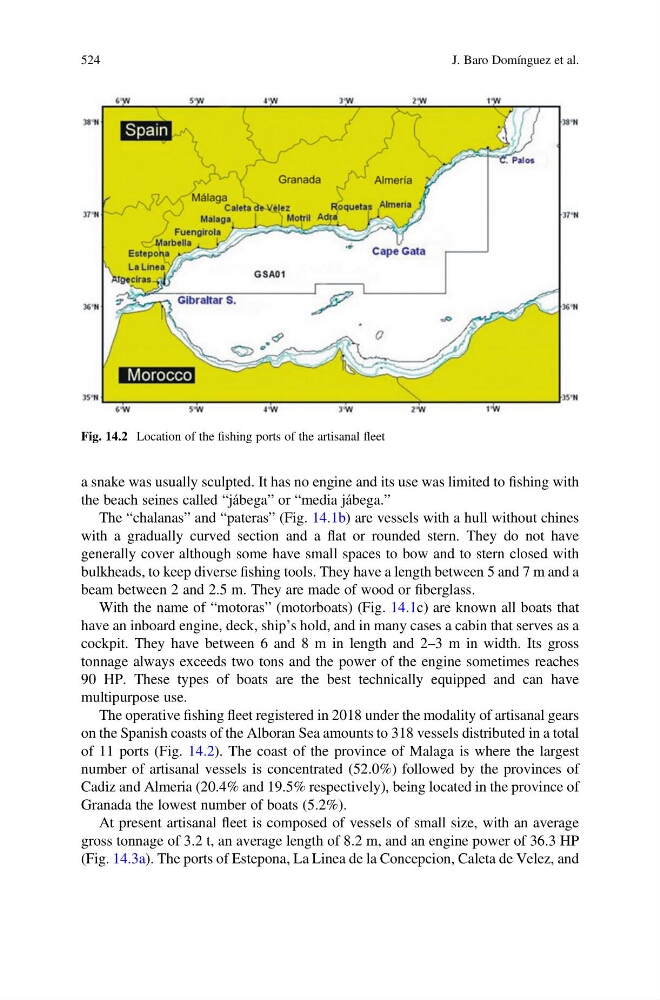
The operative fishing fleet registered in 2018 under the modality of artisanal gears
on the Spanish coasts of the Alboran Sea amounts to 318 vessels distributed in a total
of 11 ports (Fig. 14.2). The coast of the province of Malaga is where the largest
number of artisanal vessels is concentrated (52.0%) followed by the provinces of
Cadiz and Almeria (20.4% and 19.5% respectively), being located in the province of
Granada the lowest number of boats (5.2%).
At present artisanal fleet is composed of vessels of small size, with an average
gross tonnage of 3.2 t, an average length of 8.2 m, and an engine power of 36.3 HP
(Fig. 14.3a). The ports of Estepona, La Linea de la Concepcion, Caleta de Velez, and
Fig. 14.2 Location of the fishing ports of the artisanal fleet
524
J. Baro Domínguez et al.
the beach seines called “jábega” or “media jábega.”
The “chalanas” and “pateras” (Fig. 14.1b) are vessels with a hull without chines
with a gradually curved section and a flat or rounded stern. They do not have
generally cover although some have small spaces to bow and to stern closed with
bulkheads, to keep diverse fishing tools. They have a length between 5 and 7 m and a
beam between 2 and 2.5 m. They are made of wood or fiberglass.
With the name of “motoras” (motorboats) (Fig. 14.1c) are known all boats that
have an inboard engine, deck, ship’s hold, and in many cases a cabin that serves as a
cockpit. They have between 6 and 8 m in length and 2–3 m in width. Its gross
tonnage always exceeds two tons and the power of the engine sometimes reaches
90 HP. These types of boats are the best technically equipped and can have
multipurpose use.
The operative fishing fleet registered in 2018 under the modality of artisanal gears
on the Spanish coasts of the Alboran Sea amounts to 318 vessels distributed in a total
of 11 ports (Fig. 14.2). The coast of the province of Malaga is where the largest
number of artisanal vessels is concentrated (52.0%) followed by the provinces of
Cadiz and Almeria (20.4% and 19.5% respectively), being located in the province of
Granada the lowest number of boats (5.2%).
At present artisanal fleet is composed of vessels of small size, with an average
gross tonnage of 3.2 t, an average length of 8.2 m, and an engine power of 36.3 HP
(Fig. 14.3a). The ports of Estepona, La Linea de la Concepcion, Caleta de Velez, and
Fig. 14.2 Location of the fishing ports of the artisanal fleet
524
J. Baro Domínguez et al.