

As far as the ELHSs of these species are distributed in the upper part of the water
column, the surface hydrodynamics will entrain elements of Atlantic origin into the
Alboran Sea, which can have different outcomes. If the eggs and larvae are initially
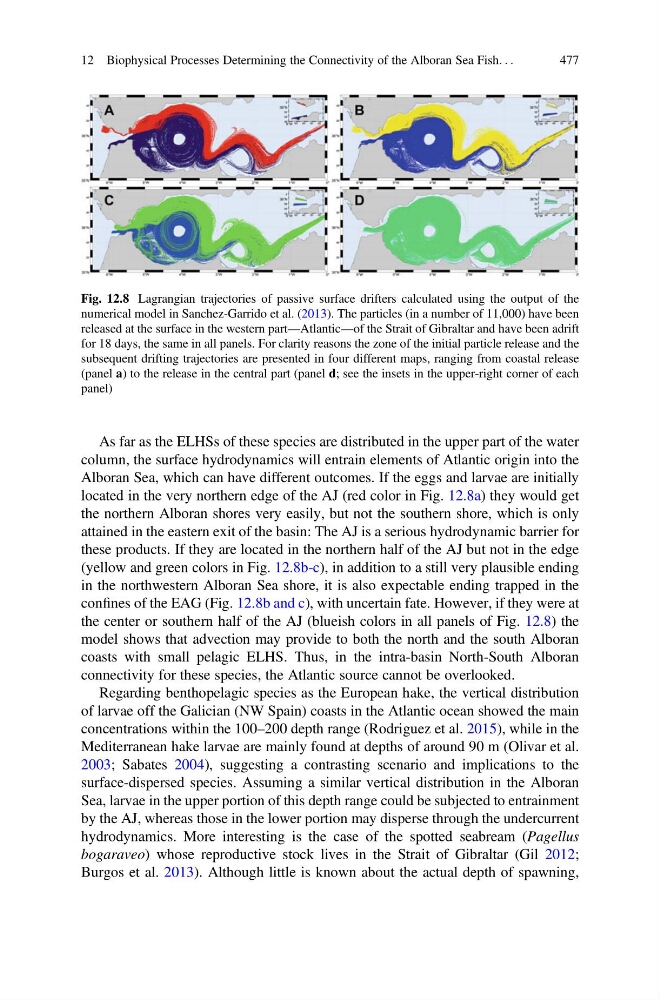
located in the very northern edge of the AJ (red color in Fig. 12.8a) they would get
the northern Alboran shores very easily, but not the southern shore, which is only
attained in the eastern exit of the basin: The AJ is a serious hydrodynamic barrier for
these products. If they are located in the northern half of the AJ but not in the edge
(yellow and green colors in Fig. 12.8b-c), in addition to a still very plausible ending
in the northwestern Alboran Sea shore, it is also expectable ending trapped in the
confines of the EAG (Fig. 12.8b and c), with uncertain fate. However, if they were at
the center or southern half of the AJ (blueish colors in all panels of Fig. 12.8) the
model shows that advection may provide to both the north and the south Alboran
coasts with small pelagic ELHS. Thus, in the intra-basin North-South Alboran
connectivity for these species, the Atlantic source cannot be overlooked.
Regarding benthopelagic species as the European hake, the vertical distribution
of larvae off the Galician (NW Spain) coasts in the Atlantic ocean showed the main
concentrations within the 100–200 depth range (Rodriguez et al. 2015), while in the
Mediterranean hake larvae are mainly found at depths of around 90 m (Olivar et al.
2003; Sabates 2004), suggesting a contrasting scenario and implications to the
surface-dispersed species. Assuming a similar vertical distribution in the Alboran
Sea, larvae in the upper portion of this depth range could be subjected to entrainment
by the AJ, whereas those in the lower portion may disperse through the undercurrent
hydrodynamics. More interesting is the case of the spotted seabream (Pagellus
bogaraveo) whose reproductive stock lives in the Strait of Gibraltar (Gil 2012;
Burgos et al. 2013). Although little is known about the actual depth of spawning,
Fig. 12.8 Lagrangian trajectories of passive surface drifters calculated using the output of the
numerical model in Sanchez-Garrido et al. (2013). The particles (in a number of 11,000) have been
released at the surface in the western part—Atlantic—of the Strait of Gibraltar and have been adrift
for 18 days, the same in all panels. For clarity reasons the zone of the initial particle release and the
subsequent drifting trajectories are presented in four different maps, ranging from coastal release
(panel a) to the release in the central part (panel d; see the insets in the upper-right corner of each
panel)
12 Biophysical Processes Determining the Connectivity of the Alboran Sea Fish. . .
477
column, the surface hydrodynamics will entrain elements of Atlantic origin into the
Alboran Sea, which can have different outcomes. If the eggs and larvae are initially
located in the very northern edge of the AJ (red color in Fig. 12.8a) they would get
the northern Alboran shores very easily, but not the southern shore, which is only
attained in the eastern exit of the basin: The AJ is a serious hydrodynamic barrier for
these products. If they are located in the northern half of the AJ but not in the edge
(yellow and green colors in Fig. 12.8b-c), in addition to a still very plausible ending
in the northwestern Alboran Sea shore, it is also expectable ending trapped in the
confines of the EAG (Fig. 12.8b and c), with uncertain fate. However, if they were at
the center or southern half of the AJ (blueish colors in all panels of Fig. 12.8) the
model shows that advection may provide to both the north and the south Alboran
coasts with small pelagic ELHS. Thus, in the intra-basin North-South Alboran
connectivity for these species, the Atlantic source cannot be overlooked.
Regarding benthopelagic species as the European hake, the vertical distribution
of larvae off the Galician (NW Spain) coasts in the Atlantic ocean showed the main
concentrations within the 100–200 depth range (Rodriguez et al. 2015), while in the
Mediterranean hake larvae are mainly found at depths of around 90 m (Olivar et al.
2003; Sabates 2004), suggesting a contrasting scenario and implications to the
surface-dispersed species. Assuming a similar vertical distribution in the Alboran
Sea, larvae in the upper portion of this depth range could be subjected to entrainment
by the AJ, whereas those in the lower portion may disperse through the undercurrent
hydrodynamics. More interesting is the case of the spotted seabream (Pagellus
bogaraveo) whose reproductive stock lives in the Strait of Gibraltar (Gil 2012;
Burgos et al. 2013). Although little is known about the actual depth of spawning,
Fig. 12.8 Lagrangian trajectories of passive surface drifters calculated using the output of the
numerical model in Sanchez-Garrido et al. (2013). The particles (in a number of 11,000) have been
released at the surface in the western part—Atlantic—of the Strait of Gibraltar and have been adrift
for 18 days, the same in all panels. For clarity reasons the zone of the initial particle release and the
subsequent drifting trajectories are presented in four different maps, ranging from coastal release
(panel a) to the release in the central part (panel d; see the insets in the upper-right corner of each
panel)
12 Biophysical Processes Determining the Connectivity of the Alboran Sea Fish. . .
477